
Cephaloplex
A Genealogy of the "Community Relations Service"

“I have a greater duty beyond being an attorney, and that’s to be a social engineer.”
—Jasmine Rand, attorney for the family of Trayvon Martin
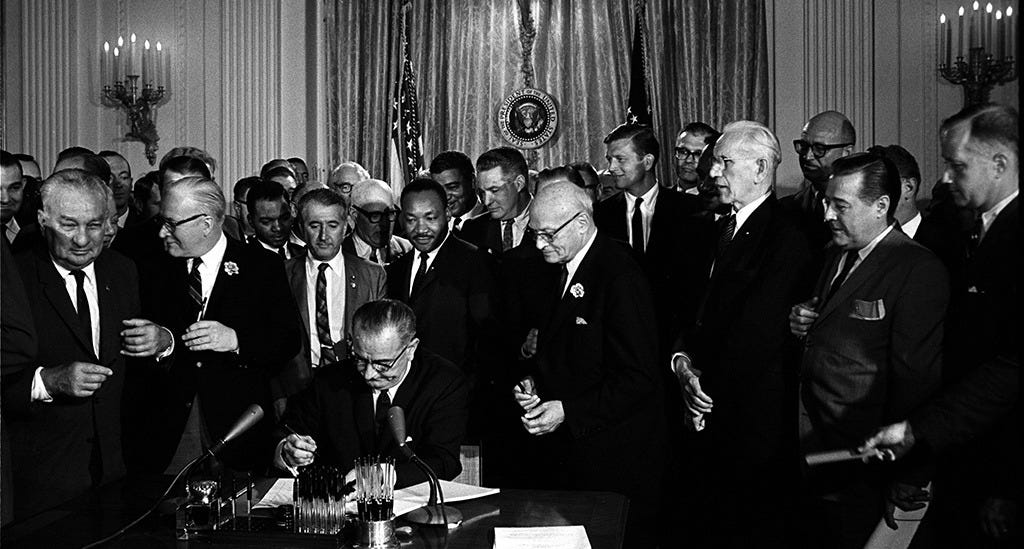
The 1960s Civil Rights crusade was nothing less than a second American Civil War, a color revolution prosecuted with psychological warfare techniques refined during WW2, executed by many of the same OSS and OWI trained psywarriors, assisted by New Deal communists and social engineers, all funded by the CIA and the philanthropic foundations.
The beginnings of the Act's instrument of enforcement, the Community Relations Service (CRS), can be traced to the late 1950s when then Senator Lyndon B. Johnson drafted what would become the Act in talks with his strategic advisor Benjamin V. Cohen, trustee of the influential Twentieth Century Fund and lawyer for the American Zionist movement, both coming up with the idea of a “conciliation” or “mediation agency” as the optimal mechanism.
In 1957, Johnson assigned the drafting of what became Title X to Chicago labor lawyer Arthur Goldberg, former chief of the OSS Labor Branch, responsible for the FAUST Plan where German-born, pro-Soviet communist spies were air dropped into hostile territory (FBI Memo, May 6, 1942).
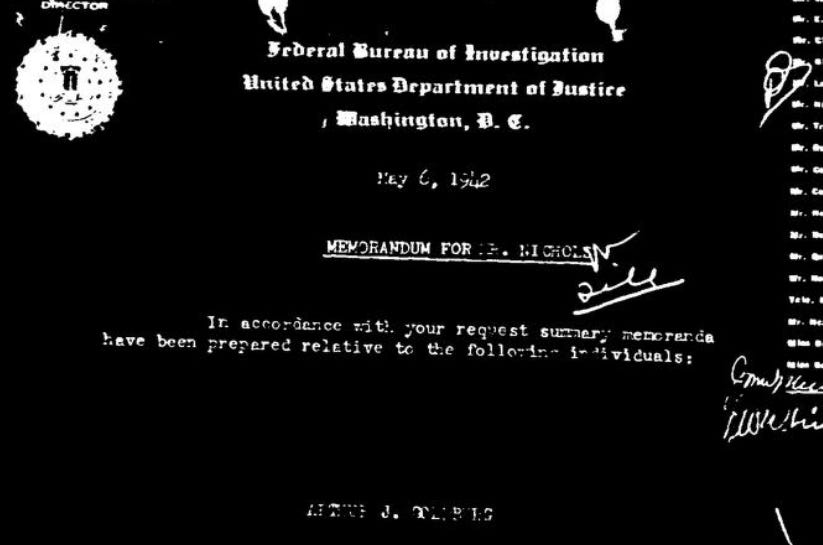
The real history of the Community Relations Service (CRS) is in “labor lawyers” (criminal and communist proxies), and former OSS psywarriors. It’s the behind-the-scenes operators who are erased from the Civil Rights story, like Theodore Kheel, who worked on the provision for CRS together with LBJ and Cohen. In fact, according to White House telephone recordings1, the blueprint for the new conciliation service was to be based directly on Kheel’s labor-mediation practices.
Ted Kheel, a shady New York labor arbitrator, was involved in the ‘Argentine Watergate’ guerilla financing scandal, acting as a liaison between American Bank & Trust, a subsidiary of Swiss-Israel, Citibank's former chairman, George Moore, Secretary of State William P. Rogers, David Rockefeller and other notables (NYT) (WP). At the time, Kheel was chairman of Edmond Safra’s Republic National Bank, used by the Russian mafia (NYT), (Friedman 2002), and the Medellin drug cartel, having been named but never indicted in Operation Polar Cap, the sweeping federal investigation into Colombian drug money-laundering (Ehrenfield 1992).
Safra was a known associate of the Israeli spy Robert Maxwell (Gordon 2002), and died in a house fire under suspicious circumstances in 1999, amidst claims that he had been murdered for giving evidence to the FBI and Swiss authorities.
“… Kheel has created an image for himself of conciliator, mediator, champion of the rights of Everyman. So successfully, in fact, that his involvement in financial enterprises of the most questionable nature has gone virtually unnoticed . . .”
—New York Magazine, Jan 8, 1978, ‘The Many Worlds of Theodore Kheel’, by Richard Karp
Ted Kheel was a colleague of Goldberg’s, a fellow avid New Dealer, a close friend of Johnson’s, a fixer for Kennedy, considered New York’s “most prominent industrial peacemaker,” and named one of the city’s most powerful men in the late 1960s (NYT), (NYM), (1969), (1991), (1998). He helmed several foundations and programs specifically aimed at transitioning “collective bargaining” and labor mediation techniques into racial conflict. Goldberg would even sponsor one of these, Kheel’s “Board of Mediation for Community Disputes” (Lasky, V. (1970) Arthur J. Goldberg, the Old and the New).
Here is the germ of CRS’s “mediation”— it was born out of an enormous empire of grift. Kheel and his milieu represented the filth of mid-century New York…. power brokers, fixers, influence peddlers, pro bono civil rights lawyers with private slush funds… what is called “mediation” was spun out through the matrices of “civil society,” a slime-mold colony operating at the fringes of organized-crime and foreign intelligence.

The Civil Rights Act of 1964 was, in fact, explicitly established through mafia coercion tactics. During the early 60s, the Southern states were constantly threatened with anarcho-tyrannous rhetoric from prominent Democrat congressmen, together with President Kennedy, in print and on live television—
“The old code of equity law, under which we live, commands for every wrong a remedy, but in too many communities, in too many parts of the country, wrongs are inflicted on Negro citizens for which there are no remedies at law. Unless the Congress acts, their only remedy is in the street.’’
It was only through the totality of media-power captured by the CIA and their PR man Henry Luce, the Chicago and Yale schools of human engineering, vitally sustained by the limitless war chests of foundation money, and through propaganda consortiums like the Americans for Democratic Action, that the Civil Rights hoax was synthesized into reality. The “Negro Revolt” was, in fact, a white power movement.
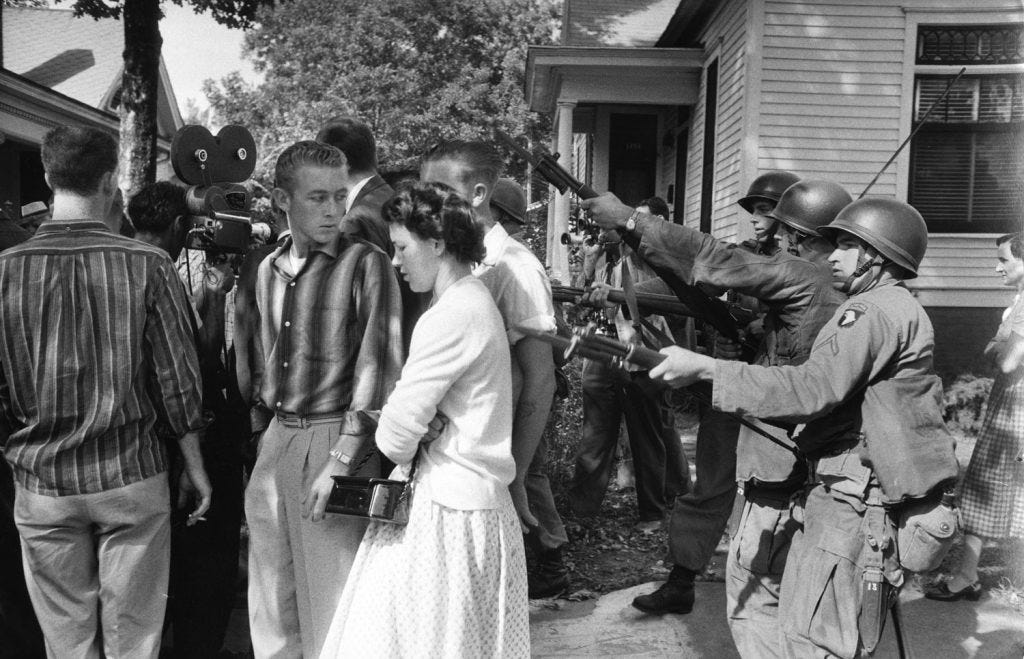
There was no real “direct action,” their recourse was not to the street but the Screen, as “black power developed within a larger American racial context shaped largely by the imperatives of the multiple forms of white power. It often grew only with the funding, consent, and influence of agents of that power—like the Ford Foundation” (Ferguson 2007).
The CRS was effectively a secret service that operated in deliberate “self-effacing” anonymity for decades, acting as a political warfare department of the race communist Ziggurat until its closure last year [now refunded . But it would be a mistake to assume that the momentary defunding of the CRS means an end to the administrative engine behind it, which is almost entirely privatized at this point.
In 2013, when Fox News’ Greta Van Susteren pressed Trayvon Martin’s family attorney, the very Floridian Jasmine Rand, she broke kayfabe and let slip, “I have a greater duty beyond being an attorney, and that’s to be a social engineer. When the law doesn’t get it right, I believe that we have the right to…object to the decision of the jury” (NR).
Rand gave away the game, and has never again been tapped for a prominent civil rights case. But she was still paid. Later that year, she was invited to help the Lawyers’ Committee for Civil Rights Under Law (LCCRUL) to establish its Young Lawyers’ Committee (also referred to as “Young Lawyers Division”). Rand was made an executive board member. She now has her own firm and can be hired through entertainment agencies as a “Caucasian civil rights activist” (PDA Entertainment Group).
From 1966 to 1975, under former intelligence and propaganda officer in the Office of War Information, McGeorge Bundy2, the LCCRUL was vitally sustained by the CIA-front Ford Foundation, and today receives tens of millions from the Open Society. This is the pattern, as we will see, everyone gets paid “for fulfilling the legal profession’s highest ideal of advancing equal justice for all” (PDA).
LCCRUL began as a Kennedy admin “pro bono” war party during the early ‘60s Mississippi invasion, operating in symmetry with the communist Urban League (Hawkins 1994). (LCCRUL). Rand’s invocation of “social engineering” registered briefly, then disappeared from discourse. One year on, the term was repeated by the principal of her firm, Parks & Crump: Benjamin Crump, Esq. (Crump).
The sentiment was apparently derived from a quote, or possibly folklore, that he attributed to Charles Hamilton Houston, architect of the NAACP’s strategy against segregation, whose “sociological jurisprudence” itself emerged from a circle of self-described social engineers funded by the Rockefeller and Carnegie foundations, and through the mentorship of the New Dealer communist, Felix Frankfurter (Lagemann 1992) (Jackson 2005) (Dilling 2006) (Crockett 1961) (FBI).
In 1969, Hamilton arrived at Columbia University to fill a Ford Foundation created professorship in “urban political science” and became one of the first black men to hold an academic chair at an Ivy League university. Over the next decades, he would train an army of black lawyers who would go on to form today’s black grievance lawfare industry. The entity called “Jasmine Rand” encapsulates the century of the social engineer; she is a tentacle of the cephaloplex.
The CRS genealogy has two main lines. First, from its prehistory CRS inherited a CIA/Marxist “crisis/solution” dialectic: manufacture or exploit crises to force through pre-determined “resolutions.” Called during the war white/grey/black propaganda, refined by OSS applied anthropologists such as Gregory Bateson and Margaret Mead, later repurposed by Saul Alinsky and others, it’s a kind of “strategic scripting” that weaponizes ethno-psychological fault lines.
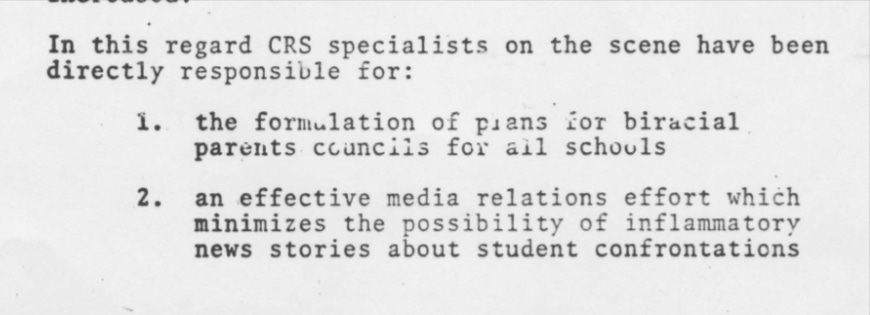
The idea is to provoke protests, category revolutions, or varying degrees of criminal anarchy, and then, through “effective media relations,” reframe the resulting carnage into politically expedient mise-en-scènes, which provide pretexts for the deployment of federal agents, the military, and activist Supreme Court justices.
Second, CRS can be traced to the notorious Chicago School of Pragmatism, the human engineering movements of the 1910s and 1920s—Fabianism, Veblenism, Institutionalism—and the philanthropic foundations that funded them. This muscular urge toward technocracy first grew in reaction to the degeneracy and ennui of the fin de siècle, best articulated by the Fabian preference for a bureaucratic socialist state:
Like any good engineer, the Fabians tried to make forces work together rather than in opposition. Hence, they favored compromise, collective bargaining, and arbitration over “the crude and old-fashioned strike.” (Rose 1986)
The Fabians’ basic formula was that some measure of employee welfare, or at least the hallucination of such, would make industry more efficient. This philosophy would be materialized at University of Chicago by the proto-biotechnologist Jacques Loeb, whose work in the technology of living substance [einer Technik der lebenden Wesen], propelled by a desire to “to form new combinations from the elements of living nature,” to “produc[e] new forms at will,” to “produc[e] living matter artificially,” and to control the “energetics of life phenomena,” would inspire technocrats like Thorstein Veblen, and the infamous inventor of operant conditioning, B.F. Skinner.
By the early 1900s, endless waves of riots and industrial-scale catastrophes had convinced elites that direct domination of labor was untenable. The worker was in all out rebellion: mass walkouts, wildcat strikes, boycotts, slow-downs, sabotage, bloody insurgencies such as the Rockefeller Coalfield Wars (1913–14), the Battle of Virden, and a grisly list of massacres—Everett, Lattimer, Matewan, Centralia, the burning of women and children at Ludlow—the violence and repression only intensified revolutionary currents.
Then, provoked by communist agitation in the wake of the Bolshevik Revolution, the nationwide convulsions of 1919.3 Even the most bloodthirsty “robber baron” got the message; this multi-decade vista of carnage drew forth an epiphany: the cold trauma of the machine, which was compared to “shell shock,” rendered impotent traditional methods of discipline. The worker could not through shows of force be adapted to industrial society; novel technique must adapt him to it.
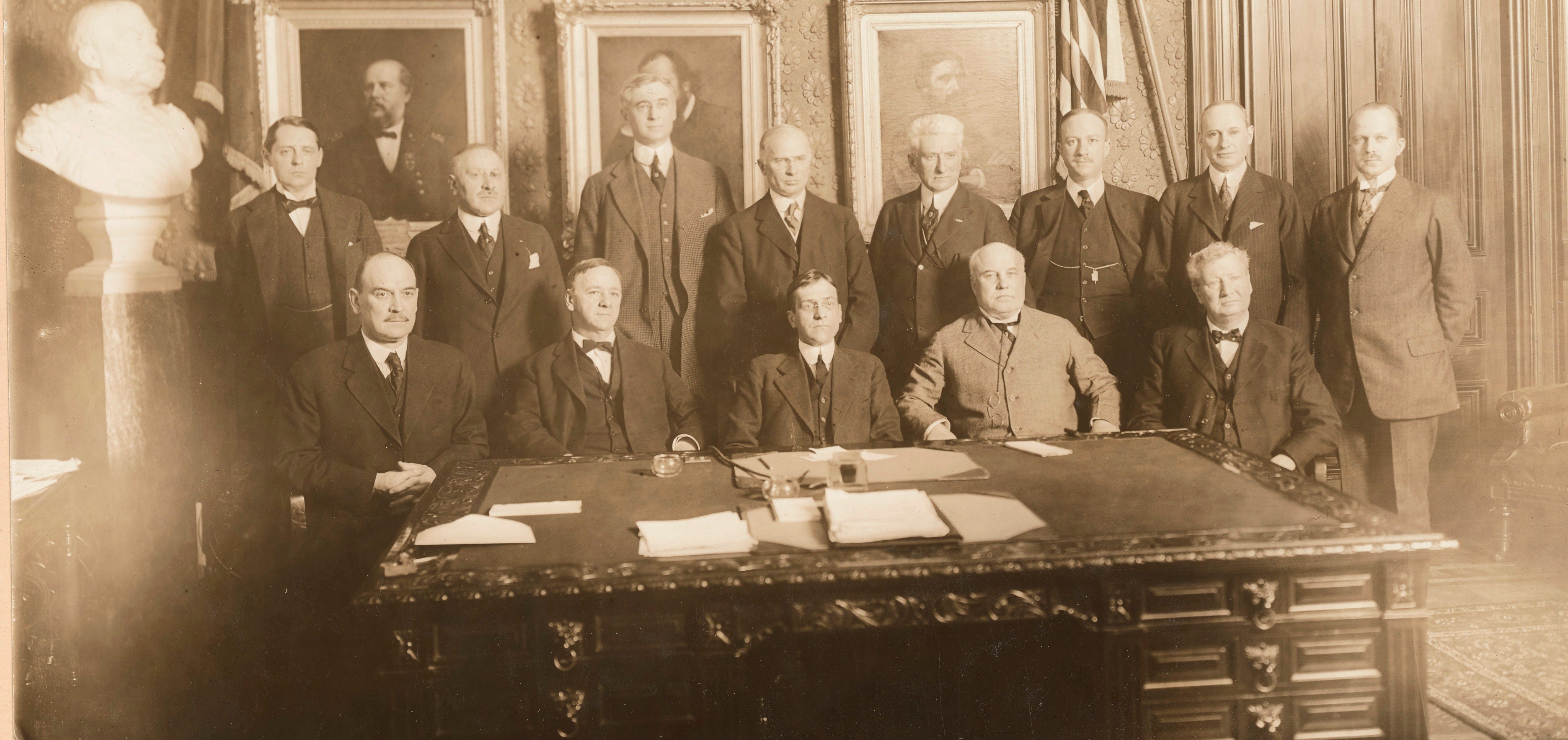
In the first world war, the 1918–19 National War Labor Board (NRLB) replaced the picket line with “collective bargaining,” a routinized grievance mechanism, to sustain wartime production; as Roosevelt put it, “There shall be no interruption of any work which contributes to the effective prosecution of the war.”
In short, the proposed techniques of “industrial democracy” and “collective bargaining” were not initiated by the workers, but were always a therapeutic managerial solution meant to induce a “reorganization of rights” as a “substitute for class war” under the banner of “public interest” (Creel). In principle, this makes sense in wartime, when a unified “public interest” is readily definable; in peacetime it becomes a vague propaganda abstraction—the phantom public being the one interest not directly represented on tripartite labor boards.
Inter-war efforts to make collective bargaining and other supposed “pro-union” measures permanent were met with resistance across the board, and were easily evaded by industrialists due to a lack of enforcement mechanisms. To be clear, all of this, these early sketches of New Deal architecture, were considered “fascist” by 1930s Marxist-Leninists:
[The National Labor Relations Act (NLRA) of 1935, or Wagner Act] grants the workers the right to unions of their choice for collective bargaining. But it also grants Congress the right to intervene if a strike appears to interfere with interstate Commerce. The Wagner Act is part of Roosevelt’s apparatus for regulating and controlling labor and capital and harmonizing their relationships. It is part of the state functioning of a planned, collectivist capitalism towards which Roosevelt is advancing, and as such is another step paving the way for Fascism.
—Class struggle, Official organ of the Communist League of Struggle
(Internationalist-Communist), Editor: Albert Weisbord (1937)
In 1942, the peculiar features of this “fascism” come to focus in strange quasi-public figures such as Ted Kheel, who sat for the “public interest” on NRLB panels alongside Carnegie Corporation economists, radical socialists, industrialists and union bureaucrats, assembling a zany wartime laboratory for experiments in “industrial democracy.” Influenced by the interwar turn to militarized psychology, labor-mediation technique aggregated during World War II and then formed a hard sclerotium. The path was not toward fascism, not even on the horizontal plane, but to orthogonal laboratory imaginaries, a rapture into the “consciousness of the machine” (Ellul).
By the mid-1950s the science of industrial relations had mobilized Hugo Münsterberg’s “industrial psychology” theories, disseminated through the Division of Applied Psychology at the Carnegie Institute of Technology, and totally re-inscribed the union as a concept. With a little assistance from OSS-Batesonian “applied anthropology,” it was made possible for a triumvirate—the state, the foundations, and an organized labor-minority—to define, revise, and perpetually reformulate that ambiguous, ever-shifting figure called “public interest.”
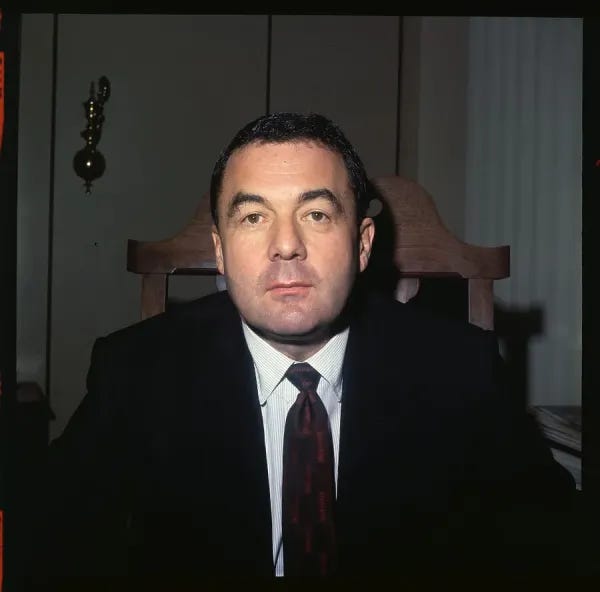
The arc of Theodore Kheel’s star rises parallel to this procession into the laboratory imagination. The wartime chapter of his career reads less like a civil rights résumé and more like the dossier of a greasy labor-state fixer: thrown into the maw of mobilization in 1942, the future godfather of mediation helped to set up and run the New York War Labor Board, a city-sized version of the federal apparatus, and served as its chairman and administrator, hiring staff, renting offices in the Daily News building, and keeping the machine lubricated.
By 1944, his oily black star had constellated; Kheel’s special talents as a mediator and his obvious political skills soon brought him opportunity to move to the new wartime agency, the National War Labor Board (WLB), comprised of several future AFL-CIO officers, the first buds of his powerful network, and was swiftly tapped as its executive director. By 1944, he had been appointed executive director of the WLB, with a staff of 2,500 who were hearing 150 disputes a week.
After the war, Kheel was assigned to a special transit committee in 1946 alongside several identified communists like Anna M. Rosenberg, a member of the John Reed Club, known as a “communist front group for intellectuals” (FBI 1950), (Klehr 2000). After the war, New York City Hall recruited him and within months Kheel was installed as the director of New York’s Division of Labor Relations, a post where he would begin to transmute his wartime arbitration experience into an enormous kingdom of grease.


Kheel established himself in labor’s intellectual production, in milieus like Cornell’s School of Industrial & Labor Relations (ILR), where terms such as “industrial psychology,” “organizational behavior,” “social ecology,” “human factors”, and “collective bargaining” were applied to the problem of mass man, in studies funded by the Office of Naval Research and other military research agencies. The ILR School’s online history notes: “An ILR education is grounded in the social sciences. Students and faculty explore and gain an understanding of human behavior through the lens of the workplace.”4 This new school of labor cybernetics extended Kheel’s reach, lending his arbitrations an academic patina as well as political kinetics.
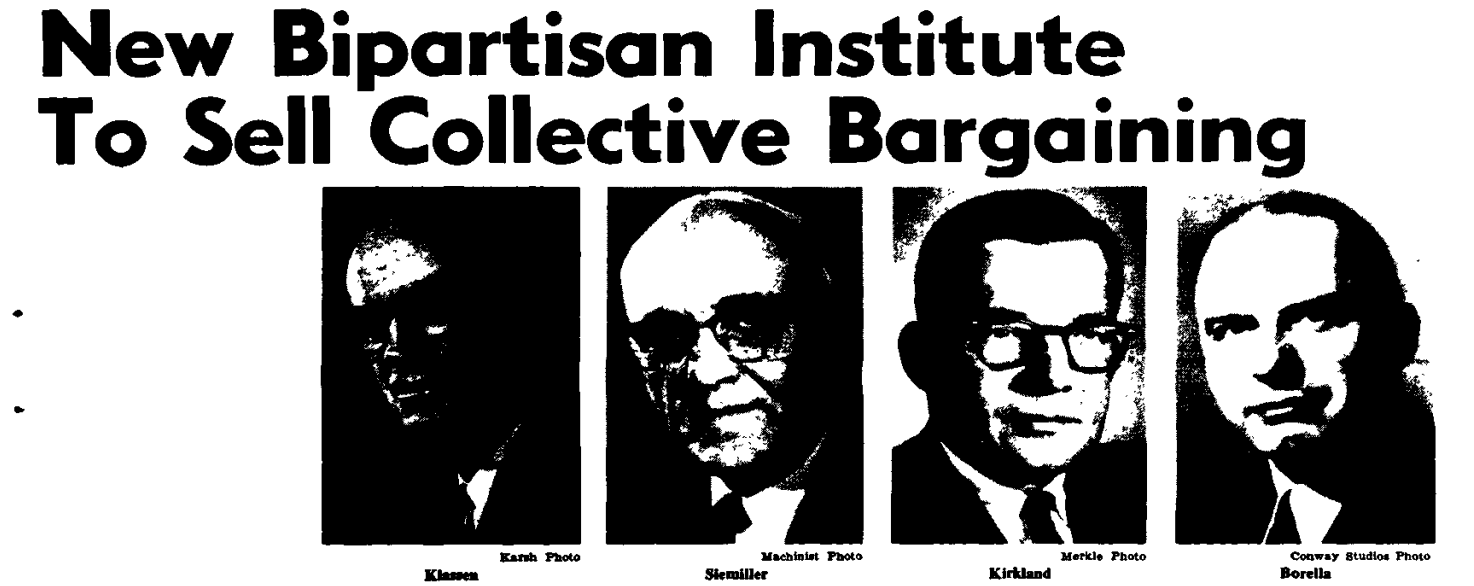
Kheel’s Institute of Collective Bargaining and Group Relations, proposed and funded by the Ford Foundation, was formed in cooperation with Cornell ILR, to “serve as the educational resource for the Institute.” Cornell was a major hub for intelligence research, with its Interdisciplinary Materials Science Laboratory sponsored by ARPA and sociological, cultural and anthropological studies financed by the CIA through the Society for the Investigation of Human Ecology, based at Cornell.
In the mid‐1950’s the CIA had approached Dr. Harold Wolff at the Cornell University Medical School and asked him to lead the 1954 Project QKHILLTOP, studying Communist brainwashing techniques used on Chinese prisoners. During this era, from the 1950s to mid 60s, the Office of Naval Research, Air Force research offices and other Defense Department channels routinely acted as pass-throughs for CIA science. Thus, all the ONR, AFOSR, and DoD funded Cornell projects in communication research or human performance/stress would have been funded similarly.
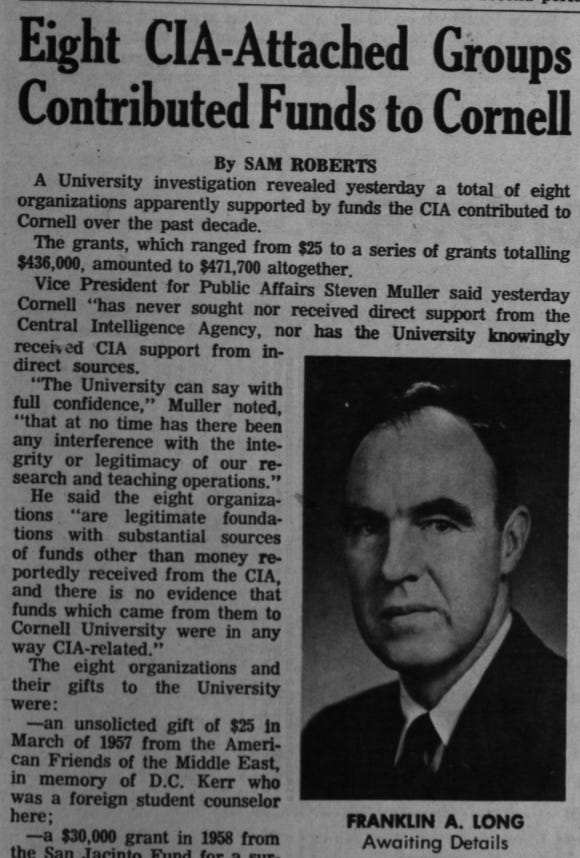
From 1961 through 1963, the School of Industrial and Labor Relations specifically received $289,500 channeled through foundations identified as conduits for the CIA, with IRS returns showing the Marshall Foundation contributions derived from the Beacon, Borden, Price, Edsel, and Tower Funds, most of which were identified in 1964 House hearings as involved in “foreign relations of the CIA.”
The money distributed to ILR was used to finance a project called "The International Labor Training Program," with CIA funds hidden in a “School for Union Leaders” curriculum. On the advisory council for the International Labor Training Program was Joseph A. Beirne, president of the American Communications Workers, an AFL-CIO vice-president, and secretary-treasurer of the American Institute for Free Labor Development (AIFLD), a major union cover for intelligence in Latin America. According to Drew Pearson in his syndicated column (New York Post, Feb. 24) large flows of CIA money were channeled through the Postal, Telegraph and Telephone International of the International Confederation of Free Trade Unions (ICFTU), with Beirne’s active participation. CIA money channeled to labor organizations is “‘estimated at around $100,000,000 a year,”’ wrote Pearson, a gargantuan sum in this era.
CIA-labor creatures like Beirne, positioned on the Board of Directors of Kheel’s Institute of Collective Bargaining and Group Relations, are an excellent example of the mediator’s power network. Such a pedigree no doubt explains how Kheel’s civic influence expanded to encompass multiple US presidents and consultancy with the UN, despite the profession of “arbitration” lacking a serious existence until the late 1970s.
By 1956 Kheel was acting as the chief arbiter between the NY transit companies and the unions. It was around this point he began to diversify his labor credentials into a civil-rights imprimatur as president of the Urban League (of the New York chapter in 1955 and later national president), leveraging himself as both a labor fixer and a broker of socio-technic reform. In the early 60s, Kheel was a principal operator in the “Kennedy Airlift” responsible for “airlifting” hundreds of Africans into the United States, including Obama’s father (who has been identified as a CIA asset in “mainstream” scholarship since at least 2022 (2021). To be fair, it appears there wasn’t an African émigré in the 1950s-1960s that wasn’t a beneficiary of CIA grants (Ray et al 1980), (Stockwell 1968).
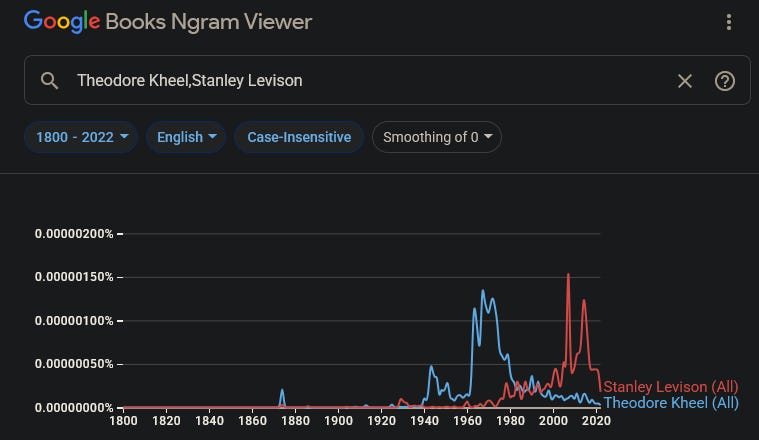
The NY Urban League was at the forefront of bleeding-edge, race communism campaigns and was described as such in several House Un-American Activities Committee (HUAC) reports. In the FBI files on Martin Luther King, Jr., Kheel’s own “Ghandi Society for Human Rights” foundation was identified as a pass-through for communist money into King’s coffers, alongside the Communist Party’s (CPUSA) Stanley Levison, and A. Philip Randolph, labor leader and AFL-CIO vice president.
“The Urban League” represents a very Eastern Establishment pseudo-communism. In the more organic Marxist and far-left media, Kheel is known variously as a capitalist wheeler-dealer, a traitor, a strike-breaker and a company man. By the early 1970s, his morphology as a “Rockefeller creature” was well-known, as he had even helped Arthur Goldberg promote Eisenhower’s union-busting provisions (1970). In a 1967 article from the “Bulletin of International Socialism” his interests are located: “LBJ’s blue ribbon arbitration panel was headed by scab Senator Wayne Morse and included Theodore Kheel, who helped eliminate tens of thousands of railroad jobs.”
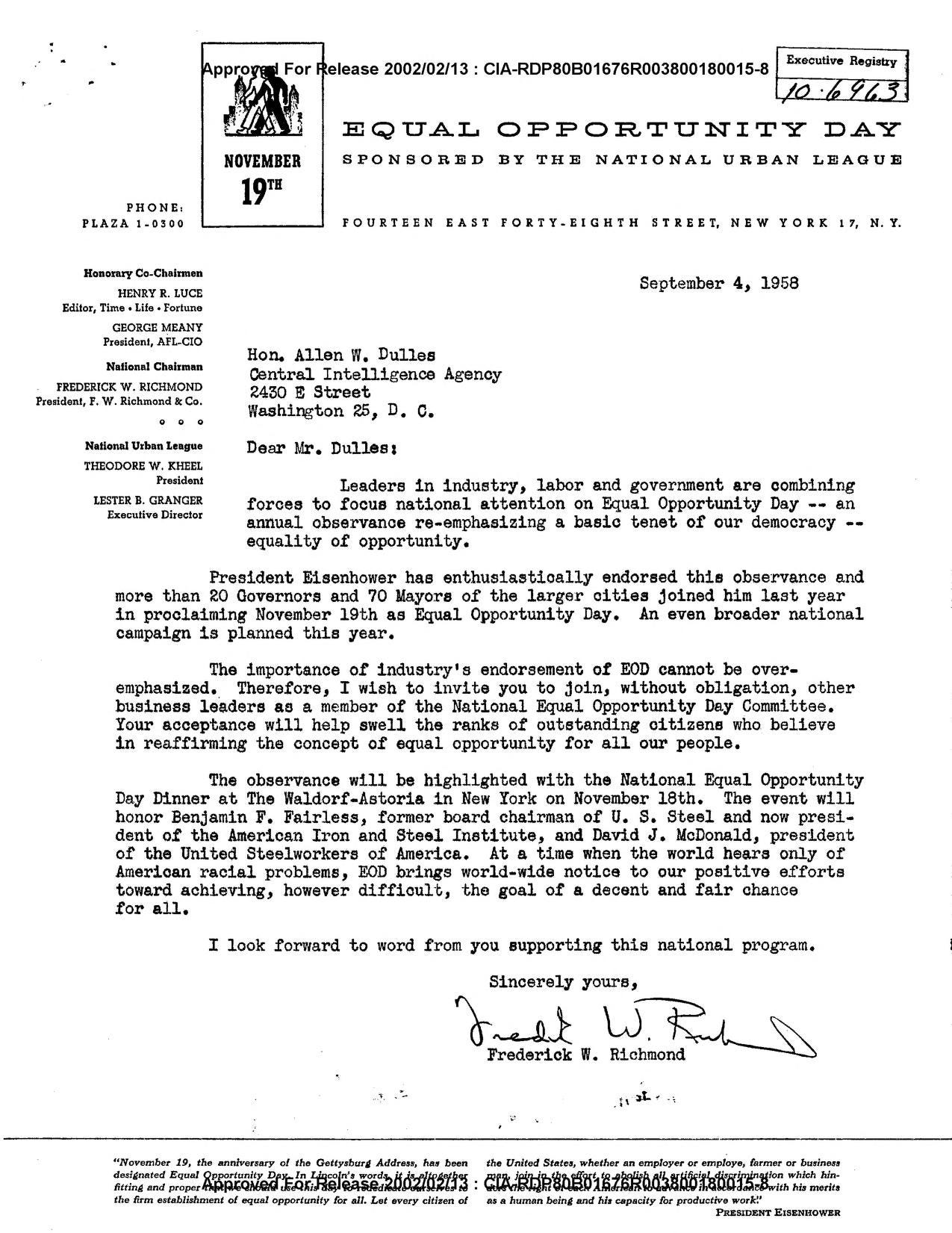
The typical “Urban League” public function would gather diverse sponsors and guests like labor’s strongman George Meany of the AFL-CIO, Henry Luce of Time magazine and Allen Dulles of the CIA (see above document). As the country’s premier administrator of public justice, Kheel would be recruited in 1962 to act as PR consultant for President Kennedy’s Committee on Equal Employment Opportunity, recommending that it secure a ‘‘more aggressive public relations program” (Brauer 1977).

Parallel to these mycorrhizal braidings was Theodore Kheel’s nonprofit network, a well-funded policy clearinghouse. At its heart sat the American Foundation for Automation and Employment, and its gilded “Automation House,” a luxurious East 68th Street town house owned by Kheel’s nonprofit, “a center for rethinking human–machine labor” (Turner 2008), home to the “Board of Mediation for Community Disputes” and the “Center for Mediation and Conflict Resolution,” founded in 1968.
In the mid-1960’s, Kheel was on the ground floor of racial mediation, involved in several depolicing initiatives, for instance, serving as co-chairman of the New York Federated Associations for Impartial Review (FAIR), an umbrella group composed of pro bono lawyers, the ACLU, ADL and the black militant CORE. FAIR was formed to campaign for an interracial “Civilian Complaint Review Board,” basically an instrument of the nascent grievance industry.
Kheel appears often in civil rights contexts throughout the ‘60s. However, after various financial crimes from which he mysteriously escaped indictment, and one rather embarrassing Ford Foundation (FF) bungle, his involvement in the “second reconstruction” would be progressively downplayed to the point of erasure.
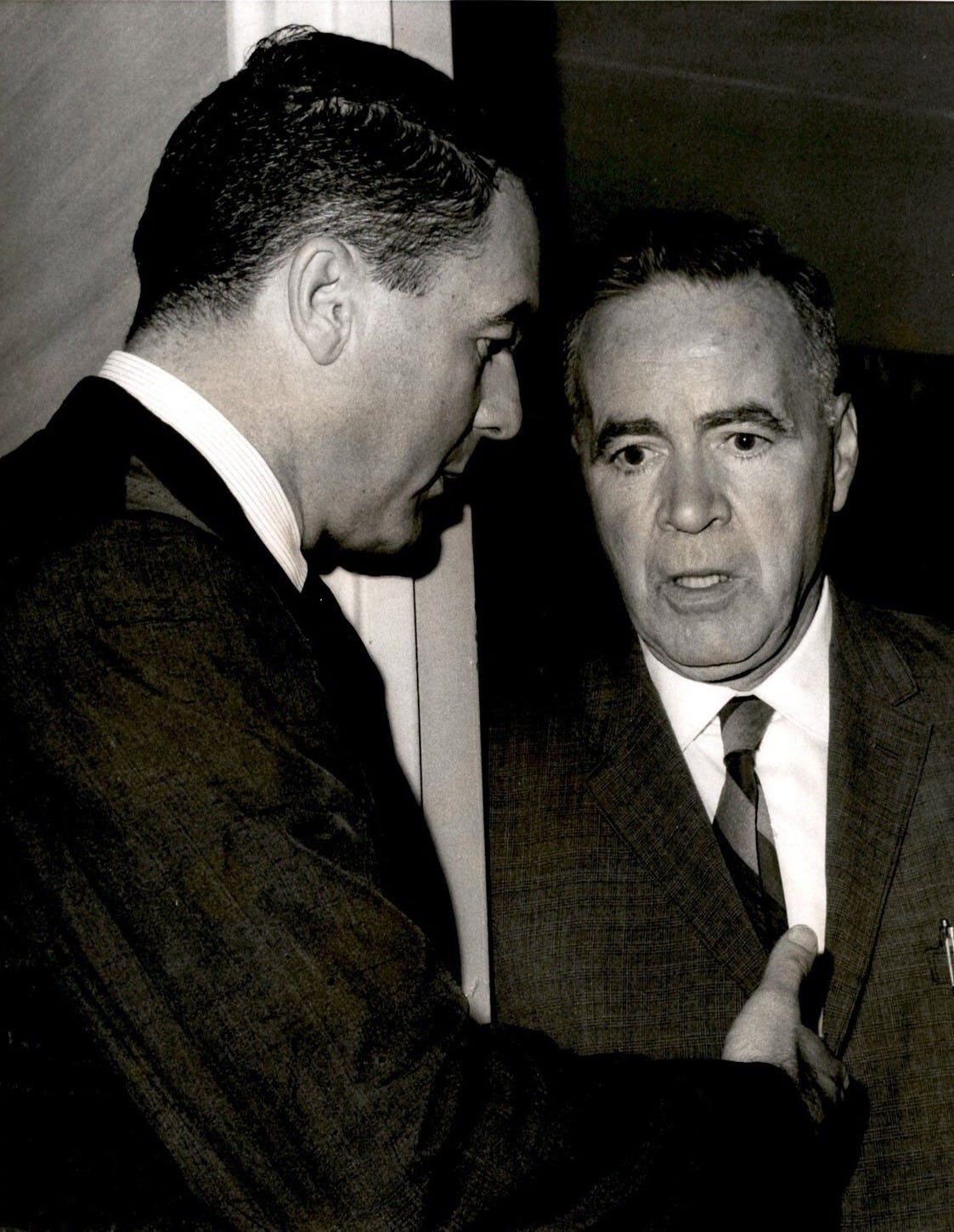
However, his reputation was still holding strong in the 1968 New York teacher strike at the racially charged Ocean Hill-Brownsville experimental school (a misbegotten FF experiment). Kheel acted as fixer, leaving the foundation relatively untarnished. Ford grants would soon after pour into his enterprises (including the two Automation House projects together drew roughly $1.1 million from FF alone), ostensibly underwriting his “mediation” work.
Poignantly, the prime mandate for Kheel’s “Center for Mediation and Conflict Resolution” (CMCR) was “restorative justice” aimed at racial tensions, black gangs and student agitation so as to build credibility for alternative dispute resolution (ADR) in non-labor contexts. Kheel was Ford’s man on the ground, marketing ADR as a policing alternative. CMCR would later merge with the Board of Mediation for Community Disputes in 1972 to form the Institute for Mediation and Conflict Resolution (IMCR), with Ted Kheel on the initial board alongside George Nicolau, a former president of the FF.
All of this period’s “research initiatives” linked to Kheel’s civic activities have the same greasy sheen, but of course, these backroom deals are almost never reported. After all, Kheel was the newspaper publishers’ fixer with the unions, and because of this, the man is nearly invisible. For example, in its reporting on the Graiver affair, the New York Times described scenes of “Financial Intrigue, Mystery Shroud American Bank and Trust Collapse” (1976), with Kheel suspiciously absent from all reporting. We must dig to discover that Automation House was a de facto slush fund / pay-to-play nonprofit that allowed unions, newspapers, the AFL-CIO and corporations to funnel money to Kheel under the guise of charitable contributions.
In 1969, the FF, together with the Hewlett and MacArthur foundations, had injected hundreds of millions in seed monies to community dispute resolution institutes all over the country. This goes beyond vital sustainment to “field-building,” a national profession printed into existence. The FF provided significant funding to the American Arbitration Association and nearly $2 million to Theodore Kheel’s IMCR to engage in alternative dispute resolution “experiments” in places like Harlem. The techniques described are Kheel’s labor mediation “bottom line” approach (1980) (NYT).
And in a single former mediator’s memoir, we find the hyphae connecting Kheel directly to the CRS—
In New York City the Institute for Mediation and Conflict Resolution was among the few with an established program to help curb the wide-spread social upheaval of the day and to help relieve the overloaded judicial system. It was to that enterprise, among others, that CRS turned for the early staff training of its small band of budding mediators.
—Conflict Without Chaos: A Look Back at Conflict Intervention Initiatives During the Nation’s Early Civil Rights Era, Bob Greenwald, (2008) (emphasis added)
Kheel’s institute trained the first CRS mediators. The “others” mentioned by the former mediator are the Federal Mediation and Conciliation Service (FMCS) and the American Arbitration Association (further discussed below). In the two histories dedicated to CRS available, there is zero mention of Theodore Kheel. It seems CRS was too sensitive an organ to connect the dubious figure to its evolution. The point of all this sanitization is layered concealment: to stop you from tracing CRS to labor’s corruption, the coercion mechanisms of their social engineers, and their roots in spook/foundation social experiments.
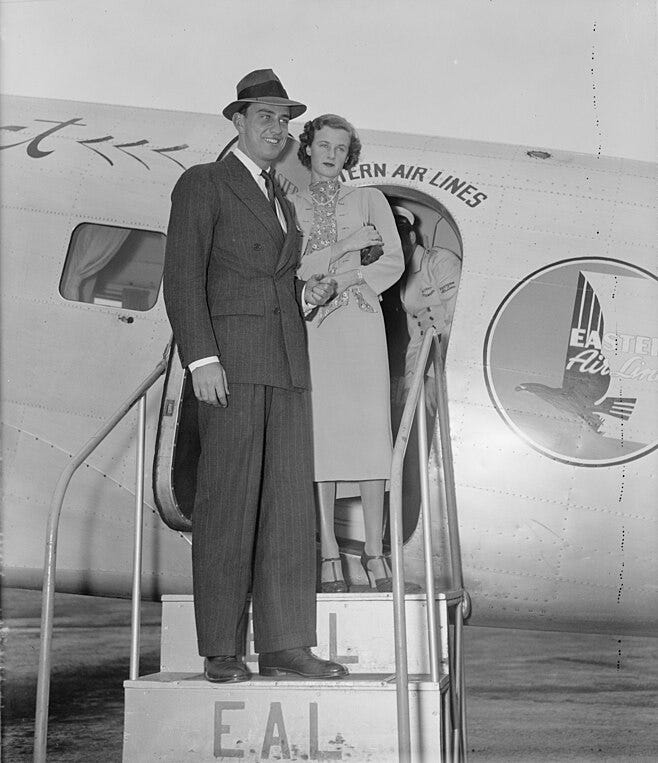
Yet, here is Kheel’s name in 1965, in a statement by Franklin D. Roosevelt, Jr., acting as Chairman of the Equal Employment Opportunity Commission (EEOC), before a congressional hearing on strengthening EEOC's anti-discrimination enforcement powers—
Roosevelt first paraphrases Kheel: “conciliation is most successful when the parties know that effective machinery for enforcement is readily at hand,” and then, quoting directly from LBJ’s “Kheel Report,”
“Enforcement and persuasion are not separate and distinct, nor incompatible, but related parts of the same program. They are opposite sides of the same coin. Both are necessary and indispensable to the other.”
This policy push would lead to the creation of the Office of Federal Contract Compliance Programs (OFCCP), the force behind affirmative action, a force distributed by the conciliators of the Federal Mediation and Conciliation Service (FMCS), the patron-partner to CRS, through a series of ambiguous gradations between mediations, “informal investigations” and formal enforcements.
In the early 1960s, the utterly corrupt FMCS (2013) (2025), directed by former War Labor Board staff William E. Simkin, was the federal agency that first injected labor mediation, ad hoc, into civil contexts during the slate of “hybrid” labor/racial conflicts emerging out of the civil rights hoax, contexts in which Kheel appears several times, sometimes contracted directly with FMCS, sometimes partnered as a privately financed fixer.
Before WW2, the FMCS director and close associate of Kheel, William E. Simkins, worked for the radical American Friends Service Committee (AFSC). The AFSC was formed in 1917 by a group of 14 socialist Quakers to promote and aid draft-dodging. It was penetrated and used by the Communists as early as the 1920s, when it sent Jessica Smith, who later married Soviet spies Harold Ware and John Abt (the Ware Group), to the Soviet Union. Since the 1960s, the AFSC has supported revolutionary terrorist groups such as the Vietcong, the Palestine Liberation Organization, and the Central American Castroite groups.
In the late ‘60s, the AFSC would be investigated by the FBI and military intelligence for their role in the “New Left” coalition, together with the suspicious Institute for Policy Studies (IPS). Today, they are a major force behind criminal anarchy: abolish all prisons, “defund the police,” open borders mass immigration, and other extremist deformalization schemes. Through their coalition, the AFSC and the IPS were deeply implicated in the logistics and funding for the radical, communist-infiltrated Students for a Democratic Society (SDS) and their Mobilization For Survival “the Mobe” (MFS).
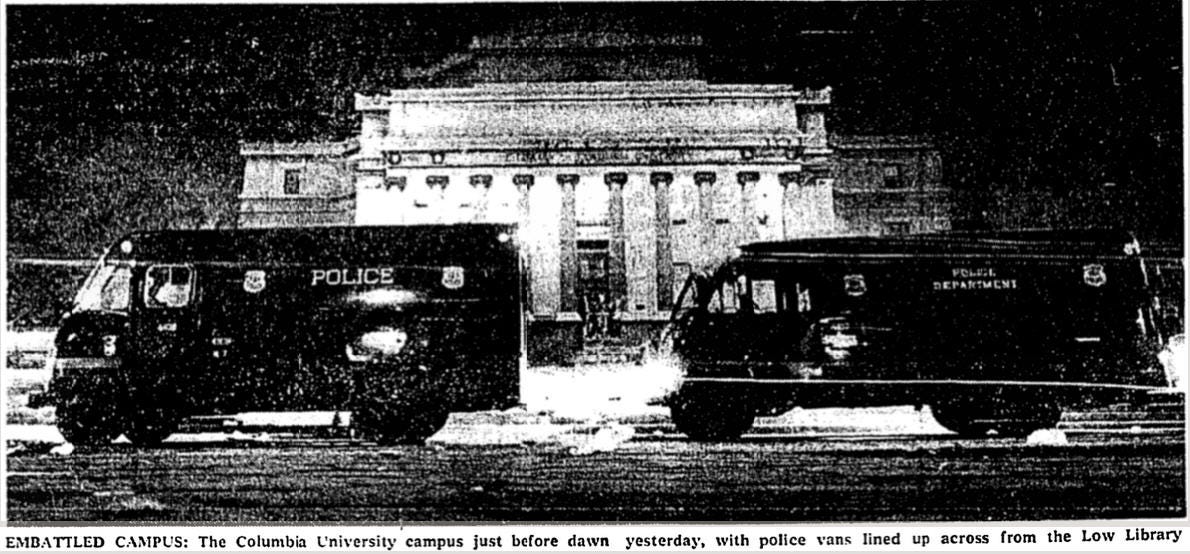
In 1968, the SDS, led by future Weatherman Mark Rudd, occupied Hamilton Hall at Columbia University. They deployed irregular “confrontation tactics”: taking over buildings, ransacking offices, holding hostages and destroying draft records; by the end of it, several hundred students had taken over five buildings and would have to be physically removed by a force of 1,000 policemen.
Kheel had entered this disaster as a neutral mediator, recommended by Kenneth Clark (one of FF’s “applied psychologists”), and accompanied him into Hamilton Hall. He proposed that the student agitators evacuate buildings, resume classes, and face penalties appealable to an external panel (which would include Kheel, Clark, and McGeorge Bundy) that could override the administration, while maintaining the status quo on their demands.
The black contingent, the Student Afro-American Society (SAS), rejected the offer, and the whole thing collapsed into chaos. Riot police arrested over 700 agitators, and Colombia acceded to demands to “change the fundamental teachings and curricula to the most bizarre and irrelevant of pursuits ever conceived. It was a pattern of radicalization replicated in school after school across the country” (2017).
In CRS histories, it is barely mentioned in passing that FMCS was the basis for the CRS as a concept, but the fact of the matter is that FMCS provided all the mediation training and techniques to CRS staff, drawing from their rich experience in corruption, graft, and union/mob dealings. Together with Kheel’s Institute for Mediation and Conflict Resolution, the FMCS basically created CRS in 1965-1979, supplying staff, screening FMCS-produced films, holding conferences, developing its institutional architecture, conducting negotiation and mediation training sessions and internships, and establishing a field liaison for “hybrid” events (Barrett 1985).
The FMCS has a national security remit, and is deeply embedded in the Nuclear Enterprise, as it handles disputes with the ICBM Missile Sites Labor Commission and has “non-official” inter-personnel connections with the Atomic Energy Labor-Management Relations Panel. It settles labor disputes for Northrop Grumman, Nevada National Security Site, Lockheed Martin, Boeing and Raytheon. The mediation techniques provided to the CRS would then be necessarily coercive by design, formulated as psychotechnology by applied psychologists and sociologists.
According to William Simkin, the true extent of this integration with the military-industrial complex is a matter of national security:
We’re not a statistical agency, but at a minimum I would say that we have eight or nine hundred or a thousand cases a year which are of some significance to the Department of Defense. The subcontracting of defense work by the principal contractors and subcontracting below that is so extensive that the tentacles of our defense effort reach out to hundreds and thousands of plants in this country. In many cases, either for security reasons or other, some of this involvement is not known to the public generally; it’s known to a very few people.
—William E. Simkin Oral History Interview—JFK #1, 2/21/1967 [emphasis added]
There is no orderly Russian nesting doll here. There is the unbounded spasm of a hundred tentacles. Each tentacle with a thousand chemotactile suckers which can change shape independently. Each sucker has local control circuits, with neural, hormonal, and muscular feedback, producing an astonishing variety of body patterns. Some have ridges, like teeth. Some smile and offer to mediate.
We try to collect and order them, we name these patterns, “Arthur Goldberg,” “Theodore Kheel,” and now “FMCS,” but these union-men... their feet seem to join with the floor; they are part of some Other’s collection: their smiles hide thinking tongues dense with inter-ganglionic connections, their handshake extends from anthracite veins, from territories arboreal and gorgonic, from hollows in the earth worn by the unceasing limbs of the industrial-mediation cephaloplex—
Kheel, of course, had extremely close and continuous interaction with FMCS, and was often contracted as an arbitrator. Whenever a former director of FMCS died, the New York Times quoted Kheel (NYT) (NYT). The subterranean industrial relations network is most likely, at this point, larger than America’s physical industry. Mediation and “collective bargaining” are major movements within this domain, but its products and services extend to all the necessary human technique that a modern post-industrial society requires. The racial grievance industry is merely a subset of this larger scientific-managerial economy.
…when technique enters into every area of life, including the human, it ceases to be external to man and becomes his very substance. It is no longer face to face with man but is integrated with him, and it progressively absorbs him. In this respect, technique is radically different from the machine. This transformation, so obvious in modem Society, is the result of the fact that technique has become autonomous.
—The Technological Society, Jacques Ellul
Among the more public tentacles of this fragmented and now heavily privatized industry are institutions like Kheel’s ‘School of Industrial and Labor Relations at Cornell’, or the prestigious ‘Program on Negotiation at Harvard Law School’ (sponsored by a consortium with M.I.T.). But the central neurite bundles, the large axial nerve cord (ANC) where the instincts of “social justice” are activated, occupy network densities such as the American Arbitration Association (AAA).
In one 1969 column titled “A Profession of Peace-Makers,” then AAA president Donald Strauss, breathlessly declared:
We must also broaden the objective of our services. The avoidance of conflict or violence, desirable as this goal may be, is not sufficient to win the cooperation of disputants in most of the confrontations which threaten our society today. Mediation must facilitate change -- change in the way things are done, in the balance of power, in the roles played by the participants in an institution. Mediation must be a lubricant to the reordering of political forces, it must help a society adjust to new conditions rather than act simply as a barrier to violence that the forces of change may produce.
— Third Men in Areas of Conflict, An Assessment of the work of the National Center for Dispute Settlement, (American Arbitration Association), written by James Laue [Community Relations Service Research Director]
The AAA’s National Center for Dispute Settlement (NCDS) in Washington, D.C. had among its consultants figures like the Quaker William Simkin, former director of the FMCS (and former staff of the extremist AFSC). Immediately after the formation of CRS, the Ford Foundation [CIA], funded the NCDS (2004), while it was simultaneously funding the militant black power movement.
All the institutional knowledge and informal relationships necessary to support a privatized inoffizielle mitarbeiter — a mass collaborator network penetrating every level of society — are still contained in the FMCS and the AAA.
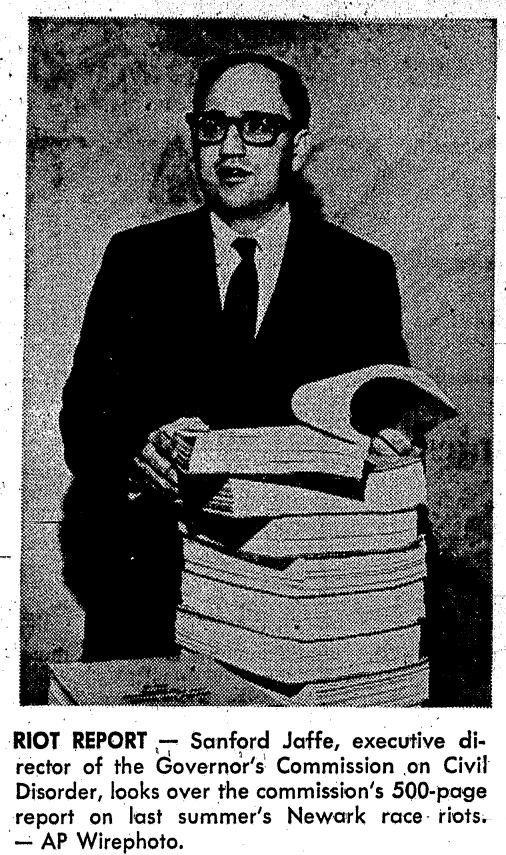
In 1982, the Ford Foundation, together with the Hewlett Foundation and the MacArthur Foundation, created the National Institute for Dispute Resolution headquartered in Washington, and from there basically instantiated the field of “dispute resolution” on a national level. According to Sanford Jaffe, the FF operator who oversaw the project, he and Roger Heyns (UC Berkeley's chancellor and soon to be president of the Hewlett Foundation) were responsible for engineering the assemblage— “the courts, the community, the nonprofit organizations, arbitration—and support at universities” (Rutgers Oral History Archives, 2014).
Jaffe worked under McGeorge Bundy in the FF crusade to support “civil rights” causes. He was the principal actor in creating public interest law firms, which became the backbone of the racial grievance network. Jaffe’s strategy found a loophole in tax code, as public-interest law firms were not directly subject to 501(c)(3) political advocacy prohibitions, allowing Ford to create an “army” of such firms for social transformation. Funded groups included the Mexican American Legal Defense and Educational Fund (MALDEF), National Council of La Raza (NCLR), and Puerto Rican Legal Defense and Education Fund (PRLDEF).
Backed by the Ford Foundation, these groups would fundamentally transform the public debate about immigration, both legal and illegal, and ultimately shape policy, reflecting agendas that originated on the political fringe and, in the absence of Ford funds, would probably have remained there. (DTN)
The very beginnings of interracial mediation are here with the Ford Foundation and the FMCS, or rather, beneath it, in the sub rosa network of activist freaks, and extending into the oily black interstices of the American Federation of Labor and Congress of Industrial Organizations (AFL-CIO).
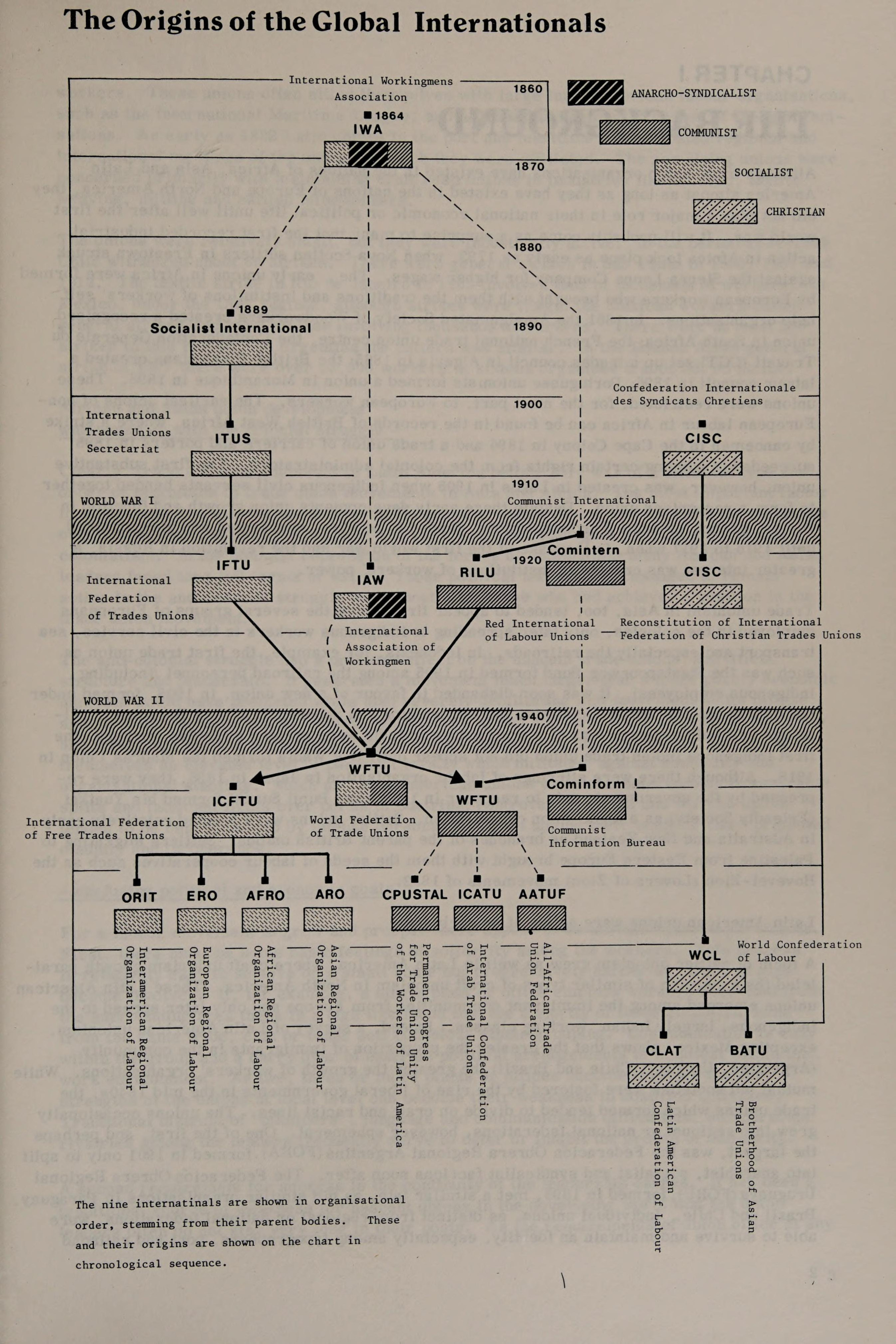
The interlock between labor, intelligence and racial mediation goes back to WW2, when Herbert Blankenhorn, an OSS colonel, had suggested that a vital area of activity should be the labor movements around the world; he won William Donovan’s support and began recruiting for the “OSS Labor Division.”
He enlisted George Bowden, who brought with him, as his assistant, the Congress of Industrial Organizations’ (CIO) chief counsel, CRS architect Arthur Goldberg; within months Goldberg was operating as OSS labor chief out of Allen Dulles’ office in New York and began to hire hundreds of trades unionists and labor attorneys to work with the labor branch. Gerry Van Arkel, one of those so employed, was sent to North Africa where he set up penetration and political intelligence networks among the exiled European socialists.
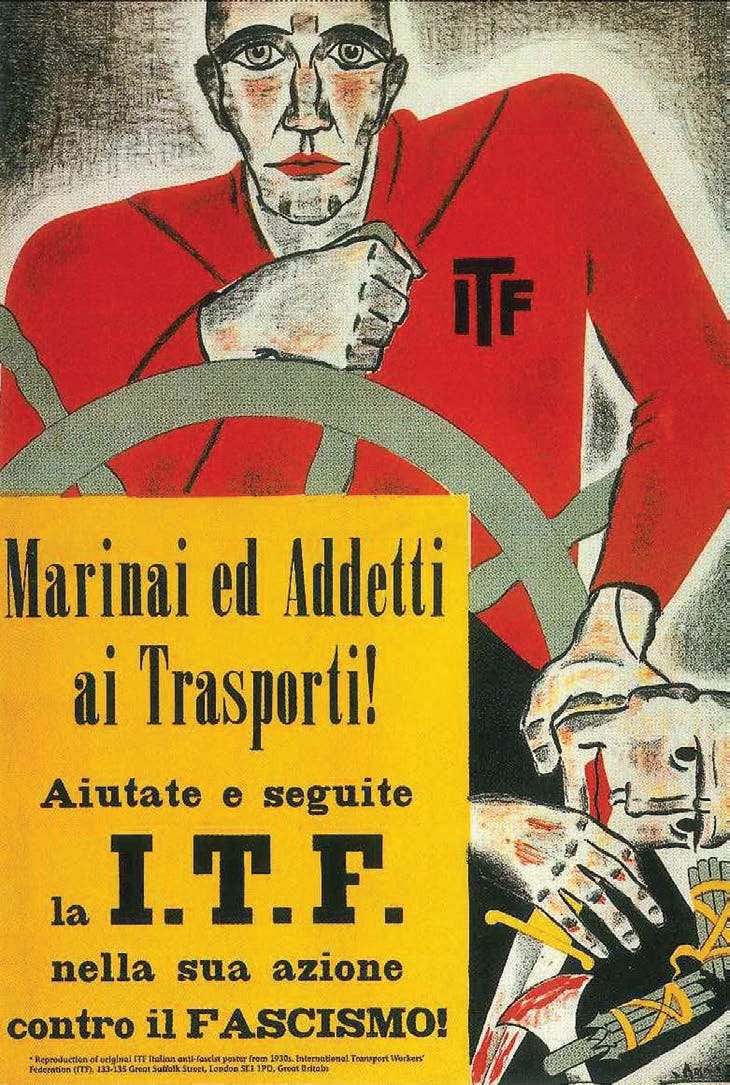
In mid-1942 Goldberg and Bowden met the former leftist partisan in the Spanish Civil War, Omar Becu of the International Transport Workers’ Federation (ITF), which had moved its entire operations to London’s Transport House in collaboration with British intelligence to provide information on transport movements and labor conditions in occupied Europe. Becu urged Goldberg to establish contacts with anti-fascist union cells and Goldberg and the chief of the OSS Labor Branch George Pratt came to London to set up the operation (Stebenne 1996). Pratt stayed in London to run the labor branch, meeting regularly with German socialist, communist and labor refugees and paying them “retainers.”
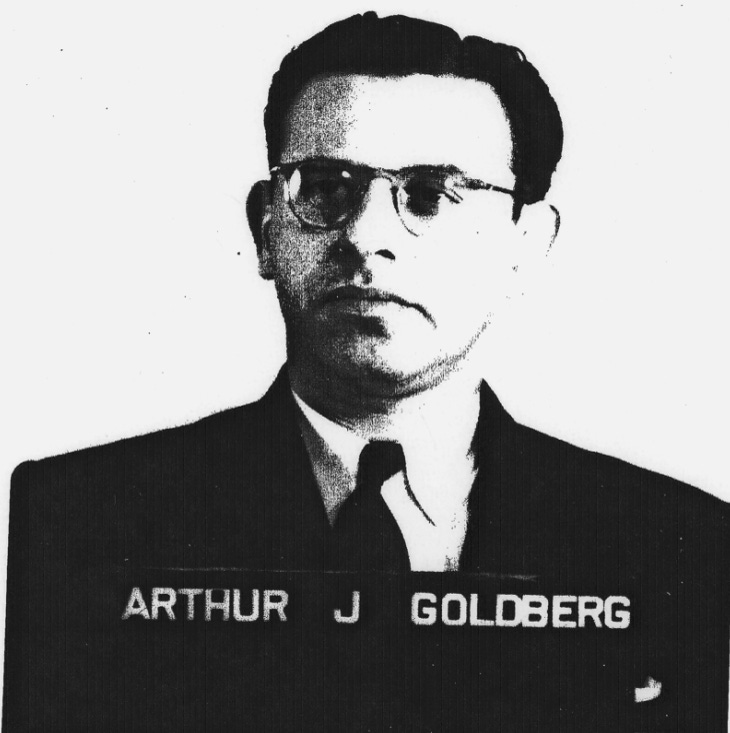
The OSS labor branch decided that their trades unionists could penetrate Germany itself and enlisted Lazar Tepper, the International Ladies Garment Workers Union (ILGWU) research director, who in 1943 reported to the OSS HQ at Grosvenor Street to head “Project Bach”: the creation of labor agents to operate behind German lines, report on conditions, and supervise sabotage.
Project Bach drew upon trades unionists in London, the ITSs and the IFTU to enlist volunteers who were parachuted or infiltrated into Sweden, Belgium, Holland, Italy, France, Poland, and Germany itself; these labor agents conducted numerous successful operations, provided American intelligence with virtually their only reliable hard information from within Germany, and set up elaborate stay-behind nets for reactivation after liberation.
The OSS attracted numerous, unnamed American unionists who served in virtually every theater of the war; in Latin America the labor work was placed under Nelson Rockefeller’s Office of Inter-American Affairs, which recruited David Saposs (Carnegie Corporation “investigator” and Twentieth Century Fund “research director”) and John Herling (chaired the Fabian LID Emergency Committee for Strikers' Relief [1934]) to co-ordinate US labor initiatives. These characters worked to organize a congress of anti-fascist exiles in Uruguay, with the help of special agents such as Serafino Romualdi, who worked to gather support for US policy among Italian communities, and kept Italian socialist unions at odds with the communist unions, before returning to Latin America as a Free Trade Union Committee (FTUC) representative.
As a side note, the Rockefeller/Carnegie creature Saposs is characterized in Vassiliev, White Notebook No. 3 as a “Trotskyite,” a renegade from the Communist Party, a sellout, and a jealous opportunist5. This turncoat characterization of the suspicious New Dealer turned vociferous “anti-communist” explains almost everything about left-liberal anti-communism in general. They were simply the most conniving, and least ideological, compelled by the overriding instinct of spiteful mutanism.
The loose concatenations that bound US labor to the security state were permanently consolidated by the enormous program of postwar “aid” (clientelization)— the Marshall Plan gave many ex-OSS labor staff important roles in postwar Europe as Cold War games of simulation began, occupation forces in Asia were augmented by labor specialists to build “anti-communist” (syncretic socialist) unionism. The OSS’s postwar reshuffle into the Central Intelligence Group, and later the CIA, placed many “labor specialists” in critical positions.
These “specialists” all seemed to be in sympoietic6 alignment with the transcendent object of the New Deal-Cold War ziggurat; and this was, of course, total psychopolitical warfare on the world population.
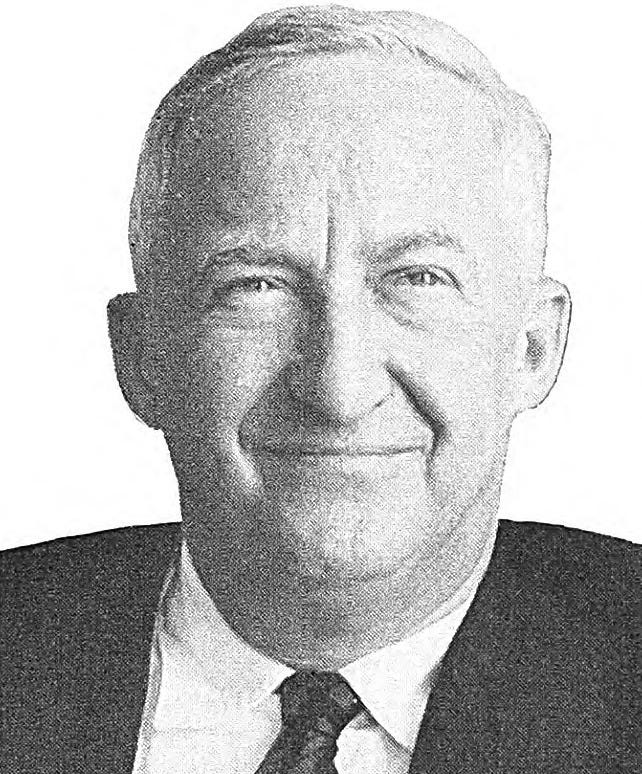
In the 1950s, the CIA, through Jay Lovestone’s Free Trade Union Committee (FTUC), was funneling millions into promoting “international labor relations,” in Africa, India, Indonesia, all over the world, in support of “free unions founded on collective bargaining in an open marketplace, and opposition to state-run unions on the Soviet model.” Lovestone, who led the Communist Party USA from 1927 to 1929 before his expulsion by Stalin and subsequent defection, became an anti-communist operative in the American Federation of Labor (AFL), serving as assistant to David Dubinsky in the International Ladies’ Garment Workers’ Union and later directing the AFL-CIO’s “International Affairs Department.”
Lovestone’s extensive anti-communist operations in post-war Europe were expanded by orders of magnitude by money siphoned off from the $13 billion Marshall Plan. There is rumor of an $800 million dollar “sugar fund” but there are no public records of how much money the CIA funneled to the labor movement. There was no congressional oversight of the agency. As Thomas Braden, an assistant to CIA director Allan Dulles said: “The CIA could do exactly as it pleased. It could buy armies. It could buy bombs. It was one of the first world-wide multinationals.”
Thomas Braden served as head of the CIA’s International Organizations Division (IOD) from 1950 to 1954 and managed the funding to Lovestone’s network. In a 1983 interview, he stated: “There was a guy named Mike Ross that ran the CIO and Jay Lovestone ran the AFL side. Irving Brown ran around Europe organizing things, and Jay Lovestone sent the money. Allen was giving Lovestone money long before I came into the agency, and I think he was doing only what had been done before.”
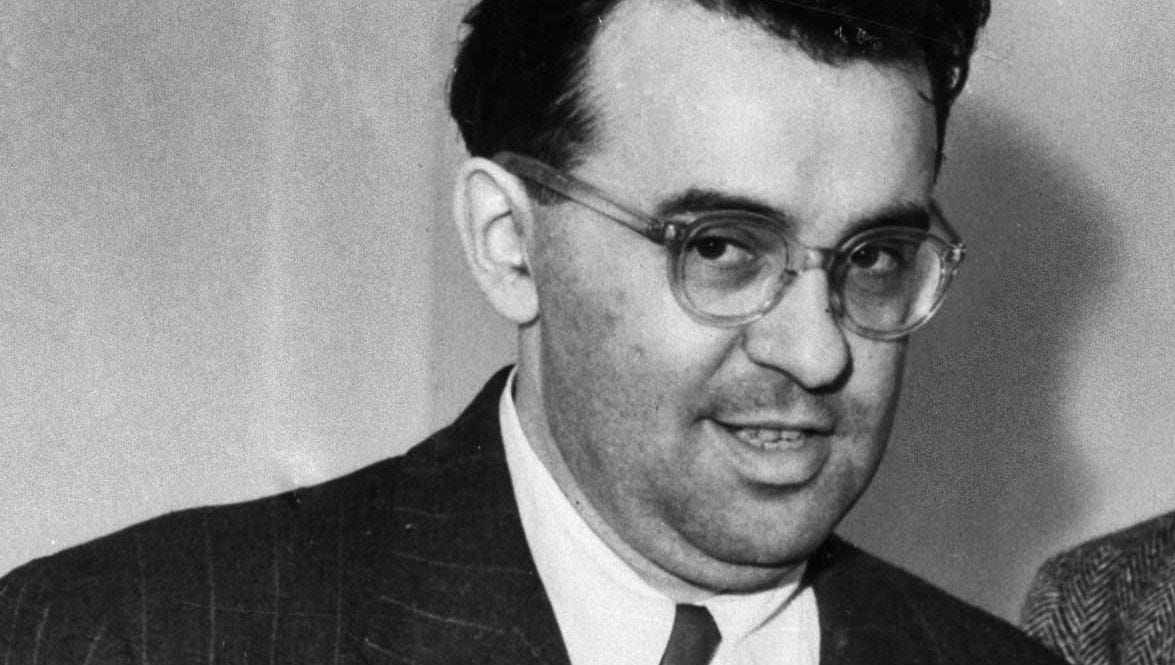
As part of this reconstruction, by 1949, the International Confederation of Free Trade Unions (ICFTU) would, through the engineering of the CIA, its agents and conduits like the FTUC, come to supplant the World Federation of Trade Unions (WFTU).
The Marshall Plan revived the CIO’s hopes for an international role—heretofore largely precluded—in conjunction with the AFL, and prompted them, together with the TUC, to finally abandon the WFTU in 1949 and join with the AFL in the new International Confederation of Free Trade Unions (ICFTU), which brought the Western “free” unions together and excluded the Soviet Bloc. But even in this political alliance the AFL and CIO continued to diverge on fundamental goals for the American assistance program for Europe. The CIO still harbored the hope for a third way between communism and “illiberal” capitalism, best expressed by union president Walter Reuther, with his declaration of being “neither with Wall Street nor with Stalin.”
—excerpt from American Labor’s Global Ambassadors (2013)
This “third way” discursive space between the AFL and CIO was always the frothing slime molds of Fabian Socialism, which was ever an agglutinous, ad hoc/post hoc, administrative collectivism, or more bluntly, the hideous verschmezung of psychic mineralization, throughwith is channeled the collective trance of technic shock.
In this same period, the CIA was using the Kaplan Fund to funnel funds into the Institute of International Labor Research, Inc. (IILR), a New York trade-oriented non-profit organization active in Latin American labor. The IILR brought together “anticommunist” radicals from across the Americas and was chaired by eminent socialist Norman Thomas, a former director of the League for Industrial Democracy (LID). The Fabian Society lists LID as a sister organization, “which carries on active propaganda in the United States on very similar lines to our own work here” (1929). "Industrial Democracy" is a Fabian concept and the title of an influential book written by Sidney Webb, a founding member of the Fabians.
There is a splatter of sulphur and mercury here: the rotten chemical stench of cyber-alchemic hermaphroditism— the masculine Red of communism is chemically castrated and filtered, leaving only a “Society of Friends” colored UN-blue, moved by the light of New Dealer “anti-communism,” ..synthesizing a Fabian Rebis composed of radical socialists.
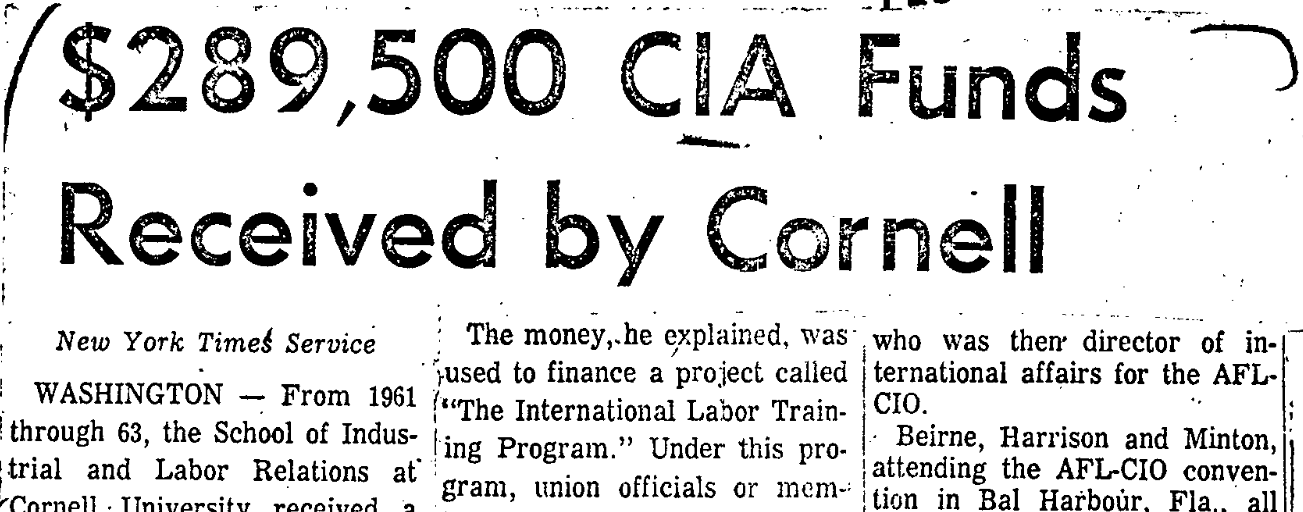
Between 1961 and 1963 Cornell, Theodore Kheel’s alma mater, received $289,500 from the CIA, awarded to the School of Industrial Relations (SIR). This was part of the ongoing anti-communist “labor relations” campaign covertly organized with the AFL-CIO. The money was funneled through the Marshall Foundation to SIR, to finance its “international labor training program.” Of course, Ford Foundation grants and awards to Cornell and other labor relations programs in this period were in perfect symmetry with these Third World decolonization projects, and continued well after the more “formal” intelligence funding ended. It appears the interracial mediation techniques of CRS started with CIA-funded counter-insurgency.
Such hijinks at Cornell began in 1947, when the Department of Defense and the State Department established the Committee on Human Resources (CHR) to coordinate all U.S. military spending on social psychology, sociology, and the social sciences, including communication studies (propaganda). This oversight group, in large part, would pioneer the axonal tracts of the U.S. academic–intelligence network. Cornell was among its vertical lobes, with its president personally assisting the steering committee:
Back in 1944, John Gardner [former OSS Psychological Staff, CHR consultant], later head of the Carnegie Foundation, and James Perkins, president of Cornell [and Carnegie Corporation executive, DoD Research Board], visited my office and expressed their opinion that R & A had pioneered an important new direction in education. After the war, the Carnegie Foundation put up the initial money to start Russian and Middle East and Far East Research Centers at Harvard and Columbia and elsewhere [a joint Carnegie–U.S. Air Force–CIA venture], with sociologists and historians and political scientists all working on the same area study — a very important part of the modern university curriculum.” (Ford 1970).
Alongside the government committee, the Council on Foreign Relation created Study Group 5152 to assist the State Department with “the expansion of existing government and private intelligence and research activities.” Carnegie’s John Gardner was a member of both (Simpson 1994) (Paget 2015). Through such efforts, from the 1950s to the early 1960s the security apparatus would be involved in funding or coordinating nearly all international labor relations programs. Reviewing the literature, it appears that many of Cornell’s labor studies were funded with Navy grants, most with a psychological focus.
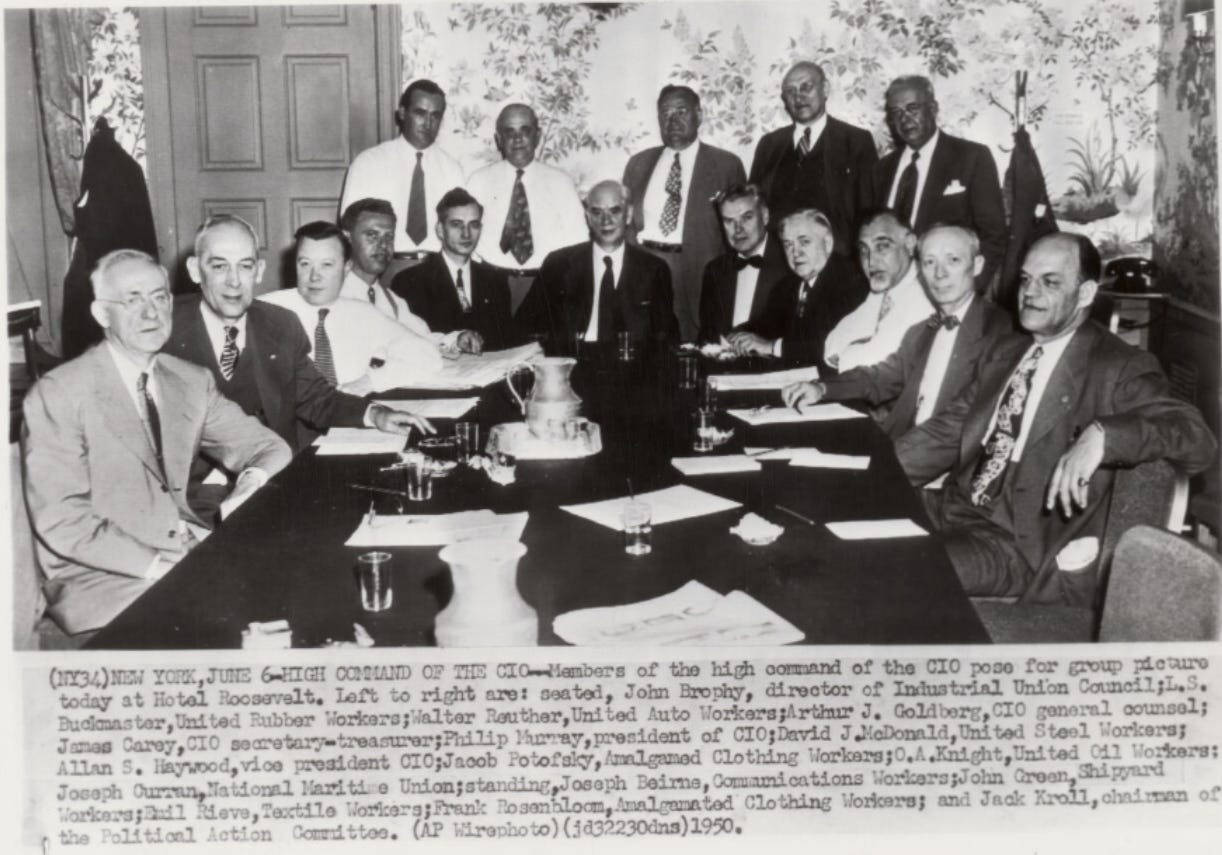
Cornell’s relation to AFL-CIO international affairs continued throughout the 1950s. In October 12–17, 1958, the university’s ILR sponsored a conference designed to arouse more labor union interest in U.S. anti-communist operations in Asia, Africa and Latin America. CIA liaisons Lovestone and Harrison were among the speakers at that conference.
The advisory council of Cornell’s CIA-International Labor Training Program included four AFL-CIO leaders: the already discussed Joseph A. Beirne; George Harrison, president emeritus, Railway Clerks Union; Lee W. Minton, president, Glass Bottle Blowers Association; and the late Michael Ross, then director of the AFL-CIO’s “foreign relations.”
Theodore Kheel, Beirne, Harrison, Minton, and Ross were all involved with the American Institute for Free Labor Development (AIFLD), either formally or informally. The AIFLD was established in 1962 by the AFL-CIO to promote non-communist trade unions in Latin America, taking over the work of the CIA’s FTUC. This time funds would be funneled through other instruments, namely the ICFTU, then USAID and the National Endowment for Democracy (CIA). The AIFLD would develop several foreign labor relations organizations as part of its decolonization efforts. One such, the African-American Labor Center (AALC) headed by black bag courier and intelligence operative Irving Brown, was created by the AIFLD, with 90 percent of its funds coming from USAID (Busch1980).
The raison d’être for these Cold War “government-organized non-governmental organization,” (GONGOs?), was primarily for the purposes of de/recolonization, the supposed “anti-communist bulwark” narrative was operatively tangential or a post-hoc justification. In other words, the AFL-CIO took the initiative (Busch 1980).
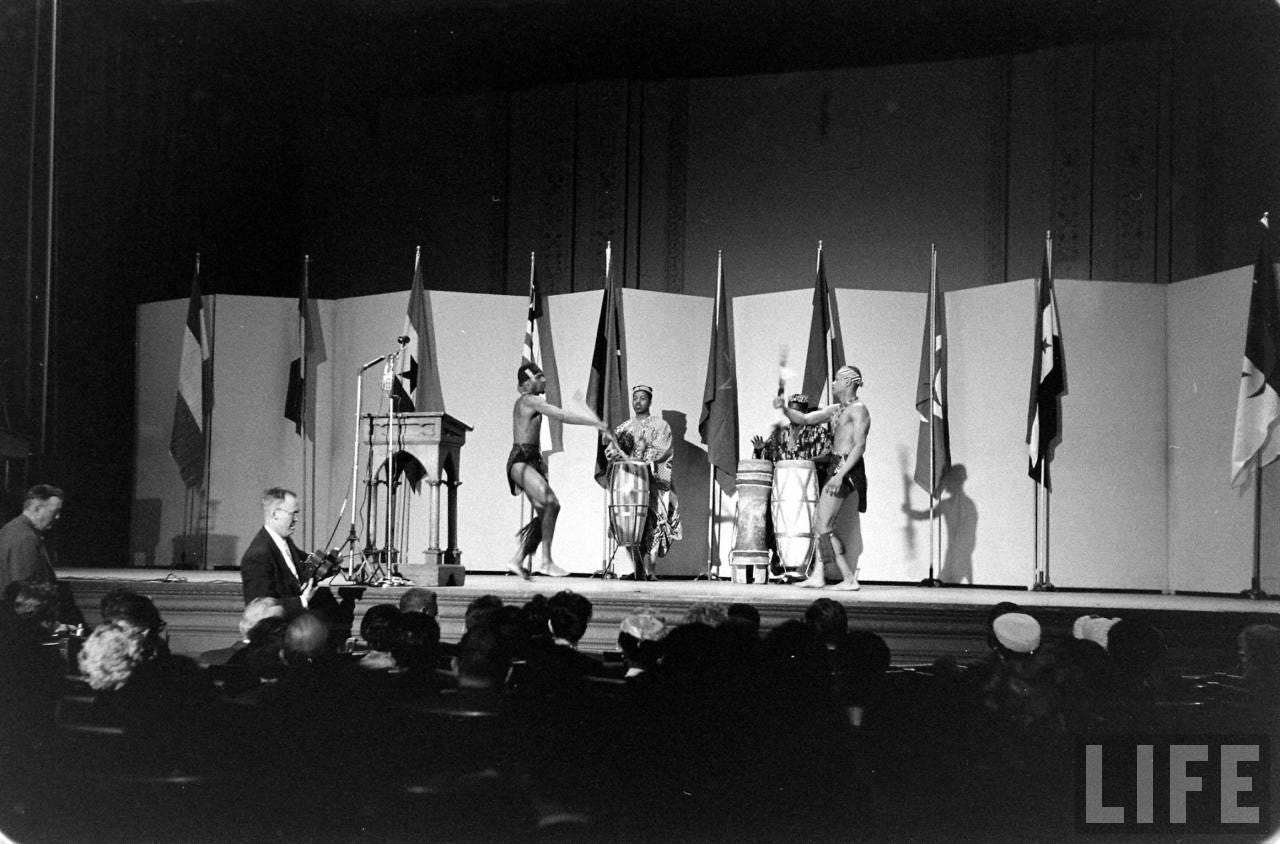
Kenya’s Tom Mboya, of the “Kennedy Airlift,” also known as PROJECT AIRLIFT-AFRICA, was funded directly by the AFL-CIO (2017) and by the CIA-AALC through its founder Irving Brown, who has been severally identified as a funnel for CIA cash to Mboya (CIA), (Wilford 2008), (Morris 1967), (Schuhrke 2024).
Mboya was groomed from the start by the CIA as an “anti-communist” alternative to explicitly pro-Soviet African labor leaders, working directly and intimately with Lovestone’s ICFTU. To be clear, whether it was widely known at the time that Lovestone was working with the CIA is almost immaterial, as he was overly explicit about their labor-intelligence activities, and spoke with clear conscience of the AFL as a “revolutionary” agent of change, since at least 1953:
Much can be done on an independent basis that can-not be done through governmental representation and/or instigation. Foreign affairs at the present time require vigorous volunteer action. Such action, when taken by the A. F. of L. or the International Confederation of Free Trade Unions, in which the A. F. of L. is the largest affiliate, is contained by no rules of behavior, no tradition of methods, and no doctrinaire answers. In response to specific problems, the A. F. of L. practices trial and error, and unorthodox methods.
—declassified CIA document, Boston Committee on Foreign Relations, 1953, CIA Reading Room, cia-rdp83-00423r000200530001-0
Jay Lovestone describes these “unorthodox methods”— “to lead people to see their position as we see it; they then react to it in their own way.” He cites Irving Brown as the best example of a “direct representative” of labor’s foreign interests. When Mboya was in New York, he operated out of Brown’s offices (2011).
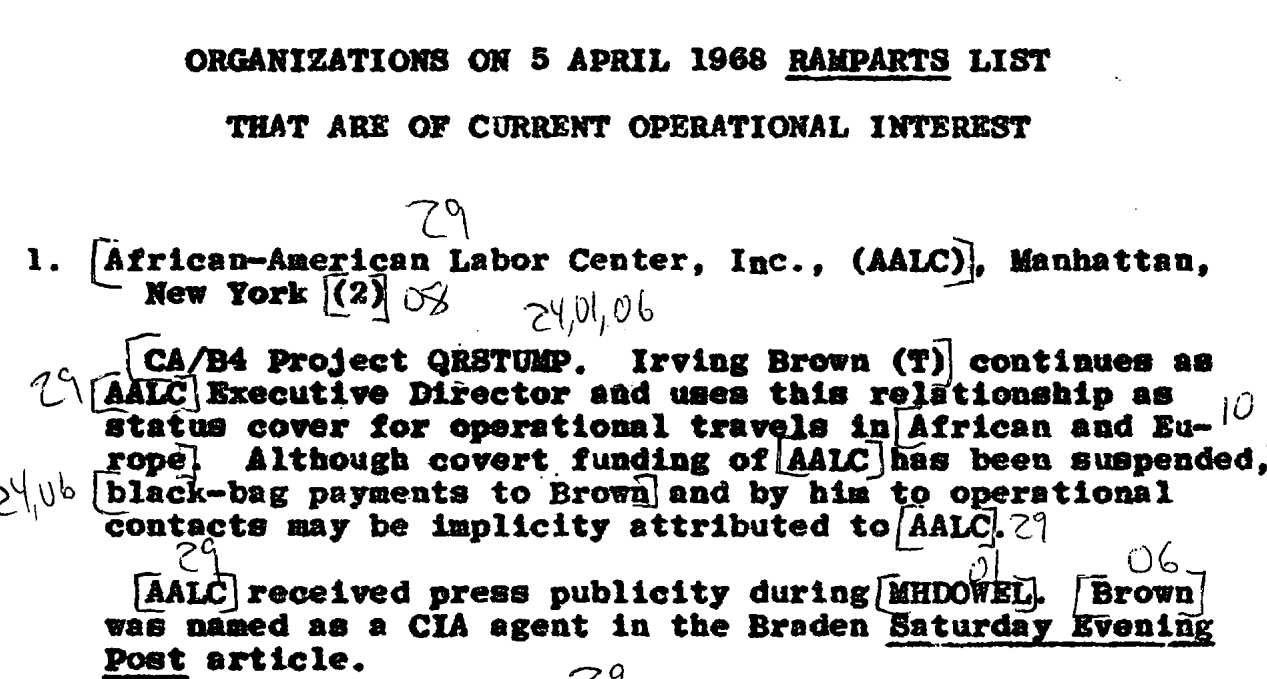
Declassified records and ex-official statements confirm that Irving Brown received millions in subsidies from the CIA’s Division of International Organizations to support “splits” in unions across France, Italy, Greece, and Finland. (NYT), (See also The AFL-CIO Has Its Own CIA, 1966).
Mboya’s earlier 1950s publicity circuit in the US, the later airlift tours, and the student scholarship programs were, in fact, built on Brown’s intelligence work (Horne 2009), (Carew 2018). For his part, Kheel was co-founder and board member of the African-American Students Foundation (AASF), the organization that collaborated with Mboya to run the Mboya-Kennedy student airlifts (1959–1963) delivering a payload of 778 Africans, mostly from Kenya. Keel acted as the event organizer for Mboya’s American tours (NYT) and would even, with Mboya in tow, testify before congress, asking for money, basically acting as a lobbyist for the AFL-CIO (1961).
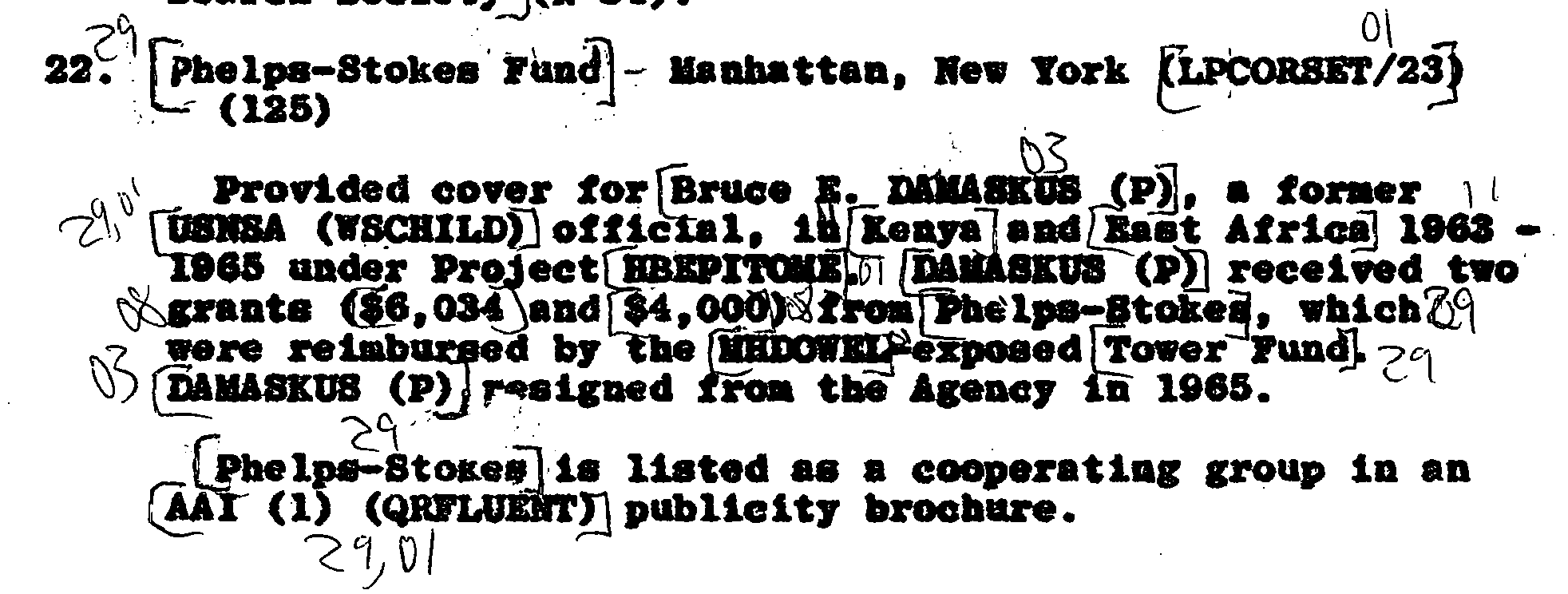
The AASF was vitally sustained, financially and institutionally, by the Phelps-Stokes Fund, listed in recently declassified documents as a “witting organization.” At least two partner organizations in the airlift were CIA cut outs: the Institute for International Education (an “unwitting” recipient of cover grants, QKOPERA) and the African-American Institute (a “witting” division project, or “action-organization,” under QRSTUMP, a still mysterious cryptonym used in context with Irving Brown) (BV).
Kheel’s airlifts were also sponsored by the American Committee on Africa (ACOA), which recent scholarship — including Frances Stonor Saunders’ The Cultural Cold War and Susan Williams’ rather vitriolic but well-researched White Malice among others —has indicated was an Agency pass through and recruitment vehicle.
Mboya would later be publicly embarrassed by charges of CIA manipulation and assassinated. Whether Kheel was “witting” or not scarcely matters. This locates his milieu, a place where his former associates end up shot in the street or mysteriously burnt to death.
Kheel’s other Automation House project was the “Institute of Collective Bargaining and Group Relations,” founded to “improve the art” of mediation, as he told the New York Times, with a focus on racial matters and community disputes, because “there is a need to develop methods for resolving such conflicts, which are not susceptible to solution by legislation. This is one of the pressing problems of our time” (NYT, emphasis added).
The institute was helmed by Lane Kirkland, then executive assistant to George Meany, president of the AFL-CIO. Meany was a co-investor in Kheel’s luxury resort in Punta Cana in the Dominican Republic, along with Alexander Barkan (director of AFL-CIO’s lobbying unit, COPE), Lane Kirkland, the AFL-CIO secretary-treasurer, and Harvard labor academic John T. Dunlop, who would become secretary of labor (NACLA 2016), (NYT 1974), (NYP 2008).
In 1976, an Argentine banker and client of Kheel’s, David Graiver, bought shares in Punta Cana on credit, used them as collateral to borrow $2 million, and disappeared in the crash of a private jet in Mexico. When his body was not recovered, a special grand jury in New York indicted him for looting $50 million from the American Bank & Trust. (NYP)
Gravier oversaw the financial operations of Montoneros terrorists and administered the underground funding needs of Argentine naval generals, allegedly under the influence of the Propaganda-2 Masonic lodge. (Nailor 2004),(Clairin 2018), (Cersósimo 2022). Like Safra, he died amidst speculation of assassination.
To put all this in context: by the time the Civil Rights Act was signed in 1964, decades of Cold War glaciation had utterly terraformed the civic topography; the encroaching military-intelligence complex aside, labor organizations such as the American Federation of Labor-Congress of Industrial Organizations (AFL–CIO) were positioned as “anti-communist bulwarks.” The labor organizations had its own “international affairs” department, waged total labor-intelligence warfare and partnered with the CIA, and both were integrated into the State Department’s broader social-scientific programs to accelerate the decolonization of the Third World during the 1950s and 1960s.
The AFL–CIO, the largest federation of unions in the United States, representing 13 million workers, and its history of covert action has been empirically established and shows that the organized labor-minority has sought to dominate foreign labor movements since the early years of the twentieth century (1900-1910s). It clearly shows that Labor’s foreign policy leaders voluntarily acted as conscious agents in major U.S. covert operations, and in helping to overthrow democratically elected governments. In short, the AFL-CIO has its own imperial project, commonly called “labor imperialism,” and it arises from within the labor bureaucracy itself, from within the AFL-CIO, not from external actors such as the U.S. Government, the White House, and/or the U.S. Central Intelligence Agency (2011) (Filippelli 1989).
There is a myth that this imperial project of the CIA/AFL-CIO “suppressed the global left.” This is an inversion of reality. In fact, it has a long record of massively funding technically “non-communist,” yet radically socialist parties and unions, such as the Italian Socialist splinter PSIUP, and, through the OSS/CIA conduit FTUC, the French Force Ouvrière, ostensibly to split the labor movement away from pro-Soviet communist parties.
They’ve supported unions such as the UIL (Unione Italiana del Lavoro), co-founded by former Partito Comunista Italiano (PCI) militants, including its first secretary-general Italo Viglianesi, who ran operations with PCI radicals while receiving millions in covert funds. Josip Broz Tito’s Yugoslav communist revolutionary regime, the “Titoists,” were kept afloat by Western aid after the 1948 split with the Soviets.
Throughout the Cold War, to help promote “industrial democracy” and to oppose the Soviet Comintern-directed communist parties, the CIA/AFL-CIO’s most dominant strategy was to “split” off all these various leftist unions, no matter how radical, from the Soviet-infiltrated communist labor groups. This included grooming and massively funding far-left socialist “labor media” intellectuals, journalists, and publications in Poland, the Nordic states, across Western Europe, Central and South America, and Asia.
If anyone says “CIA oppressed the international left,” they are saying that international leftism is identical to actively pro-Soviet Bolshevik communism.
Indeed, as they say, the AFL-CIO never lent support to formally, vocally pro-Soviet communist unions, but it has, in addition to supporting “reactionaries,” repeatedly backed self-identified Marxist, radical socialist, or “ex-communist” (we promise) agitators and unions as long as they publicly disavowed Moscow or Chairman Mao, or were at least anti-local revolutionary Left.
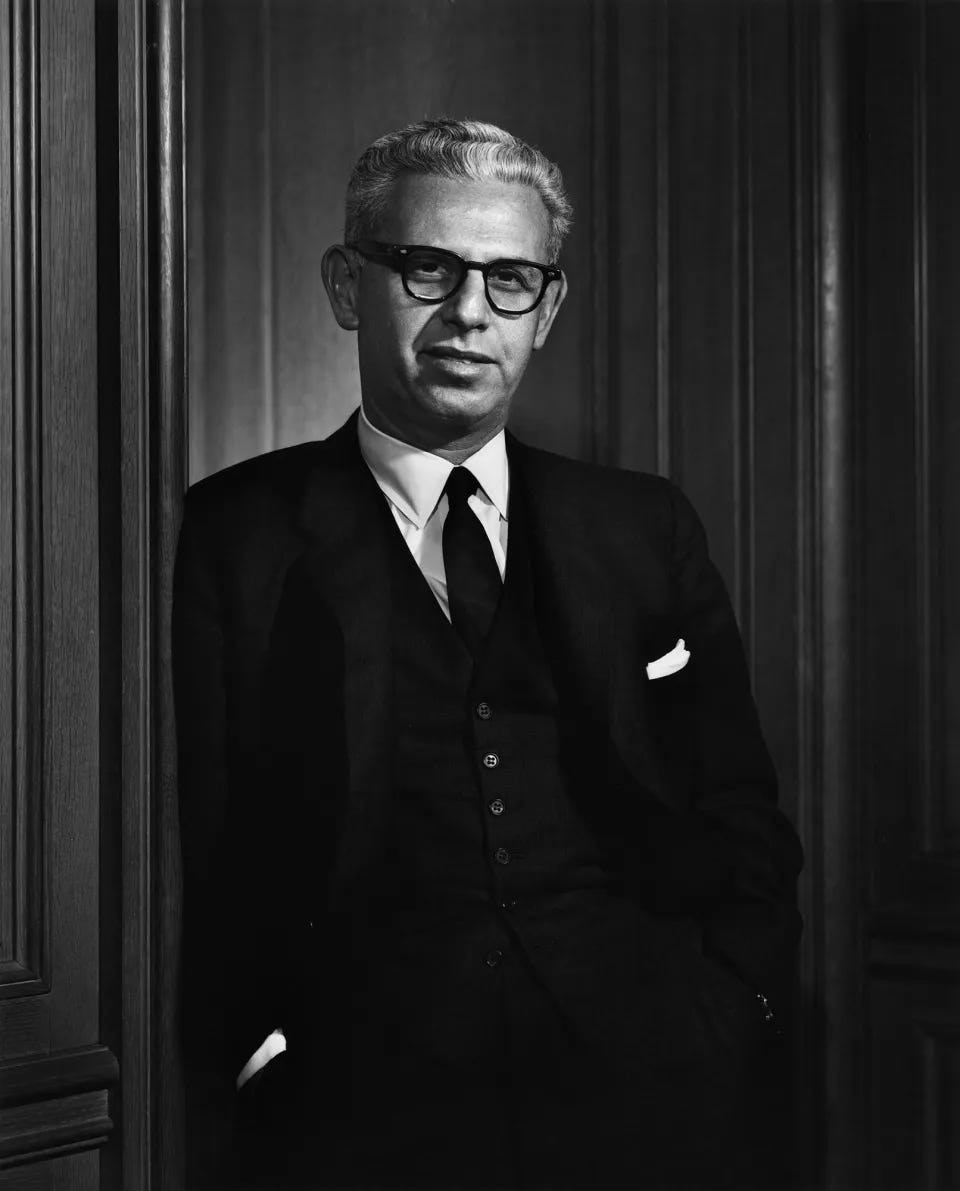
The gold standard for such “strategic scripting” was set by Arthur Goldberg, the ostensible legal genius behind the Community Relations Service. Goldberg had been a member of the British intelligence front “White Committee” that had broadcast false signals of popular support for aiding Great Britain and helped push the US into the war against Germany. This made him an old hand at simulating popular movements (Mahl 1998), (Laurie 1996).
The Committee to Defend America by Aiding the Allies (CDAAA) functioned as a cut-out for British Security Coordination (BSC) inside the United States during the early phase of the Second World War. The Committee routed funds and messaging into WRUL, a short-wave station that served as a transatlantic relay for propaganda broadcasts. It also participated in a network of British front organizations that underwrote opinion research through BSC-directed Market Analysts, Inc., which was able to simulate a large pro-intervention public inside the dubious construct of “neutral polling.”
The Committee’s William Allen White News Service, run by journalist and playwright John Balderston from offices in Rockefeller Center, shared floors, back corridors, and operational space with BSC headquarters and an array of other British fronts— it was all publicly respectable, and plausibly deniable.
“It would be most disastrous to the William Allen White Committee were it ever to be established that it was communicating and collaborating with any branch of His Majesty’s Government.”
—Philip Henry Kerr, 11th Marquess of Lothian (Mahl 1998).
In 1947, Goldberg, in addition to his other OSS Labor Branch adventures, helped to engineer a split in the clandestine union, French Confédération Générale du Travail (CGT). The CGT was composed of a socialist majority and a communist minority, which began a campaign to seize control of the organization. The communists insisted that the covert funds be divided between the factions, and when OSS refused, the operation was publicly exposed in the Communist press, making Goldberg’s activities known to the Gestapo.
Nevertheless, by drip-feeding money, Goldberg and the FTUC were able to bring about a split of one-fifth of the CGT’s membership, which went on to form the socialist Force Ouvrière, receiving $5,000 every three weeks from the AFL, not counting the money it got from other US government subsidies.
To assist with counterintelligence in these operations, former members of the Abraham Lincoln Brigade were recruited by William Donovan, tapped for their guerilla expertise, with several of them active members of the US Communist Party (CPUSA). After the war, the survivors formed a CPUSA front known as the Veterans of the Abraham Lincoln Brigade (VALB), led by identified Soviet spy Steve Nelson (1963).
In 1944, a Soviet espionage cable intercepted and deciphered as part of the VENONA project reported a list of OSS employees suspected by American security officers of passing information to the Russians and being members of the Communist Party, including one “Major Arthur Goldberg” among others (2011). The cable, dated 22 September 1944 and sent from the KGB station in New York to Moscow, detailed an internal OSS security review, and the NSA redacted all names but one in its public release, leaving only “Donald Wheeler” unredacted due to his already being confirmed as a Soviet agent.
Despite compulsory efforts to cast Goldberg’s redaction as a testament to his “anti-communist” credentials based on nothing but tea-leaf reading, the redaction of his name is in total symmetry with the OSS/NSA record of tolerating the most egregious reds imaginable and occluding the communist inter-penetration in US intelligence.
In addition to his experience with labor-intelligence, Goldberg came from the Chicago school of “racial communism,” and had sponsored several CPUSA fronts there. These included the Chicago Conference on Race Relations, the Conference on Constitutional Liberties in America and the National Emergency Conference, American Youth Congress among several others (FBI).
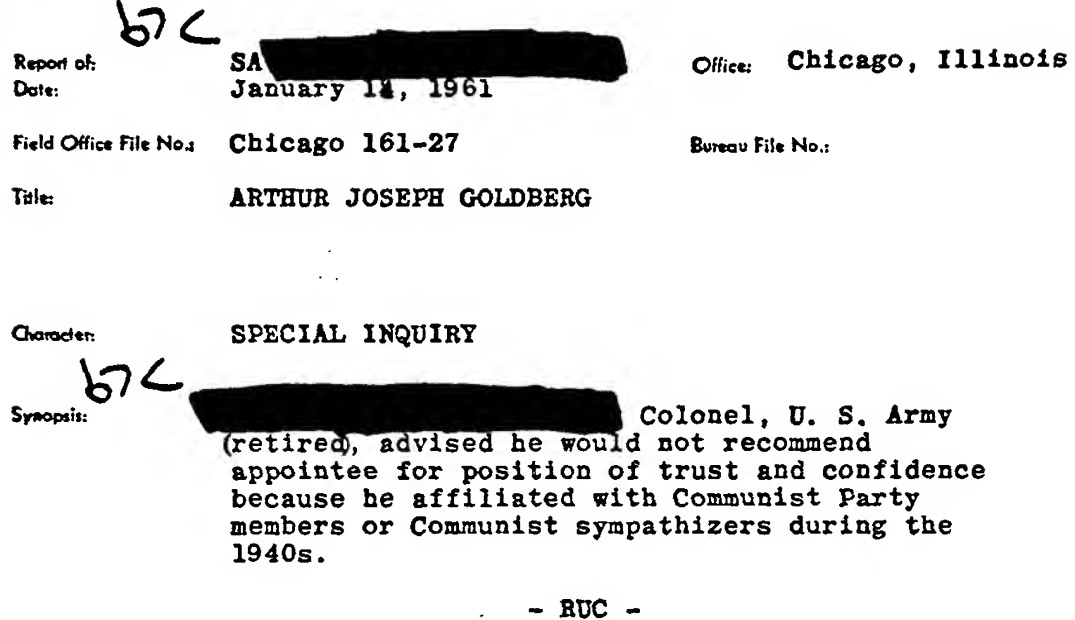
His FBI file is filled with reputable sources saying he was a communist, and he was president of the Chicago chapter of the National Lawyers Guild, known for decades to be “the foremost legal bulwark of the Communist Party”(Gannon 1969). However, it was never established that he was a “card-carrying member,” which, laughably, became the standard for proving someone a communist in the post-McCarthy era. In true New Dealer fashion, Goldberg later remained affiliated with CIA pass-throughs and recruitment bases such as the Carnegie Foundation for International Peace and the World Affairs Center. His career exemplifies the imbrication of communist influence and intelligence operations within the New Deal establishment.
Goldberg, like Saposs, was an opportunistic turncoat and would be instrumental in merging the American Federation of Labor (AFL) and the CIO in 1955, and in expelling from the general labor movement all the various unions supposedly dominated by ideological communists, or rather, dominated by his political rivals.
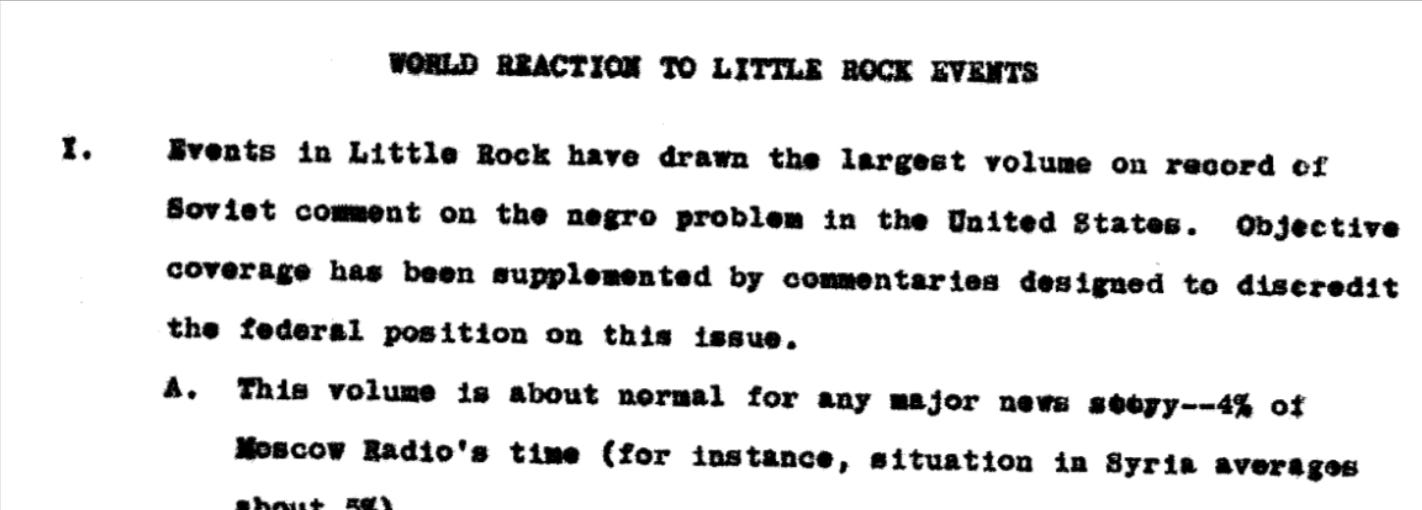
What all this achieved… the real outcome of the Cold War “anti-communist bulwark” strategy…. this courting of radical socialists to “split” them from formally Soviet front parties…. was the dispersal of billions of dollars and infinite labor-intelligence resources into the global left, massively fortifying international socialism. Ultimately, it entrenched an expansive network of funding mechanisms, intellectual recruitment and captured institutions for the radical left. The security state’s high modern, multi-decade social engineering project virtually guaranteed total leftist dominance.
Perhaps the most poignant to our concern in these games Operation Gladio (the NATO stay-behind network) and the Years of Lead in Italy (‘70s–’80s), when the CIA infiltrated Marxist Red Brigades and far-right reactionary groups, perpetuating false-flag operations under the “strategy of tension” to provoke chaos. Former defense minister Paulo Taviani told a magistrate that during his time in office, “The Italian secret services were bossed and financed by ‘the boys in Via Veneto’” - i.e. the CIA in the US embassy in the heart of Rome. Giandelio Maletti, a former secret service general, said “The CIA, following the directives of its government, wanted to create an Italian nationalism capable of halting what it saw as a slide to the left, and, for this purpose, it may have made use of right-wing terrorism” (Rowse 1996).
The next time you ever feel crazy for sensing that a particular “mass casualty event” seems vaguely artificial, remember that in Italy, a first world country, the historical center of European civilization, all major terrorist operations from the 1960s to the 1980s were conducted in collaboration with US intelligence.
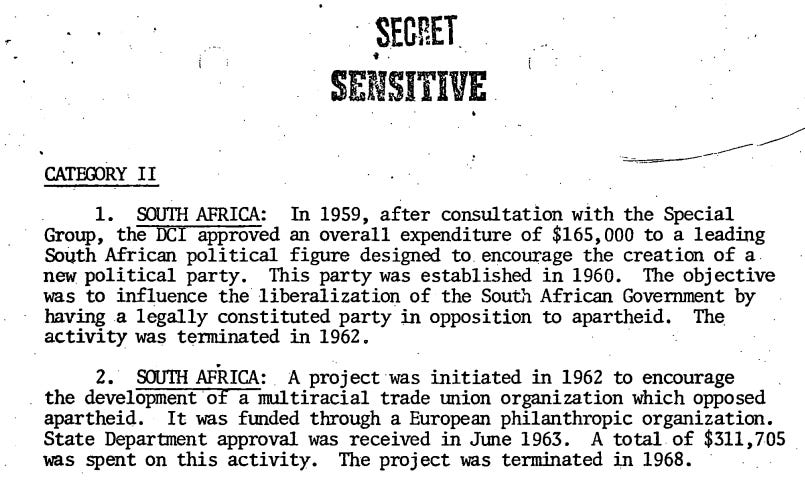
The most baffling “right wing CIA” distortion is their alleged support for South Africa’s apartheid government. The left-liberal dispositive almost frantically asserts, based on the most minimal of documentary evidence and vague rumor, that the CIA was pro-apartheid. Meanwhile in primary documents:
1. SOUTH AFRICA: In 1959, after consultation with the Special Group, the DCI approved an overall expenditure of $165,000 to a leading South African political figure designed to encourage the creation of a new political party. This party was established in 1960. The objective was to influence the liberalization of the South African Government by having a legally constituted party in opposition to apartheid. The activity was terminated in 1962.
2. SOUTH AFRICA: A project was initiated in 1962 to encourage the development of a multiracial trade union organization which opposed apartheid. It was funded through a European philanthropic organization. State Department approval was received in June 1963. A total of $311,705 was spent on this activity. The project was terminated in 1968. (104-10400-10311)
That’s a total of $3,343,872 in today’s money, a kingly sum, and that’s just what is admitted to in this one document; such accounting never includes “black bag” cash infusions or other subsidies. The engagement of the Agency’s full funding network of “witting” and “unwitting” foundations always involves a lot of grey areas. The totality of sympoietic threading, sheathing, tangling, if quantified, is likely in the 10s of millions.
Broadly, the New Deal security apparatuses were tactically anti-communist but strategically pro-socialist, pro-global welfare state, anti-colonialist and anti-sovereigntist. The beast slouches toward a gradualist, Wellsian, world welfare state; these labor-modernization projects of the CIA/AFL-CIO were an effort to remove the last tyrant from the world—the atavistic “sovereignty of the masses.” The ideology of the modern state is “administrative collectivism,” which looks almost exactly like Soviet Communism, because “Soviet Communism” wasn’t real. There have been no ideologies since the end of the last European civil wars; everyone is a technical-materialist, a slave of technique.
Even “race communism” is only a tool of deformalization; the real players do not intend to be held hostage by their own bioweapon, a tool that is meant to be applied selectively, against the middle class, or any adversarial guild of men. Mediation is part of a cyber-alchemical, transformative process that requires shifting away from legal definition, into an off-the-books, consensus-building ritual. Its subtil separation keeps the hidden.
“Social justice” is a form of “shadow justice,” a kind of séance summoning an acephalic, phantom order:
Challenges to the use of labor-management mediation techniques in the area of community conflict came from those who believed that statutory provisions in the 1964, 1965, and 1968 Civil Rights Acts should be the principal guidelines for resolving community disputes involving racial conflict (Blumrosen, 1972). These statutes established rules for decision making, while labor-management does not. To introduce labor-management mediation in this area, Alfred Blumrosen argued, was to undermine the efforts of the civil rights movement to mobilize legal resources for their political battles and erode the legal protections against racial discrimination and the remedies for those discriminated against.
—Shadow justice : the ideology and institutionalization of alternatives to courts, Harrington, (1985)
Labor-mediation technique represent the abolishing of the rule of law, an occulting of hierarchies and inherent divisions of interests.
“No rules govern mediation. It is instinctive and intuitive rather than scientific.”
—Theodore Kheel (1957)
In phantom governance, the preferred democratic mode is the “métapsychorraie,” defined as a socially active, decentralized psychic outflow or hemorrhage, an outrage, a riot, a fandom, a collective psychorrhagia that may generate subtle, ephemeral effects, such as symbolic sounds, tactile sensation (e.g., pseudo-communitas, vague sensations of solidarity, welfare, identity), or the door-knock of appeasements, but will never interfere with the machinery of power.
This phantomized state induces in the population hallucinations of “collective interest,” often with the assistance of visionary media, and elicits certain perceptions of living apparitions, a true belief in political holograms like Eisenhower or Obama, which are nothing but ideoplastic extensions projected by oligarchic interests.
“True representation, … like true association, is always specific and functional, and never general and inclusive. What is represented is never man, the individual, but always certain purposes common to groups of individuals. That theory of representative government which is based upon the idea that individuals can be represented as wholes is a false theory, and destruction (sic) of personal rights and social well-being.”
—G. D. H. Cole, Social Theory, (1920) [Cole, and the Guild Socialists, were contemporary enemies of the Fabian Society]
The first chair of the tripartite War Labor Board representing “the public,” William H. Davis, was a member of the Council on Foreign Relations, chairman of the Twentieth Century Fund Labor Committee, served as chairman of the New School of Social Research and was active in the Cornell Labor Relations Institute (WHS), the latter two vitally sustained by the Ford Foundation (FF) and the Rockefeller Foundation (RF).
The New School established the “University in Exile,” funded by RF and Hiram Halle, to provide a haven for fleeing Weimar degenerates. The Twentieth Century Fund (TCF) exhibited pronounced, verifiable Fabian symmetries, acting as a primary conduit for Fabian socialism in the United States, including for instance, under director Evans Clark, vitally sustaining the work of Stuart Chase.
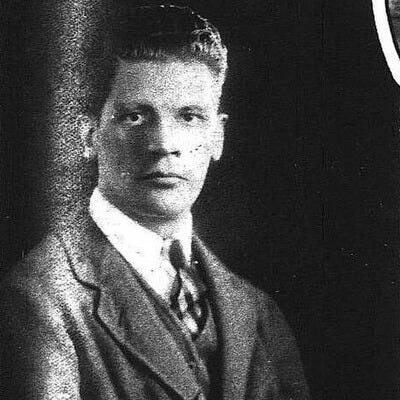
In brief, Stuart Chase, a prominent New Deal campaigner and social engineer, had his ideals profoundly influenced by Fabian socialism, as evidenced by his founding of the Fabian Club of Chicago. Chase would later serve as president of the Ann Arbor chapter of the Intercollegiate Socialist Society, again, demonstrating the informal symmetries7. Deeply influenced by Thorstein Veblen of the Technocrat Party and Fabians such as Sidney Webb and George Bernard Shaw, Chase popularized the “managerial socialism” that significantly influenced the New Deal, an amalgam of Marxist, Fabian Socialist and Technocratic ideas.
Chase publicly lauded the Soviet Gosplan, asking, “Why should the Russians have all the fun of remaking the world?” and coined the phrase “New Deal” in his 1932 book of the same title, and would later serve as an advisor to President Roosevelt. As director of the Twentieth Century Fund from 1928 to 1953, Clark financed the publication of New Deal, which outlines a gradualist social revolution via peaceful means, drawing heavily from the Fabian Sidney Webb’s “Labour and the New Social Order.”
In addition, Chase wrote The Proper Study of Mankind (1948), at the instance of Donald Young, then of the Social Science Research Council (SSRC), a Carnegie Corporation cut-out staffed with former Office of War Information (OWI) and OSS officers. The SSRC was deliberately reconstructed in the post-war period by William Donovan to be an organ of policy propaganda and social engineering research.
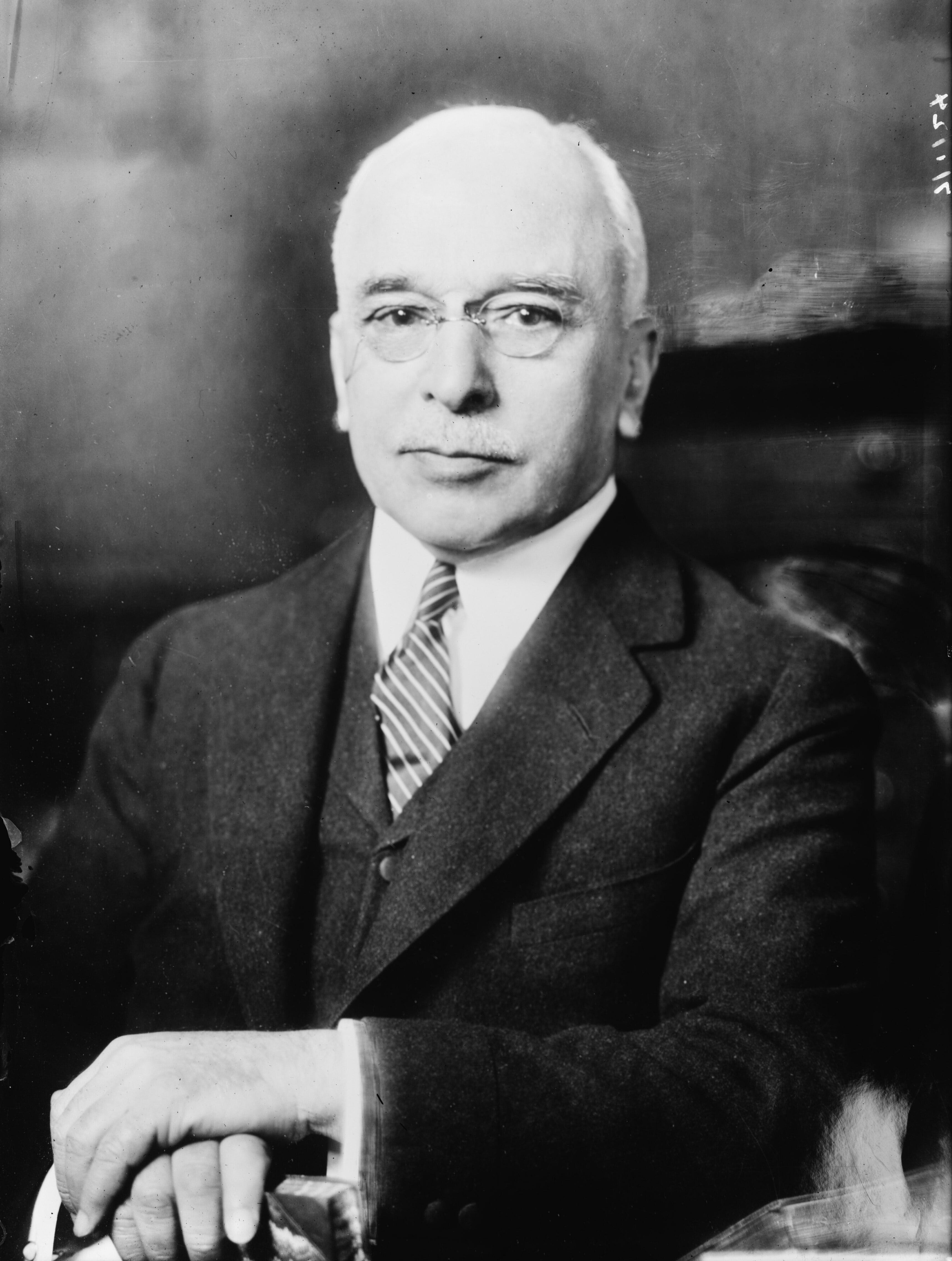
The TCF was also major contributor to the Carnegie-controlled SSRC. The primary focus of the fund was increasing consumption: “Mass production has made mass distribution necessary”, asserted TCF founder, department store tycoon Edward Filene in 1927. He was building, as Filene once observed of his own Boston store, “an Adam-less Eden” on a national scale. Filene believed that only an empowered “consuming public,” operating through decentralized (Adam-less), “democratic institutions” could effectively restructure the nation’s political economy (Roelofs 2003). Filene, a “corporate liberal” and an outspoken crusader for the New Deal, was in symmetry with Stuart Chase because the Fabian socialist believed the consumption of material goods was the only basis for the production of social facts (Westbrook 1980).
In order to unify disparate parts and organize a mass market cyborg economy, Americans had to be educated, or rather, “socialized,” into the American identity shaped by industrial fakelore and Hollywood cinema, but above all else, by the consuming personality itself; the Ameri-mass must learn the occult art of self-propagating auto-propaganda called “consumer identity,” and normalize the psychic disturbances in a personality subject to a mass market mediasphere.
To ensure that people became “immune” to formal propaganda, Filene issued grants to the Institute for Propaganda Analysis (IPA), providing his all-consuming public lessons in media literacy (he is actually credited for creating media literacy). The object was the “educated consumer,” and much of the content focused on advertising tricks like “glittering generalities.” His IPA was sending its own “anti-propaganda” into high-schools, and like modern high school education is conditioning for productive mobility, IPA material, as far as Filene’s interests were concerned, were meant to provide a consumer mobilization that would “tranquilize working-class militancy” (2001).
When Filene convened the inaugural IPA meeting on “education for democracy” and invited the social constructivist Alfred Adler, Edward Bernays and later added to the board the SSRC social engineering veteran James T. Shotwell and the scientific managerial Percy S. Brown, he was not, in fact, “educating” but re-educating the public. Teaching people a handful of tricks is not drawing out the powers of the mind; his object was changing sociopolitical behavior.
Widespread within the socially oriented literature of business in the twenties and thirties is a notion of educating people into an acceptance of the products and aesthetics of a mass-produced culture. Industrial development, then, became far more than a technological process, but also a process of organizing and controlling “long pent-up human impulses” (Filene) in such a way that these impulses might serve to provide social underpinnings to the industrial system.
—Captains of Consciousness: Advertising and the Social Roots of the Consumer Culture, Stuart Ewen, (2001)
After all, Filene was a department store tycoon, and wasn’t selling a certain product, he was selling “shopping” as a modern enchantment, a new mode of being. Everything he did was toward the cultivation of decentralized consumer beings, homo creditus, including his invention of the credit union and writing his thesis on a plan to establish a chain of cooperative department stores. The goal was mobilizing the consumer instinct, and transforming the phantom dimension of advertising into a “world of facts,” by instilling consumers with a cheap, artificial skepticism. He was, in reality, stifling a revolt against the materialist, consumerist ontology. In sum, with his prescient understanding of psycho-politics, he wanted to teach Americans to guard the doors of their own haunted madhouse.
Filene, prophesied in 1936:
What is needed is that the American masses shall learn the art of constructive self-government in this machine age – in this age in which life is no longer organized on a small community pattern but in which all Americans are more or less dependent upon what all other Americans are doing.
In other words, Filene’s “consuming public” with its synthetic identity shall become a “collectivized construct.” Americans will learn the art of a new communal pattern, that of an amorphous all-consuming super-organism, and then, as Filene implies with his support of the League of Nations, a global super-organism. Filene rendered this in axiom: “Mass production demands the education of the masses, the masses must learn to behave like human beings in a mass production world.”
Incidentally, the director of the Twentieth Century Fund from 1957 to ‘67 was one August Heckscher, scion of a millionaire industrialist, who had left a position in the Political Science Department at Yale to join the OSS Foreign Nationalities (Smith 1972). The previous director, from 1928 to 1953, was Evans Clark, a founding member of the Intercollegiate Socialist Society (ISS) in 1905, serving on its national executive committee. The ISS renamed itself the League for Industrial Democracy (LID) (“America’s Fabian Society”) in 1921 and Evans served as the first vice president.
And there you have the “Twentieth Century Fund,” a blend of merchant wealth, social engineering, OSS psywarriors, Fabianism, psycho-politics and Marxism… mediated together …a fund for a modern age of collective transactions, a novel approach to the social construct, a sort of “New Deal,” if you will.
These New Deal systems formed a cabal of producer interests— producers of governance, goods and facts, in conspiracy against the nation of individuals, against the Republic, now rendered down to an all-consuming Ur-public.
William H. Davis’, the first steward of “public interest” on a tripartite “collective bargaining” panel, his decidedly Rockefeller-TCF interests aside, would also take part in the little known “Kheel Committee” (WHS), otherwise styled as the “Lawyers Advisory Committee on the Alabama Libel Suits,” a group of lawyers led by Ted Kheel who fought to help Martin Luther King, Jr. when the state of Alabama took him to court. The organizational meeting for the committee was held in the lavish Lotos Club.
New Dealers like Davis were a typical representative of “the public interest” on tripartite councils. Corrupt, foundation-aligned, influence peddling, activist lawyers; the amoral enforcers of the New Deal moral economy:
The lawyers [of the Kheel Committee] represented a broad cross-section of the New York bar; “Protestants, Catholics, and Jews, Negroes and whites, Democrats and Republicans,” Kheel told the press. One of the volunteers was William Rogers, who ran his own law firm, Rogers & Wells. Rogers had just spent four years as attorney general under President Eisenhower and was involved in federal efforts to enforce integration, including intervening in the Little Rock crisis … He saw his involvement in the libel suits as the “continuation of a struggle” that he had been involved in for eight years. (Barbas 2023).
“Community interests” do not exist, and there can be no union of discrete interests, certainly not with discarnate corporations and foundations. The tripartite “collective bargaining” council is a crucible for isolating and elutriating the fine fraction of mass man, the crew chiefs and charismatic leaders of unions, and alloying those fractions into a distinct amalgam, a corrupted, cyber-alchemical marriage. The militarized tripartite councils, dominated by AFL-CIO ghouls, Kheelian creatures and mob-affiliated union leaders, with their confidential, closed-door mediations, are, by definition, ephemeral media rituals.
In practice, collective bargaining is a system of fact production that is both ephemeral (off-books) and black boxed. It is a media event that gives inordinate power to a mediator, the third man in conflicts.
The real process of labor-mediation— dissolve, separate, hide; join them in mercury. The folie à plusieurs of the Fabian “industrial pluralism” or “democracy of producers” will always operate in favor of managers in accordance with a very simple occult principle— there is no “democracy” in any secreted consensus-building ritual; there is always a Power or Authority that structures the proceedings, usually hosted in a man with great charisma, a man such as Ted Kheel. Labor-mediation, forced into civil contexts, is a social transformation technology.
So the heat working upon and against the radical metallic viscous, or oily moisture, engendereth upon the subject blackness. For at the same time the Matter is dissolved, is corrupted, groweth black, and conceiveth to engender; for all corruption is generation, and therefore ought blackness to be much desired; for that is the black sail with which the Ship of Theseus came back victorious from Crete…”
—Nicholas Flammel : his exposition of the hieroglyphical figures, (1890)
Their Names May Be Suspect
Most historians of the CIA frame its support for the civil-rights movement as a simple counterweight to Soviet propaganda that depicted the United States as a mad octopus draining the life force of black Americans. Just a normal realpolitik propaganda war. However, back in reality, the CIA were creating their own “communist front” agitation groups that were identical to the real thing in objective and effect. It seems America won the Cold War by doing exactly what Moscow wanted.
For instance, the actions of the CIA cut-out “National Student Association” (NSA) were so identical with Comintern objectives that J. Edgar Hoover wrote to a lieutenant in March 1960, “I think we had better take another look at this outfit. It is inconceivable that a group with such parallel goals as communist front groups could be so ‘legitimate.’” He also began eavesdropping and surveillance of the SNCC, one of the NSA subgroups that would later evolve into a Castroist black power terror group involved in the late 60s “days of rage” riots throughout America (Paget 2015). And Hoover was right to do so:
“We are moving toward guerilla warfare in the United States. We are going to develop urban guerilla warfare and we are going to beat them in this field because there is one thing the imperialists do not have: their men don’t want to fight... Urban guerilla warfare is the only means by which we can win in the United States because they cannot use bombs against us, since we are inside their country. They will have to fight us in hand-to-hand combat and we will defeat them.”
—Stokely Carmichael, Chairman of the Student Nonviolent Coordinating Committee (SNCC), stated in a 1967 interview in Havana, Cuba
Consular reports from the 20s-30s show the Comintern was massively focused on “the negro question,” and by the mid 1950s, over two decades of reports from Soviet defectors had consistently reported that the OGPU/NKVD had a major interest in subverting and weaponizing the “black belt” in America — including, in several accounts, agitating for a separatist “Soviet Negro Republic” or a “Negro Autonomous State” within the United States. The report states: “The Comintern has organized at Moscow courses extending over several years for the training of Negro Bolshevik agitators of American origin. The first team returned to the United States in 1927. (Dossier “Negro Question” of the Permanent Bureau of the International Anti-Bolshevik Entente)” (1930).
It was know that Russian intelligence historically exploited racial tensions among the black community in the interwar period through CPUSA fronts like the American Negro Labor Congress and the League of Struggle for Negro Rights. Their aim was to radicalize black populations and undermine U.S. cohesion by promoting concepts such as self-determination in the “Black Belt” southern states (Racial Conflicts Created by the Russian Security Authorities in the USA, Wojnowski, Page 15-17).
The task of the Communists among the Negro workers is to bring about class consciousness, and to crystallize this in independent class political action against the capitalist class; to take every possible advantage of occurrences and conditions which will tend to develop race feeling with the view of utilizing racial antagonism. At every opportunity the attempt is made to stir up trouble between the white and Negro races.
The Negroes are made to believe that the Communists practice complete racial and social equality and that only when a Communist Government is set up in the United States will the Negroes obtain equality and freedom from exploitation by the ‘white bosses,’ and in order to attract and impress the Negro, the Communists make a point of encouraging mixed social functions where white women Communists dance with Negro men and white men Communists dance with Negro women. It is openly advocated that there must be complete social and racial equality between the whites and Negroes even to the extent of intermarriage.
—Investigation of Communist Propaganda: Report, Pursuant to H. Res. 220 – U.S. House of Representatives, 71st Congress, 3rd Session, Report No. 2290, January 17, 1931.
The CPUSA and the Comintern did not care about black grievances, they were 100% concerned with biopolitical warfare, saw the American “black belt” as a “transmission belt,” a bioweapon, and urged support for their “revolutionary possibilities” with the aim to,
“use the negro, organize him in such a fashion as to use him as a festering center of rebellion inside the larger community as a whole.”
Joseph Victor Kornfeder, Communist Party defector, (1956)
In Negroes in a Soviet America (1935): “The Soviets which will arise in the Old South will be somewhat as follows: They will arise locally, here and there, as the revolution starts, and spread as it develops further... (It will) defeat all attempts of the former... capitalists at counter-revolution.” And in the testimony of Walter S. Steele before the House Un-American Activities Committee (1947):
“There is no objection on our part to the principle of a Soviet republic for Negroes in America... We have to adopt a program that will take care of their immediate needs, of course keeping in mind the necessity for organizing the revolution... The central slogan around which we can rally the Negro masses is the slogan of social equality.”
It is the mirror image of U.S. covert labor imperialism. What all this amounts to is twin colossal squid fighting in a lightless abyss.
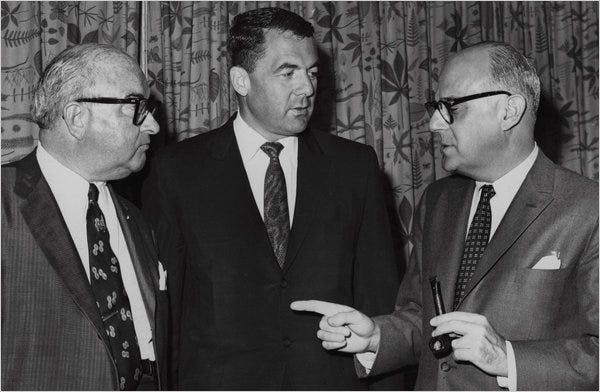
In brief, in the late 60s, the Rockefeller–Carnegie–Ford cephaloplex began to promote “alternative dispute resolution” (ADR) through social-psychology conferences that advanced tactical pluralism and a more refined, upgraded version of “collective bargaining”; these techniques were then exported to manage racial conflicts and student riots by outfits such as the National Center for Dispute Settlement (NCDS) and the Institute for Mediation and Conflict Resolution (IMCR). Both were funded by the FF and the IMCR co-founded with labor fixer Theodore Kheel.
In essence, the ideology of “alternative dispute resolution” is about de-policing, de-criminalizing and de-politicizing the anarcho-tyranny of the managerial state. For example, when reading the court documents of suits against cities that conducted these “alternative dispute resolution” (ADR) experiments in ethnic conflict, the complaints speak of murders, vandalism, shoplifting and the destruction of property. Real, visible crimes:
It appears that Deputy Mayor Robert Kiley* wants to use Paymall Shopping Center for school purposes. At one time this shopping center was in good business until the shoplifting. Now paying customers and vandalism have taken place — even a murder has taken place in this area. So one by one the merchants have closed their doors. Now it is vacant due to the atmosphere of the area, which could be considered dangerous, with very little police protection.
*[former CIA agent]
(1974) (emphasis added).
Meanwhile, the city defended its technocratic regime of militarized desegregation with the amorphous language of the helping professions, of proven “mechanisms for reducing racial tensions” formulated by the National Center for Dispute Settlement, establishing “Bi-Racial Committees” and distributing training guides in “Human and Intergroup Relations” to local community leaders (1974).
Courts are a visible medium, the documents are on record, one can read the proceedings and discover what has happened, find names and map networks. One can determine the predation signature of a “deep event” because a single person refused informal mediation and filed suit. But confidential mediations are ephemeral media, there are no stenographers in a conciliated event, everything is behind the scenes, self-effaced, auto-erasing. For the thousands of victims of forced bussing, for the subjects of an experimental social engineering project to reach arbitrary targets of “racial balance” in every school, for all the unknown number of wounded, demoralized or dead, it’s like it never happened.
In brief, the “civil rights” communist hoax and the resulting “negro rebellions” and migrations created a civilization-ending catastrophe that overwhelmed the courts and made policing impossible. The impetus to reform the police in America followed directly from the racial rebellions and radical insurgencies of the previous decade. Whether this was done deliberately or “emergently” is debatable. Regardless, the ideological project of mediation is social transformation.
Traditional boundaries, such as those separating criminal and civil disputes, broke down, as did the governmental agencies assigned to maintain them. For example, the community crime prevention concerns of the Law Enforcement Assistance Administration (LEAA) overlapped with civil justice dispute resolution such that LEAA began funding programs outside what had been traditionally defined as the criminal justice system. Indeed, it was LEAA who funded many of the early dispute programs…
—Shadow justice : the ideology and institutionalization of alternatives to courts, Harrington, (1985)

The civic apocalypse created by the hoaxers led to bizarre Law Enforcement Assistance Administration (LEAA) schemes, ironically staffed by some of the literal CIA change agents involved in the “negro revolt” in the first place, as was the case with Robert Kiley, a former CIA asset and head of the 1960s “Covert Action No. 5” or “Project 2” infiltration of the National Student Association. After his cover was blown, Kiley would formally join the CIA for a few years, then, in 1970, abruptly embark on a career in managerial science. He first worked as an assistant director at the National Police Foundation, created by the FF, which in 1970 and helmed by McGeorge Bundy.
Upon assuming the presidency of Ford in 1966, Bundy shifted the philanthropic organization’s resources toward assisting the U.S. black freedom struggle. In August of ’66, Bundy addressed the National Urban League’s (named as a communist front in multiple HUAC hearings) annual banquet in Philadelphia. “We believe,” said Bundy, “that full equality for all American Negroes is now the most urgent domestic concern of this country. We believe that the Ford Foundation must play its full part in this field because it is dedicated by its charter to human welfare” (1969 Allen).
McGeorge Bundy was the master engineer of the Cold War pipeline between the Harvard Center for International Affairs (CFIA), colloquially known as “the CIA at Harvard,” the White House, and the Pentagon; his Harvard nerve center helped produce the personnel, ideas, and institutional habits that defined U.S. Cold War statecraft. In the early 1950s, Bundy had worked closely with the CIA in arranging CIA penetration of the academia. His brother William served in the CIA 1951-61 and was the CIA’s working liaison to the National Security Council (NSC). As chair of the 303 Committee, Bundy directly coordinated the NSC-level approval process for 163 covert actions, covert and paramilitary operations. He played a central policy/oversight role in expanding the scope of psychological-warfare programs in Vietnam, for which he would later face congressional scrutiny.
FRUS documents show Bundy enthusiastically urging that PSYOP be elevated from tactical morale measures to coordinated, strategic instruments of urban messaging, rural pacification, elite persuasion, and regime-legitimacy work, including the use of innovative “strategic scripts” (predictive simulation). There is a vertiginous vortex of irony in the fact that, in 1966, Bundy was overseeing, as a CIA and military advisor, the largest anti-communist purge in history in Indonesia (1 million dead) while simultaneously supporting race-communist agitators in the United States.
The “interlock” between intelligence, the Ford Foundation (FF) and social engineering fronts goes back to the 1930s. Ford’s chairman, Paul Hoffman, a former OSS official in the late 1950s–60s, eventually set up a dedicated internal unit to channel CIA requests to the foundation and to manage the use of the foundation as cover or pass-through (Saunders 2000). This was set up at the behest of the FF and not due to any CIA “subversion” (Langenkamp 2021).
Ford began an annual contribution to support the Congress for Cultural Freedom of $1.5 million in 1966, and it was discovered that Congress was a CIA client the following year, its explicit aim was cultural influence. In the area of anti-communist area studies, Ford has acted as an extension of the OSS/CIA since WW2, giving millions to the MIT Center for International Studies, originally established with CIA funds. The FF provided $150,000 to the National Committee for a Free Europe, a CIA front that ran Radio Free Europe, to support the “Fighting Group Against Inhumanity.”
Ford’s largess extends into the depths of the intelligence world. According to David Teacher’s Rogue Agent, FF donated £20,000 to Le Cercle in the 1970s. Noted scholar of the Cold War, Frances Stonor Saunders, writes: “At times it seemed as if the Ford Foundation was simply an extension of the government … [t]he foundation had a record of close involvement in covert actions in Europe, working closely with Marshall Plan and CIA officials on specific projects” (2000).
In the late ‘60s the gaze of the security apparatus, the eye of McGeorge Bundy with his experience in “urban messaging,” turned inward, to domestic “civil disturbances,” seemingly chasing his tail as these militant movements had largely been funded and organizationally structured by the CIA and the FF, in no small part under the oversight of McGeorge Bundy himself. As Robert L. Allen, professor of Black Studies at Berkeley, deemed it in 1969, the FF was “the most important, though least publicized, organization manipulating the militant black movement.”
In 1967, the FF awarded Columbia $1.8 million as part of a $10.8 million program to endow 14 urban studies professorships across four universities, among them Harvard, MIT, and Chicago. It was framed by leftist para-politics as an effort to deradicalize the black power movement. An example of this “deradicalization” is Dr. Charles V. Hamilton, who co-authored a 1967 book with the radical black militant Stokely Carmichael entitled “Black Power, the Politics of Liberation in America.” In ‘67 Carmichael was loudly promoting guerrilla warfare and total negro revolution. Hamilton, a lecturer in the was awarded an endowed chair as Professor of Urban Studies at Columbia University by the FF.
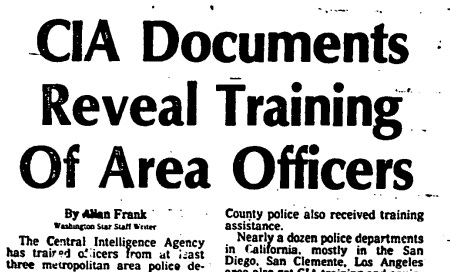
Beginning in the mid-1960s, the Central Intelligence Agency expanded its Special Division for Internal Operations (Domestic Ops) and enlarged its network of “local contact” offices around the country. Local police units attended courses at CIA training sites such as “The Farm” (Camp Peary), other Agency camps and in Arlington, VA — receiving instruction in surveillance, bomb-making and political-intelligence techniques. Kiley would recruit former CIA Robert DiGrazia and the St. Louis County Chief to join his Boston police reform experiment. Numerous former CIA staff moved into police-reform institutions and federal/state law-enforcement jobs, like Kiley’s former colleague, Mark Furstenberg of the CIA’s covert Youth and Students Branch “Covert Action 5.”
Former spooks Don R. Harris and Drexel Godfrey co-authored intelligence handbooks used by law enforcement with titles like Basic Elements of Intelligence: A Manual of Theory, Structure and Procedures for Use by Law Enforcement Agencies Against Organized Crime, which was designed to be applied to political extremists.
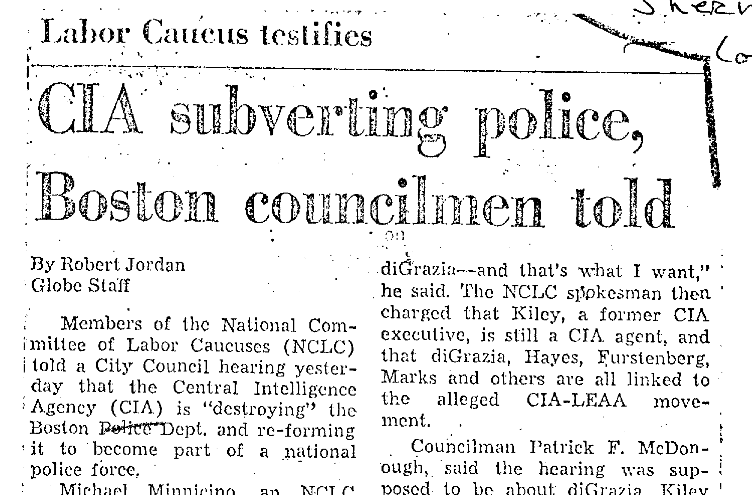
Numerous former CIA officers, like James McCord, one of the Watergate burglars, moved into police-reform bodies and law-enforcement posts, bringing their tradecraft, institutional contacts, and their counterintelligence operational mindset into domestic policing circles. This psywar miasma had a direct interaction with the Community Relations Service through the many spook-infested National Police Foundation “symposiums” where CRS agents such as Atkins Warren, Central Regional Director, appeared as speakers. Warren was a member of the Police Executive Research Forum (PERF), an offshoot of the Police Foundation.
The Police Foundation spearheaded DEI decades before it was named as such, as wells as ADR and other de-policing efforts, introducing psychiatric protocols for unmasking latent racisms, onerous rules of engagement and restrictions on police that have now led to ghettos becoming no-go zones, and, of course, CRS regularly cites their work (1987). CRS even partnered with the Police Foundation and LEAA in workshops and conferences that presented FF funded “research” like Police Use of Force that stated police killings of blacks are “manifestations of racism,” without evidence, simply because of numerical disparity.
The CRS/Police Foundation Task Force recommended restrictive policies limiting deadly force, mandatory cultural/sensitivity training, civilian oversight boards, national standards via LEAA, enhanced data collection, and “community education” to pressure officials (this is also known as “grassroots lobbying”).
Bertram Levine, a historian at CRS, was one of the first CRS conciliators who later became associate director in 1980, and was a convener of the conference on the LEAA scheme. Levine also wrote a book called The Art of Lobbying— he was a corporate lobbyist at the pharmaceutical giant Johnson & Johnson for 20 years, head of “federal relations” overseeing a team of lobbyists to influence federal policy to extend patents, opposing price control and easing safety restrictions. From The Art of Lobbying:
Certainly, other lobbying techniques—such as grassroots efforts, public relations promotions, electoral and media campaigns, and even strategic use of campaign funds—are necessary; they are often used in conjunction with direct lobbying visits.
“Why would CRS immediately hire a sociopathic lobbyist and have him act as liaison with a Ford Foundation cut out?” Another participant in the Ford/Police Foundation conference was the LEAA’s National Institute of Law Enforcement and Criminal Justice (NILECJ) and the National Institute of Justice (NIJ), promoters of “police technology.” They work with the Office of Naval Research (ONR) and the Defense Advanced Research Projects Agency (DARPA) on “crime mapping.” All this while pushing to decriminalize and de-formalize black violence. Recently, they have been funding pre-crime research, together with IBM, Hitachi, and Lexis; they have all “begun to offer ways to predict crime through data.”
Levine tells us that “the strictures of the law that created CRS and the modus operandi of the agency, which included respect for confidentiality and the avoidance of unnecessary publicity, fostered a self-effacing style of operation,” resulting in CRS becoming “one of Washington’s best kept secrets.”
This is the Hegelian alchemy of the panopticon. These actors are not “amoral realpolitik” or apolitical; they are schizopolitical, an acephalic cephalopod, a cryptid vampire-squid haunting the collective conscience of the nation. There were no “bulwarks against communism,” just as there are no anti-communists or communists in the managerial state. Out of structural and mechanical necessity, and due to the unconquerable complexity of managing a global empire, the only possible ideology of the managers is informalism, or in other terms, anarcho-tyranny.
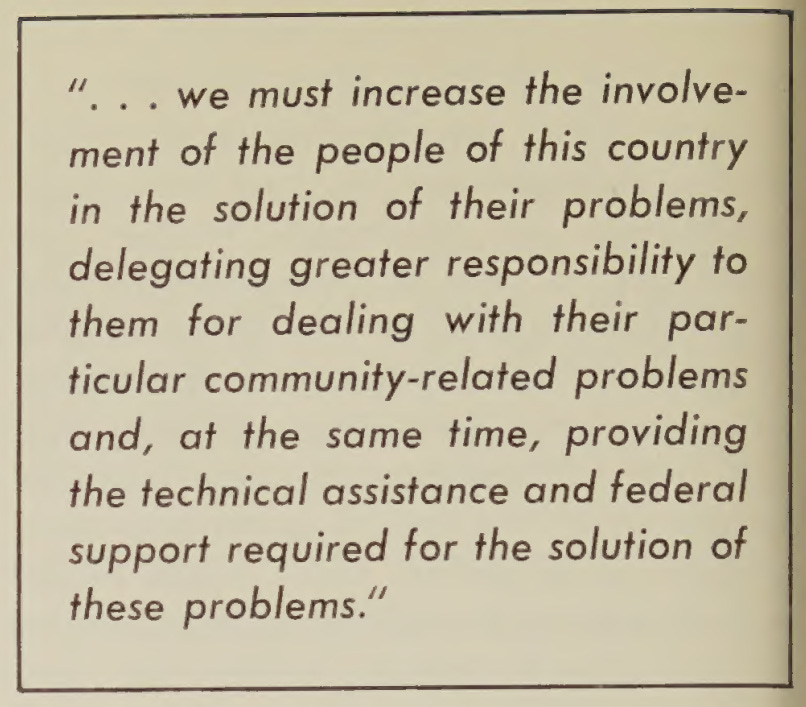
Informalism was the implicit state policy in the high modern Cold War. Take, for example, George. P. Schulz, secretary of labor, later Secretary of State, advocating for community mediation in 1969 (see above). Schulz's background in scientific management led him to provide an early conceptualization of "information technology" in manager-machine integration through his editorial and contributory work on Information Technology and Management Organization.
Schulz came out of the MIT School of Industrial Management, a development of the Department of State’s Project Troy, the formal extension of an already sprawling network of government interlocks with industrial scientists, engineers and cyberneticians that the U.S. military had nurtured during and after World War II. Project Troy, and its “political weapon system,” never ended (a bureaucratic impossibility), its components were decentralized, deformalized.
Theirs is a biomechanical intervention (Gesellschaft), rather than the effervescence of shared conscience (Gemeinschaft), wherehow informal structures and bonds of kin and kind may organize the nation emergently. The mechanical integration of disparate parts, deforming the body to attain synthetic informalism, does not produce a living nation, but a rotting political cyborg.
It is an observable fact that the more aspects of society that are deformalized, or rather, disembodied and phantomized, the more powerful and penetrative grow the tentacles of the criminal-intelligence cephaloplex, opening new opportunities for informal, or further deformalizing interventions.
Informalism represents the expansion of state power, but the form of state power represented by informalism is significantly different from traditional state social control mechanisms. There is a certain irony, if not ambiguity, in this particular form of social control because it adopts the language of the helping professions, the language of anti-coercion and anti-punishment. The symbols of community participation, represented by concepts such as neighborhood justice and community justice, are not merely masks for state power but are expressions of it. (Harrington 1988)
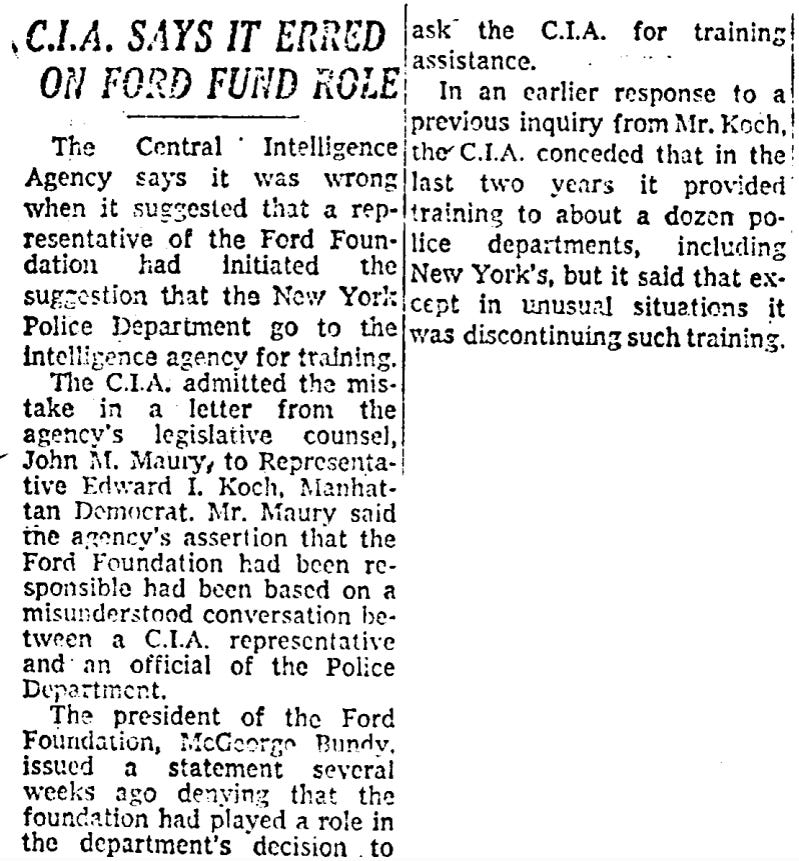
As Bertram Levine says, the CRS was “self-effacing,” making itself seem insignificant, avoiding the public, removing itself from contexts, an occlusion of the sign of state power, but wielding its full force; this is the work of a spook, a phantom instrument. The CRS is, by statutory provision, a domestic intelligence branch of the Justice Department, immune to FOIA, an X-files unit for “hate crimes” that managed to stay under the radar for decades. Naturally, the real story belongs to the instrumental “behind the scenes” change agents.
As time passed, the CRS would face increased demands due to escalating civil unrest across the United States. In 1967, a series of “domestic disturbances” (reported at the time as “negro rebellions”) occurred in over 150 cities, marking one of the most widespread periods of black revolt in the 20th century. Among these, the Detroit incident, or “the Detroit Uprising,” was one of the most severe, lasting five days from July 23 to July 28. It began after a police raid on an unlicensed after-hours club in a predominantly black neighborhood.
Official reports, including the 1968 Kerner Commission (appointed by LBJ to investigate the causes of the riots), documented that the events in Detroit resulted in 43 deaths (33 black and 10 white individuals, including civilians, police, National Guard members, and firefighters), over 1,000 injuries, approximately 1,700 fires, more than 2,500 buildings looted, damaged, or destroyed, and over 7,200 arrests. The mega-riot was attributed to underlying “structural” issues such as racial discrimination, poverty, housing segregation, and police-community relations, ignoring the previous 10 years of racial agitation and revolutionary communist rhetoric endorsed by progressives.
One such attribution was provided by Ted Kheel’s little known Metropolitan Applied Research Center (MARC) (NYT), funded with Carnegie and FF grants. MARC was yet another pro-arbitration, de-policing marketing outfit that also provided busing and school integration studies to grievance litigants. They inserted themselves in several FF de/reform interests, including the 1968 New York teacher’s strike (1969). The center was led by Kheel’s close friend and colleague Kenneth Clark the “psychologist” responsible for the absurd “doll study” instrumental in Brown v. Board of Education. Writing in the Journal of Social Issues, Clark (1965) had proclaimed that Project Camelot, the Army’s counterinsurgency modeling & simulation program, was a respectable model for social psychologists:
“Project Camelot, which proposed to study the causes of revolution or other social change, was frustrated as explosively controversial after American diplomats protested that such research appeared to other sensitive nations as a new form of intellectual imperialism and invasion. The direct research problems are somewhat similar for social psychologists who seek a systematic understanding of domestic riots and other uncontrolled social disturbances”
MARC published Search And Destroy: A Report by the Commission of Inquiry into the Black Panthers and the Police, wherein it was determined that militant black terrorists with overt revolutionary aims were the victims of racist police, authored by one Roy Wilkins of the NAACP. Wilkins was the State Department’s “Uncle Tom,” an old trusted hand at policy laundering, and had involvement with such CIA division projects as American Society of African Culture (AMSAC) and Peace With Freedom (Ramparts 1969). Incidentally, Roy was the uncle of Roger Wilkins, the first director of the Community Relations Service, tapped by Cohen and LBJ to pilot the instrument of civil rights enforcement in its crucial first stages. After his stint at CRS, Roger Wilkins would become the Ford Foundation program officer in charge of Social Development in 1969, then promoted to assist the president of the Foundation, McGeorge Bundy.
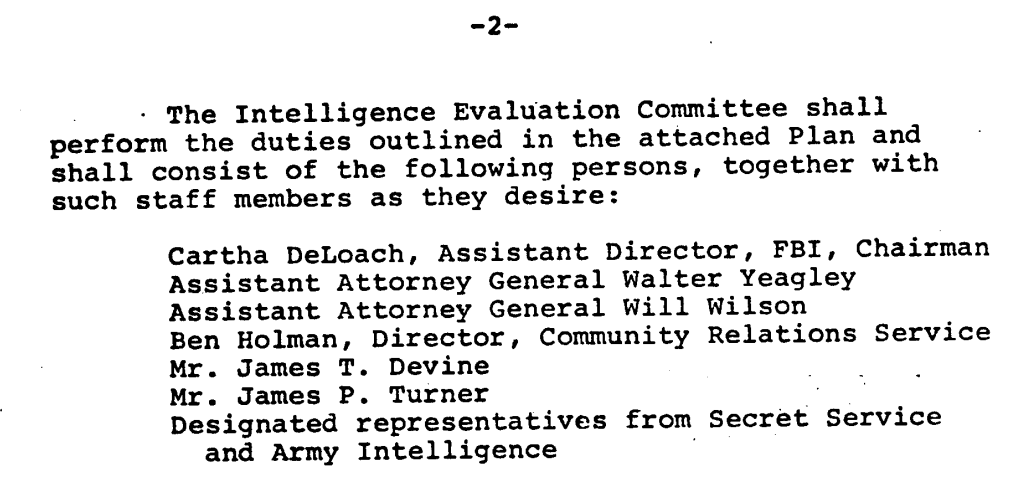
In December 1967, the Justice Department created the Inter-Division Intelligence Unit (IDIU) based on Assistant Attorney General for Civil Rights John Doar’s
recommendation. The Johnson Administration wanted a way to evaluate the FBI’s raw data on domestic disturbances. Doar recommended establishing a “single intelligence unit” to review material from the FBI, the IRS, and neighborhood, labor, and antipoverty programs. Attorney General Ramsey Clark accepted Doar’s proposal in 1967 and created the Interdivisional Information Unit (IDIU), which implemented a powerful computerized system and assembled files on roughly 12,000 citizens.
In 1969, Attorney General John Mitchell (under President Nixon) added the CIA to the Inter-divisional Information Unit. By 1970, the IDIU computer was being utilized to coordinate a flow of more than 40,000 intelligence reports per year concerning “civil disorders and campus disturbances.” In 1971, Assistant Attorney General Robert Mardian, who would later be tried on Watergate-related charges, issued a more extensive mandate for the IDIU:
“IDIU must analyze and monitor all information relating to past civil disorders as well as information relating to the potential for civil disorder.”
The IDIU was established under the Intelligence Evaluation Committee (IEC). As a result of the president’s withdrawal of approval for the expansive domestic surveillance “Huston plan,” the directors of the CIA and NSA began secretly exploring means of expanding their involvement in, and access to, domestic intelligence. Toward that end, Attorney General John Mitchell established an expansive exploratory committee inside the Justice Department.
The IEC included representatives from NSA, CIA, Army counterintelligence, and the FBI. Although the IEC’s formal task was merely to evaluate raw reports, over 90 percent of which arrived through the FBI, it also had access to intelligence derived from NSA surveillance, CIA HTLINGUAL mail-opening operations and Operation CHAOS files. Because it was “off the books” from the start, with no statutory limitations, there was considerable “interpenetration” of interests. Incidentally, the IDIU cybernetic protocol handled information for the Sirhan Sirhan assassination of Robert Kennedy.
Nixon failed to unite the agencies in a coherent program. Thus the IEC remained no more than a means of collating vast amounts of information. Watergate’s secret White House intelligence police, the "plumbers," grew out of the desire to put such information to use. James McCord, a plumber and member of the Committee for the Re-Election of the President (CREEP), received intelligence reports directly from the IEC.
Based on its review, the Church Committee concluded:
... beginning in 1967-68, the IDIU was the focal point of a massive domestic intelligence apparatus established in response to ghetto riots, militant black rhetoric, anti-war protest and campus disruptions. Through IDIU the Attorney General received the benefits of information gathered, by numerous agencies, without setting limits to intelligence reporting or providing clear policy guidance. Each component of the structure -FBI, Army, IDIU, local police and many others-set its own generalized standards and priorities, resulting in excessive collection of information about law abiding citizens.
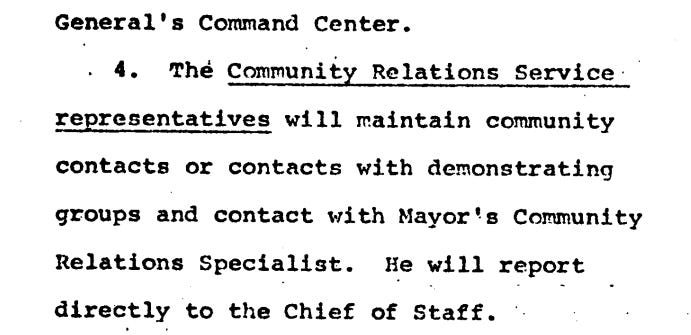
From the beginning, Ben Holman, the Director of CRS was assigned to chair the Civil Disturbance Group (CDG) liaising with the other agencies and the Department of Defense. Through the IDIU CDG, the Community Relations Service was almost instantly integrated into a military-intelligence panopticon with a literal “General’s Command Center.” Once the command center was activate, the CRS’s mission was to “maintain community contacts or contacts with demonstrating groups and contact with Mayor’s Community Relations Specialist”
The Public Information Officer on the scene will make contact with the editors of the most influential media to inform them of our presence and to set up direct lines of communications to newspaper management if and when such communications become necessary
Panopticon becomes necessary in the disembodied, phantom state, as it allows the headless, necromantic servitors of the state to observe the temperature of the social ecology, to regulate its collective psychometabolism, while remaining invisible, disembodied, and secure in lawless secrecy.
Though it is often glossed as “surveillance” and a privacy concern, the primary question being raised by the IEC, as one of the participants paraphrased it, was, “Is there a way to determine whether there is a conscious and organized effort to start riots?” It was a “crisis anticipation system.” But, as surveillance systems will always be used opportunistically and almost never under their formal mandate, any such system, in so far as it can predict, will inevitably be used to incite or coordinate. In fact, we know that in the IDIU’s Civil Rights Division, “The lawyers [there] did not want to work on counterintelligence. They were in sympathy with the revolt” (Zimroth 1974).
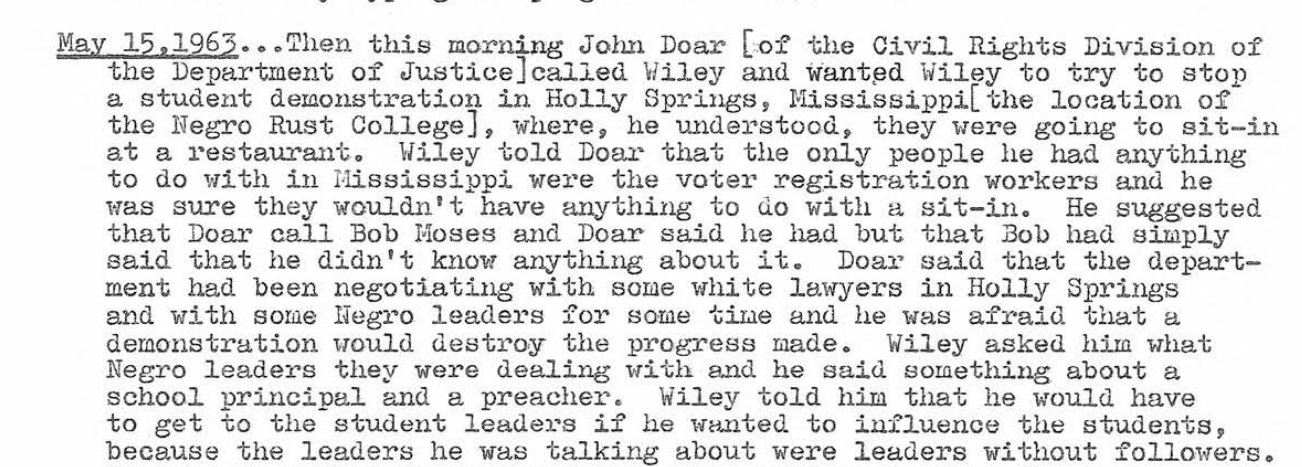
In fact, back in 1962-3, John Doar and the Kennedy Administration were directly coordinating with communist-funded black agitators. The “Bob Moses” mentioned in the diary excerpt above, was the executive secretary of SNCC and director of their Mississippi operation. Every time one of the Administration’s foundation-funded provocateurs was arrested, Kennedy’s Justice Department announced that the FBI would be reviewing the validity of the arrests. In one such case, Moses was investigated for staging an anti-black arson attack and was released after federal intervention.
The reason these groups operated with impunity was because the Kennedy administration blocked and stymied J. Edgar Hoover’s investigations at every turn, and were relaying information to MLK, warning him (and thereby committing sedition), every time Hoover submitted a subpoena for a wiretap, which were in most cases outright rejected.
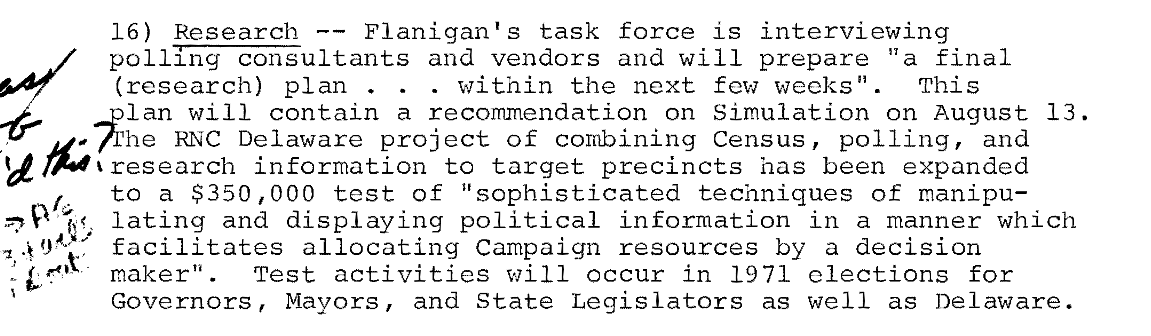
If you look at the memos revealed from the Watergate scandal, the precise word they use is “simulation,” which is wonderfully polysemic. For instance, if one can convincingly “simulate” polling data, which is precisely what CREEP planned, an interested party can change the outcome of an election. At a certain level of verisimilitude, the influence of the simulated event exceeds the reality of the event. The simulation becomes the mode of democratic participation, a game of competing illusions.
In 1969, Theodore Kheel was appointed to the board of trustees of the New York City-RAND Institute, a nonprofit formed by the Rand Corporation and the city of New York to “apply scientific and analytical methods to urban problems” (NYT). By the 1960s, RAND’s mission had broadened beyond defense, with support from the Ford Foundation, it began adapting counterinsurgency and intelligence techniques to the new era of domestic terrorism and race riots.
This was to be plugged into the same IDIU riot prediction/precrime initiatives, applying technologies originally developed for military purposes. In fact, it was more ambitious than that, they sought to simulate all of New York City. The institute’s projects included the Medicaid Vendor System for monitoring medical records and physician profiles, analysis of crime patterns, fire department and police management policies, advanced computer modeling of deployment and dispatching systems, water system management, a decade-long housing voucher study that paved the way for Section 8, automating prison inmate information, enhancing prison surveillance, analyzing guard manpower needs, and automating court administration. All clothed in the language of “civic improvement” and the helping professions (RAND) (RAND Oral History Project).
CRS was obviously intended to be part of a cybernetic population management system. With “conciliation” protocols honed during labor protests and the 1960s “days of rage,” CRS would assist in the 1970s forced bussing to achieve “racial balance” in schools, in the 1990s Rodney King riots, the railroading of George Zimmerman in the 2010s, and more recent astroturfed movements like Black Lives Matter, or for instance, in the brutal murder of Donald Giusti from Lewiston, Maine, by Somalis, where CRS kicked into action to downplay racial elements, ensure local news reported it neutrally, to prevent backlash from the local population. All this is done under FOIA-exempt confidentiality that shields its operations from scrutiny, a power not even possessed by the CIA.
In memoranda, these media manipulation functions are portrayed as “voluntary”:
“…requesting the press, on a voluntary basis, to delay publication of a story which is true but which may be of an inflammatory nature.”
—U.S. Department of Justice. (1969, July 22). Memorandum from Attorney General John N. Mitchell to Deputy Attorney General Richard G. Kleindienst: Establishment of Departmental Disturbance Group [Confidential memorandum]
“Voluntary,” except the CRS could have their FCC licenses reviewed for potential Civil Rights Act Title VII violations (2010), as well as deploy other strong arm maneuvers. It should be noted that only fourteen stations ever went to hearing on allegations of discrimination, and not one of them lost a license because of race or gender discrimination. The media were nearly uniform in their support of anti-discrimination mandates from the start, being instrumental in having them written into law.
As example of more operative CRS tactics: in the stabbing of a white student in Boston during forced school integration in (1974-75), CRS went in to protect the blacks from “white backlash.” They set up their “rumor control” system, a volunteer “information monitoring” program with amateur spies literally from the League of Women Voters, actual “swallowers of slogans” and “nosers-out of unorthodoxy,” that were trained in patented CRS grievance-gathering protocols and supposed “objective” perception regime. They also had the school hire “community aides,” people stationed in the halls watching the students for signs of racism — one of these being the stabbing victim’s older sister (Hansen 1999).
Though he survived, the victim, Michael Faith, had planned to join the Air Force. This was no longer an option; his life was destroyed. Listening to the sister’s oral history of the events, it’s clear that for the real people involved, this police-state social experiment was a surreal nightmare for everyone involved (Barbara Faith, 2006).

The CRS—both formally as an organization and through the political warfare adventures of its staff—had a documented history of collaborating with radical groups such as the communist-front Southern Christian Leadership Conference (SCLC), the black militant guerrilla brigade Student Nonviolent Coordinating Committee (SNCC), and assorted Saul Alinsky-inspired “community researchers.”
The exemplar of this heritage is James Laue, scholar-eunuch of the Ford Foundation (FF) (1970), former organizer/contributor of the radical SNCC, appearing in their earliest literature, the first person to arrive at the side of the fallen Martin Luther King, and the first director for the “community analysis” Research Department of the CRS.
In his 1965 speech at Fisk University titled Social Conflict, Social Change and the Community Relations Service during the 1965 Annual Institute of Race Relations seminar, one of countless manufactories for the training of NGO apparatchiks in the dark art of “crisis mediation,” Laue hints at the true nature of his work. In Laue’s words, the major functions of the Community Relations Service, as established under the 1964 Civil Rights Act, are:
“To assist communities in the conciliation of disagreements arising from discriminatory practices based on race, color, or national origin, which may impair the rights of persons under the law or which may affect interstate commerce.
He adds:
“A more general function is to help create a national climate of compliance with the Civil Rights Act of 1964.”
Scholar-practitioner Laue makes it clear how to generate compliance: “The great paradox we work under in the CRS is that we know that the quickest way to get folks to do right is to have a good crisis now and then…” Before 1960, he observes, there was a need for some way to create crises; since that time, direct action by the volunteer civil rights groups [foundation-funded NGOS] has brought these crises about.
So says Dr. James H. Laue, with his chairs at the National Center for Dispute Settlement and the prestigious Institute for Conflict Analysis and Resolution (ICAR) at George Mason University, the first endowed professorial chair in conflict resolution in the United States, spun into existence in the late 60s by foundation seed money. Laue’s ICAR was the first to offer a Ph.D. in the field of “conflict resolution.” With no model to follow, Laue and ICAR sought to blend theory with practice, drawing from unexpected sources:
It has its roots in labor management bargaining, in international arbitration and the rule of international law movement, in race relations in the United States, and in the formation of organizations like the Community Relations Service. Other important sources have been religious groups, especially the peace churches (the Quakers, the Brethren, and the Mennonites)…
—James Laue, Resolution: Transforming Conflict and Violence. Institute for Conflict Analysis and Resolution, George Mason University, Occasion Paper 7, n.d.
These are not offhand remarks, developing the “crisis concept of social change” was a major part of his intellectual product at CRS. His work with SNCC and at the side of MLK was all fodder for his research on a “theory of the rationalization of protest” (Laue 1989).
Once their Bolshevik language-control measures are stripped away, the CRS’s function—its mission to “create a national climate of compliance” through crisis mediation, to “get folks to do right”—can only be characterized as social engineering. That is precisely the work of applied sociologist James Laue, working in the pseudo-mystical interdisciplinary model of “conflict transformation” created by the Quaker Adam Curle (1987).
Along with Laue, the Community Relation Service also sent the applied sociologist J. Kenneth Morland, an expert in desegregation processes, to assist MLK in Selma. Morland, with his years of anthropological intergroup studies commissioned by the Rockefeller Foundation’s Institute for Research in Social Science (IRSS), had testified as an expert witness in the 1954 U.S. Supreme Court case Brown v. Board of Education. In 1964, Morland led a study resulting in the landmark 1964 report The Tragedy of Public Schools co-sponsored and assisted by the Quaker group, American Friends Service Committee, and, based on such research, he published a book on modifying racial attitudes in children in 1976.
Much of Morland’s work was achieved through grants from the Southern Regional Council, vitally sustained by the Ford Foundation. Presumably while employed with CRS, Morland spoke at the Invitational Conference on Social Change and the Role of Behavioral Scientists sponsored by Yeshiva University, where he urged that behavioral scientists be willing liaisons with activists so research can inform direct action and find viable social engineering strategies, particularly how to modify “self-concepts” (1966).
The general proceedings explicitly call for treating white racial attitudes as a manipulable object— urging the development of “methods of attitude change” and even the “politically effective presentation of research findings to aid in desegregation and arouse community support.” They point to two empirical levers: a behavioral route, since “white attitudes tend to become more favorable when desegregation is perceived as a fait accompli,” and the more direct targeting of Freudian-framed psychological sources of resistance (1966).
They recommend in-depth case studies, “assigning to special ‘on tap’ field workers the task of going into communities on short notice to do impromptu yet systematic on-the-spot investigations of riots, mob action, etc.” and experimental “before–after” research designs— all this to discover which interventions produce “the necessary conditions for inducing favorable attitude change” (1966).
The conference was attended by over a dozen Ford Foundation (FF) mercenaries, including FF program director S. M. Miller, trustee Vivian Henderson, and project leader Hylan Lewis. Much of this specific field extends from the work of military psychologist, former Office of War Information staff, and proponent of “psychotechnology” in the form of “peace pills” Kenneth Clark (HumRRO 1972) (NYT 1971) (NYT 1971), who is often cited in such efforts.
For example, Clark appears in the 1953 report, In the House of the Friends: A Social Science View of a Quaker Program in Race Relations—
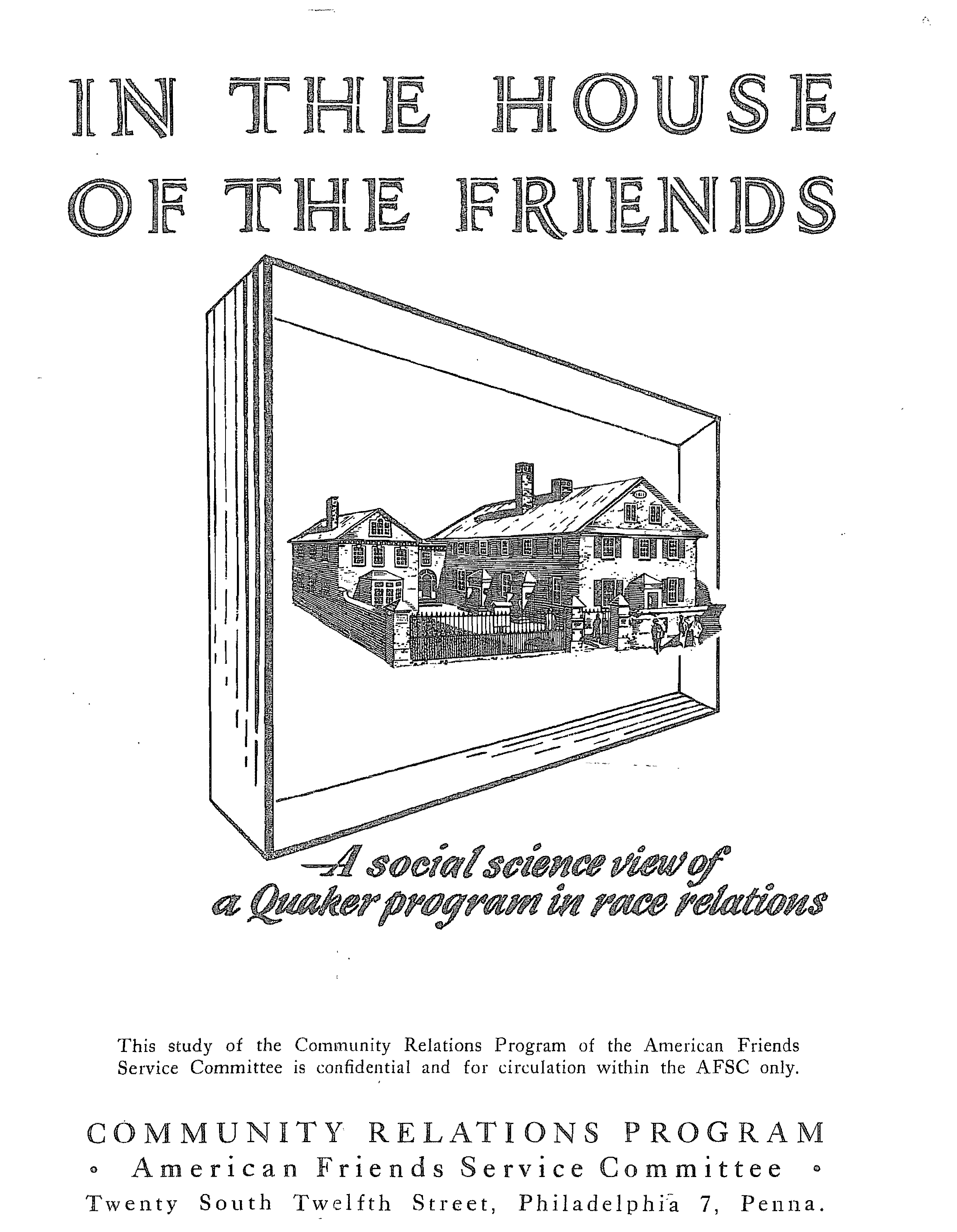
The Society of Friends (Quakers) had been integrating the behaviorist work of John Dollard from Yale’s Institute for Human Relations with their own cult conversion tactics since the early 1950s. Dollard was part of an informal network of scholars consisting of Carnegie’s John Gardner, his brother Charles Dollard, and a host of former OSS/OWI psychological warfare specialists. (Science of Coercion, Communication Research & Psychological Warfare, 1945–1960, 1994).
Military behavioral psychologist Dollard writes:
Thanks to his special neural equipment, man is of all animals the most capable of learning. He learns easily in his first social contacts in the social environment; and seems to have special abilities for acquiring new habits in later life.
The laws of learning are apparently the same for complex as for simple organisms. All learning follows this formula: an individual must be driven or excited in order to learn. He must hit on the response that is to be learned. The response must be made in the presence of relevant environmental and somatic cues.. The connection between cue and response must be cemented by reward. In other words, the individual must want something, sense something, do something and get something. There must be (1) drive, (2) cue, .(3) response, and (4) reward.
—Quoted in Robert Johnson’s In the House of the Friends: A Social Science View of a Quaker Program in Race Relations. Philadelphia: American Friends Service Committee (1953).
During the war, John Dollard worked as a consultant for the Civilian Personnel Division of the War Department; the nature of this work was characterized by one participant: “Just as World War I gave new impetus to the study of aptitudes, so World War II has given new impetus to the study of attitudes” (Jones 2007). Using the battlefield as his laboratory, Dollard would study soldier’s fear responses, and based on the Freudian “Frustration-Aggression Hypothesis,” he synthesized his findings into an influential “self-study” guide instructing soldiers how to change their attitude towards deadly combat.
But more than anything, the nature of the Society of Friends’ contribution to the sociology of race relations explains how CRS was able to attain a 100% success rate in drawing out “Attitudinal Changes” from recently bereaved white families, inducing them to immediately forgive black perpetrators of grisly crimes. Drawing from 400 years of finetuning the public relations of their radical cult, and nearly a century on the front lines of racial progressivism, the Friends suggest:
Community-based visitation, awakening of conscience; persuasion of an individual to change his practices; encouragement and re-enforcement of the person in his newly acquired position; development of a sense of well-being in a person having done the "right and moral thing.” To the extent that AFSC has been successful in its Community Relations Program, we believe that they have done this, and have induced solid and lasting changes in people's racial orientation.
—Robert Johnson, 1953. In the House of the Friends: A Social Science View of a Quaker Program in Race Relations. Philadelphia: American Friends Service Committee.
If it needs to be said, they are describing what is today a quite well known cult conversion protocol.8 Laue explicitly links CRS’s approach to the Society of Friends. Laue is the most prominent scholar-practitioner in this field of “interfaith sociology.” He is eunuch-priest of the cephaloplex. For those familiar with the infamous proto-cyberneticist and accoucheur of the CIA, Gregory Bateson, you will recognize this as a career path similar to his “applied anthropology.”
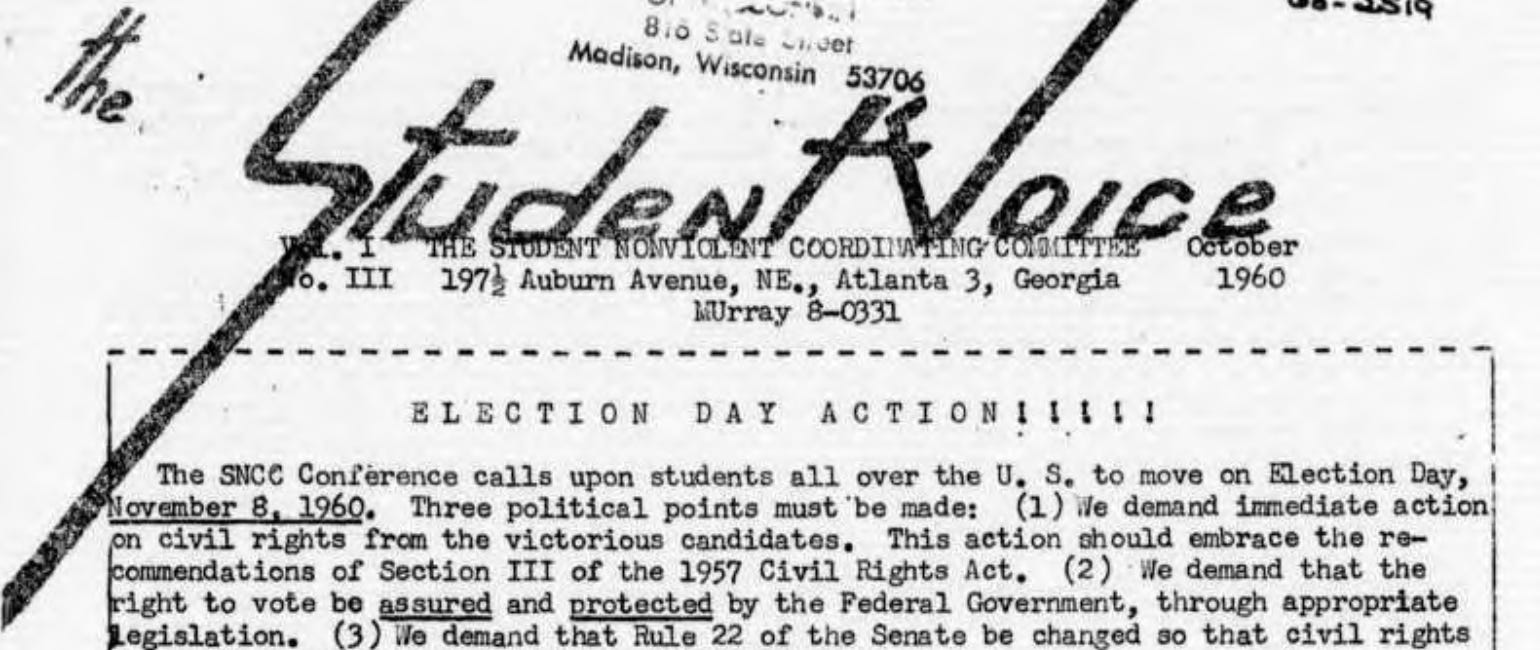
In early SNCC newsletters, Laue explained that the work of civil rights was to find “the ideal path into the collective conscience,” and for him that was the 1960 church “kneel-in” campaign. This institution, he notes, held an “overflowing reservoir of guilt about racial and ethnic injustice, a reservoir long ready for draining” (Haynes 2012). He speaks from a “socio-anthropological point of view” about the Left’s control of language and deterritorializing this guardian of the social south, the church: “It is ‘time’ both sociologically and morally...to start tickling the guilt of the collective conscience.”(Student Voice, Vol. 1 No. 3)
James Laue is not alone in his radical background. Of the 19 CRS mediators profiled by the “Civil Rights Mediation Oral History Project,” 12 had documented activism and radical agitation histories, many of them identified as revolutionary communist-fronts or saturated with communist members, like the SNCC—
“SNCC declared that ‘liberation will come only when there is final destruction of this mad octopus--the capitalistic system of the United States with all its life-sucking tentacles of exploitation and racism... the recognition instilled in SNCC workers forced its members to further popularize the legitimacy of self-defense and rebellions when oppression became too great’.”
—Federal Bureau of Investigation. (circa 1964). Student Non-Violent Coordinating Committee (SNCC) Part 10b (Appendix) of 14 (BUFILE: 100-439190)
After reading Laue’s oeuvre, any reasonable observer would infer that, from 1965 onward, wherever a CRS “conciliator” intervened in a racial crisis (often a “confrontation of injustice” deliberately incited by the civil rights-NGO network in which CRS embeds itself) the structural or systemic repression of nonwhites would be assumed. CRS intervention in any racially charged fault line means that the conflict arose because of systemic oppression, never because of any action of the “weaker” party, which is definitionally always non-white.
The real story of SNCC, its Machiavellian lineage, and violent communist objectives has been nearly wiped from popular memory. Howard Zinn, the “people’s historian” of the SNCC, lied to the FBI about his own Communist Party membership. As we will see, what we call “the far Left” has little to do with its advertised slogans. For at least a century, it has operated as a loose coalition of criminal oligarchs, subversives and radicals without a fixed ideology. Each member of this consortium is united by the sympoiesis of rot; their history marches alongside a genealogy of congenital liars who only want power.
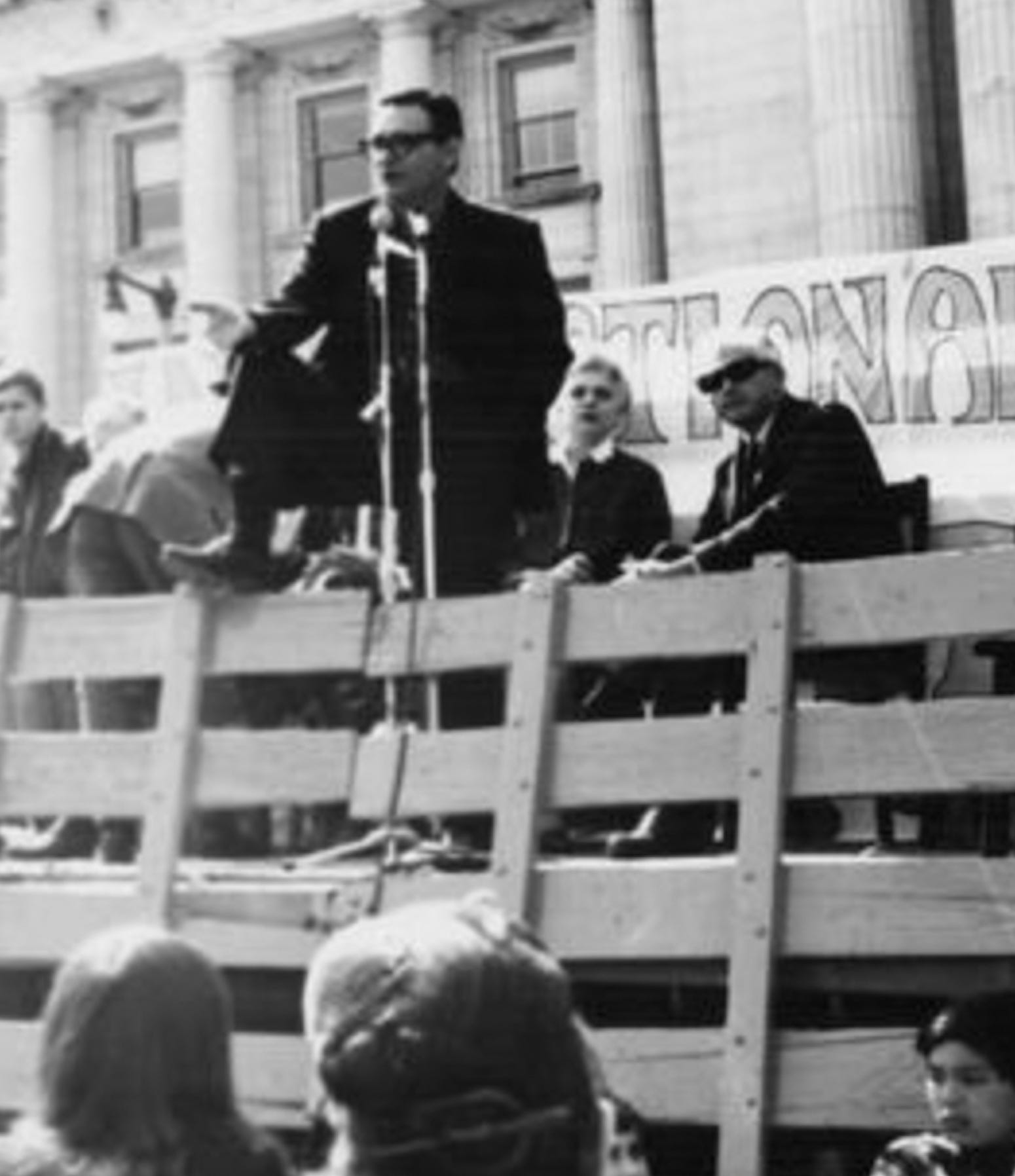
Laue is not alone in his ghoulish sociotechnical approach; the breadth of “behind the scenes” terrain is defined by such Gigeresque geology. Every feature of the Civil Rights topography is revealed, as we clear away the powdery regolith, as part of a gargantuan biomachine. One such artifact is Jack Minnis (1926–2005) one of the most important yet least publicly known of the white members of the black militant SNCC. There is little public record of his activities before 1960. Just a brief sketch, he simply appears for the “long hot summers” of the 1960s then fades into obscurity— it is only said he grew up during the Dust Bowl era, enlisted and served two years in the US Army Air Corps towards the end of WW2.
After his brief military service, Minnis (then in his 20s and early-to-mid 30s) lived in New York City and worked as a researcher for the Fabian-front League for Industrial Democracy (LID) as a researcher-organizer for its youth affiliate SLID, which in 1959 changed its name to the Students for a Democratic Society (SDS) of Weatherman Underground fame.
Minnis established and ran SNCC’s Atlanta-based Research Department, functioning as a behind-the-scenes intelligence gatherer. He compiled dossiers on government surveillance, law enforcement tactics, and political strategies, and distributed this information to field activists in order to undermine American institutions and advance black militant agitation campaigns.
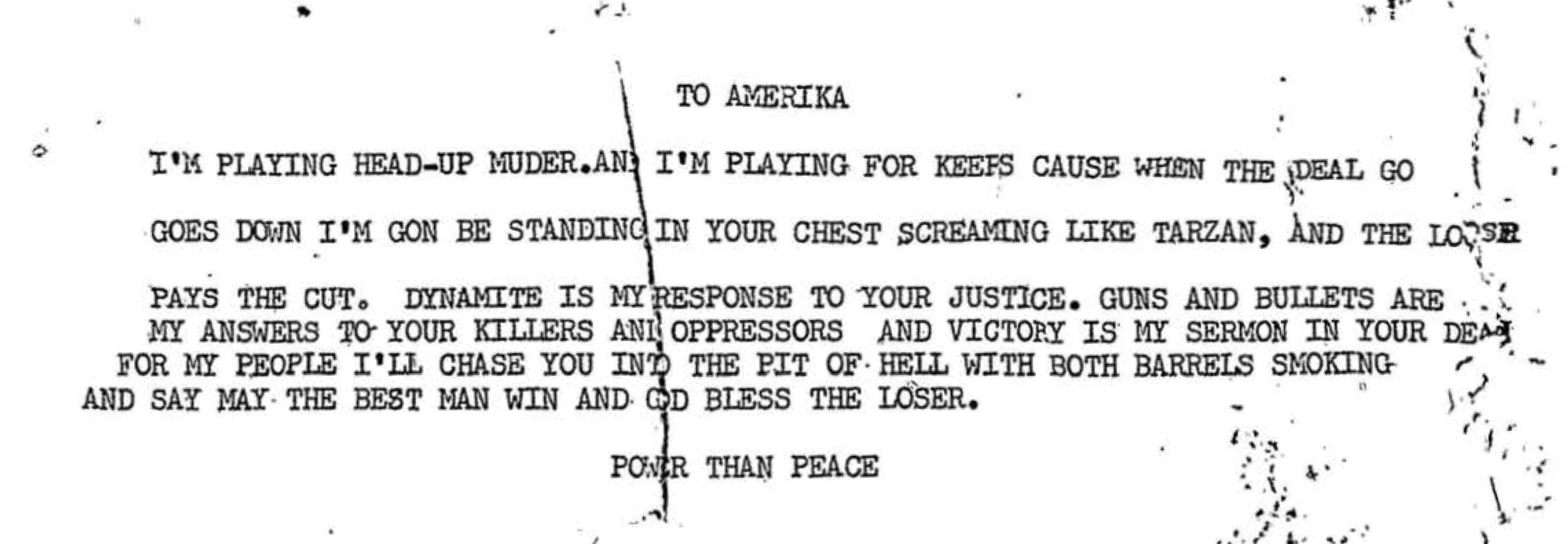
Minnis’s work directly supported the black militant shift toward revolutionary tactics, notably his authorship of a 1967 pamphlet titled “Lowndes County Freedom Organization: The Story of the Development of an Independent Political Movement on the County Level.” This document chronicled the formation of the Lowndes County Freedom Organization (LCFO) in Alabama, an all-black political entity that adopted the black panther as its symbol, a precursor to the notorious Black Panther Party (BPP). Minnis is framed as a documentarian and “researcher,” but a close examination of oral histories locates him at several critical points.


The BPP, founded shortly after in 1966 by Huey Newton and Bobby Seale, openly embraced Marxist-Leninist doctrine, promoting sabotage and guerilla warfare, communist redistribution, and alliances with foreign revolutionary groups. Minnis helped to architect the LCFO as a model for “independent” black political power, with notions of a parallel black government (Minnis 1967). This fed directly into the left’s pseudo-communist subversive playbook, which sought to fracture American society along racial lines in order to dissolve state’s rights and expand centralized human technique deeper into the social fabric.
Minnis was certainly in a position of “command and control” in the formative years of the proto-BPP. Consider his behavior in this anecdote:
I never will forget one day when we arrived at the Atlanta office during the early days of organizing in Lowndes County, I made my rounds and … started to talk to Jack about various ideas I had about organizing in the county, and it was right in the midst of pouring out these thoughts when he stopped me cold and asked me to wait. Then he gave me a compliment that I never heard before. He said, “You know you come in here with a lot of good ideas, but this one is the best I’ve ever heard and one for the books.”
He start bellowing to various staff members that he wanted to have an executive meeting right then at that time and got up from his desk and gave me a hug that came close to breaking my back and was screaming out Ruby Doris name in such an loud excited tone of voice about having a meeting I thought he had got religion or something and everyone who came into his office space in the office was taken back by his behavior, people that had started rush into his office space their faces full of awe because of the way he was acting and talking so fast, they looked at me like I had done something to him all I could do was shrug my shoulders and looked at everyone in wonderment for I didn’t know what I had said to cause him to react like he acting.
This was how the birth of the Black Panther car bumper stickers came into being which caused a psychological shock wave across the Black Belt of Alabama, Alabama, and this nation also. I celebrated later on with Jack a few weeks later and we both rejoiced going over how it all happened.
This is the manic behavior of a psywar virtuoso in the Lansdalian mold, a man possessed by muses that hymn the primacy of the image, transmitting to his dark heart the secret art of generating “psychological shock waves,” or rather, macroscopic gesticulations in the media environment. And, of course, the image of Minnis “bellowing” out orders to a room full of mystified negros demonstrates he was an executive in the organization.
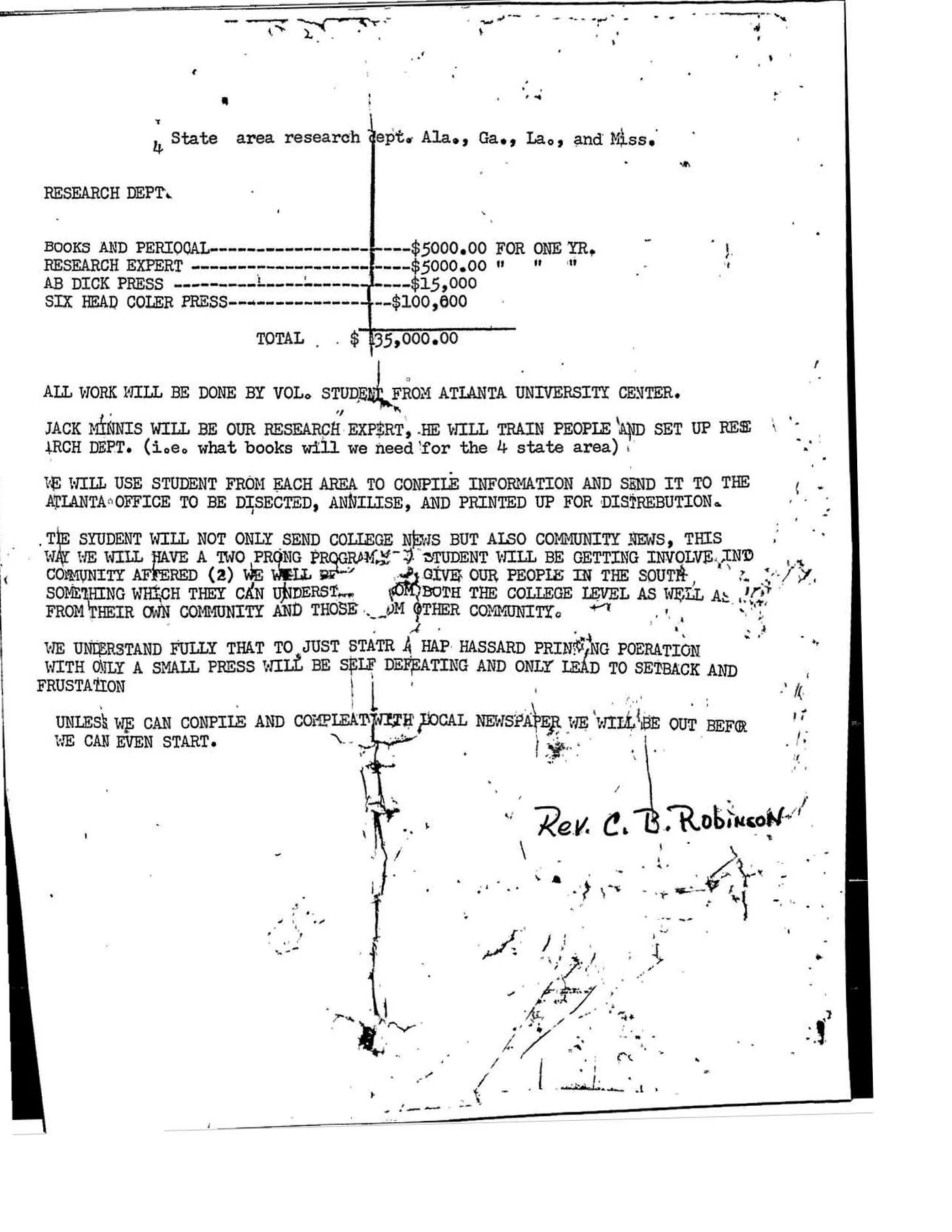
The above is a letter from Rev. Charles B. Robinson to militant SNCC figure Ralph Featherstone killed in a 1970 car bombing alongside William “Che” Payne. The document outlines a $135,000 research-agitation project based at Atlanta University Center. Students agitators from a four-state Southern area will manufacture hate crime data, send it to a central Atlanta office for analysis and printing, and distribute it. $135,000 in 1962 is roughly $1.5 million today. Jack Minnis will serve as “research expert” to train staff and establish a research department. Robinson says, “We understand fully that to just start a hap hassard printing poeration with only a small press will be self defeating and only lead to setback and frustration. Unless we can compile and compleat with local newspaper we will be out before we can even start.”
The main reason for such urgency in funding and organizing an expensive, complex regional “Research Department” covering Alabama, Georgia, Louisiana, and Mississippi— it was for the securitization rhetoric and hate crime hoax manufacture that brought in the funds, the feds, and the army. This was Jack Minnis’s real job: to set up the press, train the people, and bring in radicalized volunteers from local universities who would lie for a good cause, “to get folks to do right.”
In 1954, Carl and Anne Braden, lead instigators in the “Louisville Seven” communist plot, bought a house in a white neighborhood for a black gentleman named Andrew Wade IV with the aim of creating a situation of racial tension. After the purchase, they quickly organized a “Wade Defense Committee” and publicized the case after the black family moved in. Shortly afterward, Vernon Bown (also spelled Baun), another white member of the Seven, briefly moved in with the Wades, and the house was bombed the next morning; a grand jury would conclude “beyond a reasonable doubt” that Bown set off the explosion.


Carl Braden, a member of the CPUSA Central Committee, was convicted of sedition, sentenced to fifteen years and fined $5,000. However, he was released after the Supreme Court’s 1956 decision in Pennsylvania v. Nelson nullified the state’s anti-sedition laws. The dismissal of charges against the Seven occurred without inquiry into the merits of material evidence or testimony exonerating Braden and Bown, but solely through judicial capture that preempted their convictions.
Contrary to the claims of Wikipedia and Marxist revisionists, Brown was not “acquitted” of the charges made against him. Although he escaped trial, the evidence against him accumulated during the grand jury proceedings and at the trial of Carl Braden has never been refuted. No legal proceedings were ever brought against the spectral “white supremacist bombers” later blamed for the bombing. As far as I can tell, all the finer details of the Victor Bown bombing hoax have been wiped from the internet (always a good sign). If it weren’t for FOIA and the Congressional Record, we’d never know that—
The Wade home had a crawl space beneath it. The only entrance to this space was a small, window-size opening off the driveway. No fuse or wire was found running outside the house after the explosion. For this reason and because of the presence of the guards on the outside and around the house, the grand jury found that it would have been “impossible” for the explosive to be placed under the house by an outsider and that it had to be an “inside job,” done by “someone having easy and ready access” to the house. Bown’s portable radio was found under the house in a damaged condition after the explosion. It was set to work on batteries rather than on current. Its speaker was missing. The set was suspended by wire from a nail that had been driven into a joist of the house. A piece of wire with its insulation scraped off was also found beneath the house. A terminal out of Bown’s radio battery appeared to have been the point far connecting the explosive.
Congressional Record: Proceedings and Debates of the 90th Congress, Second Session, Volume 114—Part 11, May 15, 1968 to May 27, 1968 (Watson) (emphasis added)
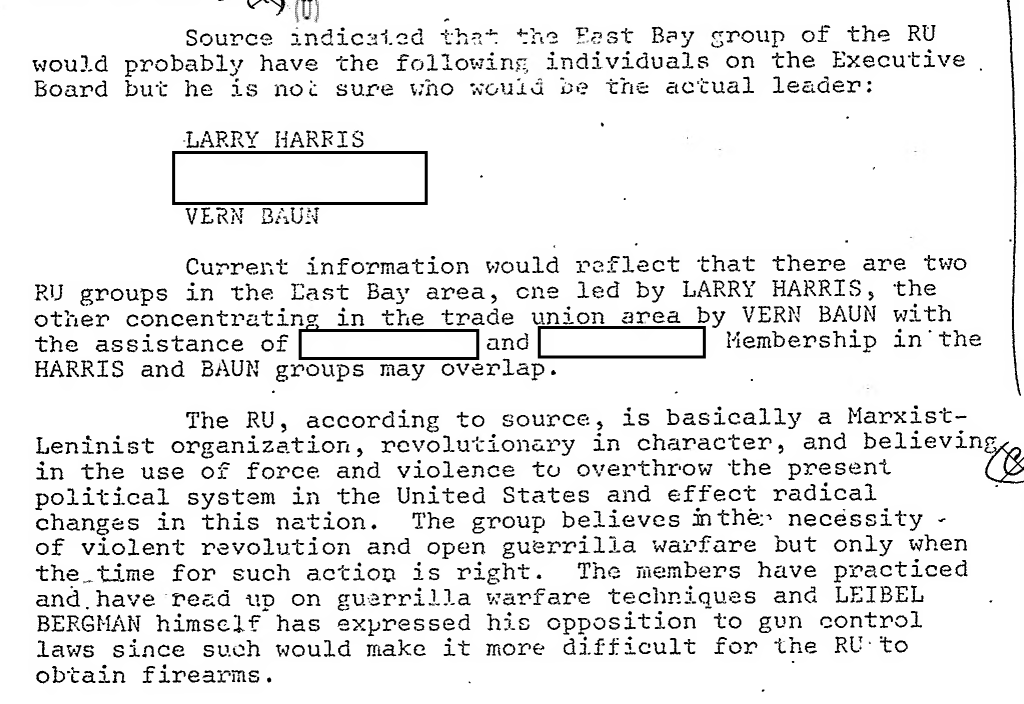
From the National Guardian, October 18, 1954: “Vernon Bown, a member of the Teamsters Union who refused to say how many times he had seen the Bradens in a two-week period, was indicted for contempt.” His tendency for guerrilla sabotage would be confirmed in 1972, when Brown would be named as an executive of the Maoist-Leninist Revolutionary Union (RU), in connection with a congressional investigation of the militant extremist group Venceremos.
The Venceremos were a heavily armed, multicultural Maoist revolutionary brigade involved in murder, bombing and kidnapping plots who routinely fortified themselves with secret stashes of rifles, grenades, pipe bombs and other explosives. The RU was accused, alongside Venceremos (its recent splinter), of posing a “potential threat to national security” as one of the strongest revolutionary organizations in the U.S. The report, based on FBI surveillance and testimony from informants saturating the RU, maintained that the RU had a “secret apparatus” for assassinations, robberies, sabotage, and stockpiling weapons. Specific RU members like Barry Greenberg were labeled “extremely radical and militant.”
Bown’s RU later evolved into the anti-gay, cult-like Revolutionary Communist Party (RCP) in 1975. A Communist teamster, veteran of the Abraham Lincoln Brigade who fought fascism in the Spanish Civil War, and later became a militant, queer-hating Maoist. There is simply zero question: he bombed that house.
Anne and Carl Braden, white Southern civil rights activists from Louisville, Kentucky, were instrumental allies and mentors to the Student Nonviolent Coordinating Committee (SNCC) from its early years in the 1960s, primarily through their leadership in the Southern Conference Educational Fund (SCEF), where they served as field secretaries starting in 1957 and later as executive directors. The SCEF was one of these “blended” New Deal pseudo-communist fronts, staffed with ideological commies and state apparatchiks. Incidentally, Carl Braden is also listed on its letterhead as one of the “national sponsors” of the Fair Play for Cuba Committee, with which Jack Minnis was involved at Tulane.
They provided multiplex support to SNCC, including financial aid such as bail money for arrested high school protesters in McComb, Mississippi, in 1961; publicity by featuring SNCC’s organizing efforts extensively in SCEF’s newspaper, The Southern Patriot, edited by Anne, which helped amplify SNCC’s agitations and reach a wide audience; and media training, where they taught white SNCC members the Alinsky-esque routines and connected them to over 320 media outlets. Jack Rogers of the Louisiana Committee Counsel stated that, “Without the help and backing of the Communist-led Southern Conference Educational Fund, the Student Non-Violent Coordinating Committee would collapse overnight,” and the conclusion of the committee was that SNCC was “substantially under the control of the Communist Party through the influence of the Southern Conference Educational Fund and the Communists who manage it.”
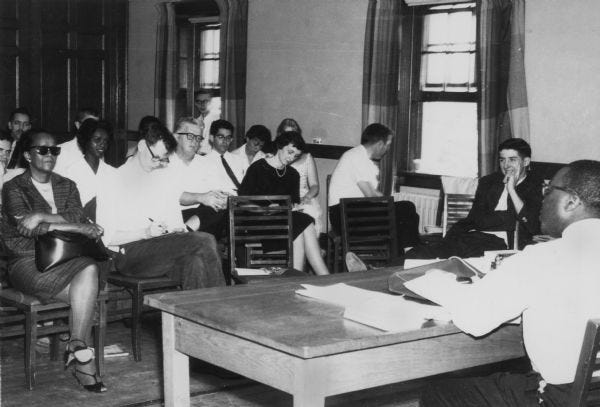
The Braden hoaxers fostered intergenerational mentorships with SNCC activists—Anne notably recruited and guided Bob Zellner, SNCC’s first white field secretary in 1961, and advocated for SCEF funding to support white student organizers like Zellner to mobilize SNCC’s operationally invaluable white college student contingent. Anne attended SNCC’s earliest meetings, documented their work through interviews, and her home served as a welcoming center for SNCC members. This relationship stemmed from the Bradens’ broader network, which included close interlocking relationships between the communist old guard and SNCC co-founder Ella Baker and other leaders.
Minnis was also the Research Director of the Voter Education Project (VEP), another subversive, Kennedy-supported civil rights agency that, ostensibly, funded Negro registration campaigns throughout the South. In reality, it was used to funnel enormous funds from the Rockefeller and Taconic foundations to “direct action” militants like the SNCC and the SDS through their agitation efforts under the umbrella group Council of Federated Organizations (COFO).
I don’t intend to list all these groups, but I will present a partial summary here for reference and to provide a sense of the scale and chaos that was visited upon Mississippi by at least 2000 northern white college students trained in non-violent “political ninjutsu” and Alinsky agitation tactics:
COFO was established in the Fall of 1963 by the Student Nonviolent Coordinating Committee (SNCC or, alternately, SNICK), the Congress of Racial Equality (CORE), the Southern Christian Leadership Conference (SCLC), and the National Association for the Advancement of Colored People (NAACP). Other organizations are also engaged in the activities which COFO coordinates in Mississippi: the Southern Conference Educational Fund, Inc. (SCEF), the National Council of the Churches of Christ in the United States of America (NCC), Students for a Democratic Society (SDS), the Communist Party of the United States of America (CPUSA), and the Kennedy-Johnson Administration (LBJ). (AO 1964-11: Vol 7 Iss. 10)
The umbrella group was run mainly by SNCC, but it was indeed a vast coalition of clowns that descended on slumberous Mississippi towns. SNCC branded their efforts as the “Mississippi Summer Project”—
By the time of the Mississippi Summer Project in 1964, SNCC’s admiration for Castroism was apparent. SNCC workers were distributing Castro propaganda, and Cuban exile Williams advocating guerrilla warfare by American Negroes and describing how Molotov cocktails could be used in American cities. (Evans and Novak)
COFO’s stated goal was to destroy the traditional power structure in Mississippi. The Crimson, April 22, 1964, on COFO’s official ‘Mississippi Summer Project’: “Viewing Mississippi as the central battlefield in the fight for equal rights, COFO aims at recruiting up to 2,000 workers, mostly out-of-state students, for a many-faceted attack on the political, social and legal structures of the state.”
More concisely, it was an application of anarcho-tyranny:
The aim of COFO is to establish a sufficiently disciplined counter-community to so provoke the old order in Mississippi as to provide cover for calling in COFO’s equivalent of the Red Army—in this case, alas, the Army of the United States.
—American Opinion, November 1964, page 10
This is made clear in their promotional material:
“The struggle for freedom in Mississippi can only be won by a combination of action within the state and a heightened awareness throughout the country of the need for massive federal intervention to ensure the voting rights of Negroes. This summer’s project will work toward both objectives.”
(Operation Freedom 1964) (italics added)
This “counter-community” just so happened to map onto the “negro republic” the Soviets had been pushing since the 1920s. The mysterious Jack Minnis, inventor of the Black Panther Party, was a political scientist close to completing his doctorate at Tulane when he joined the VEP. There is good reason that he remained a “behind the scenes” operator, because information on his activities gives away the game—
Minnis testified in Federal court in the case of the United States against Joni Rabinowitz to the effect that racial prejudice of southern juries placed the defendant in the case in serious jeopardy of a miscarriage of justice. Joni Rabinowitz, a student at Antioch College in Ohio, was field secretary of the Student Nonviolent Coordinating Committee and had been indicted for perjury by a Macon, Ga., federal grand jury in connection with civil rights activities.
The student news story to which I have referred pointed out that her father was or had been an attorney for Fidel Castro. The fact is that Joni Rabinowitz is the daughter of Victor Rabinowitz, of the New York law firm of Rabinowitz & Boudin, registered under the Foreign Agents Registration Act as agents for Fidel Castro and associated in that connection with Benjamin E. Smith, of New Orleans, counsel for the Freedom Party.
—Senator Eastland, Congressional Record: Proceedings and Debates, Volume 111, Part 2 (1965)
Senator Eastland also recounts from the cited student news article what sounds exactly like the modern “libtard fables” you see on social media—Minnis alleged he witnessed “FBI agents ‘remain dormant’ while Negroes were harassed and prevented from registering to vote,” a transparent fiction revealing that he didn’t know how FBI jurisdiction worked.
Details of the Joni Rabinowitz perjury case are revealing. The case stemmed from multiple testimonies before a federal grand jury investigating SNCC agitators who picketed the Albany, Georgia store of a federal petit juror after his jury returned a verdict unfavorable to a black defendant in a civil-rights case. SNCC organizer Joni Rabinowitz and five local participants denied under oath any prior knowledge of or role in the intimidation—testimony that formed the basis of the perjury charge. This is the reality of the “civil rights” movement. Strong-arm tactics, foreign agents, mysterious operators and lies.
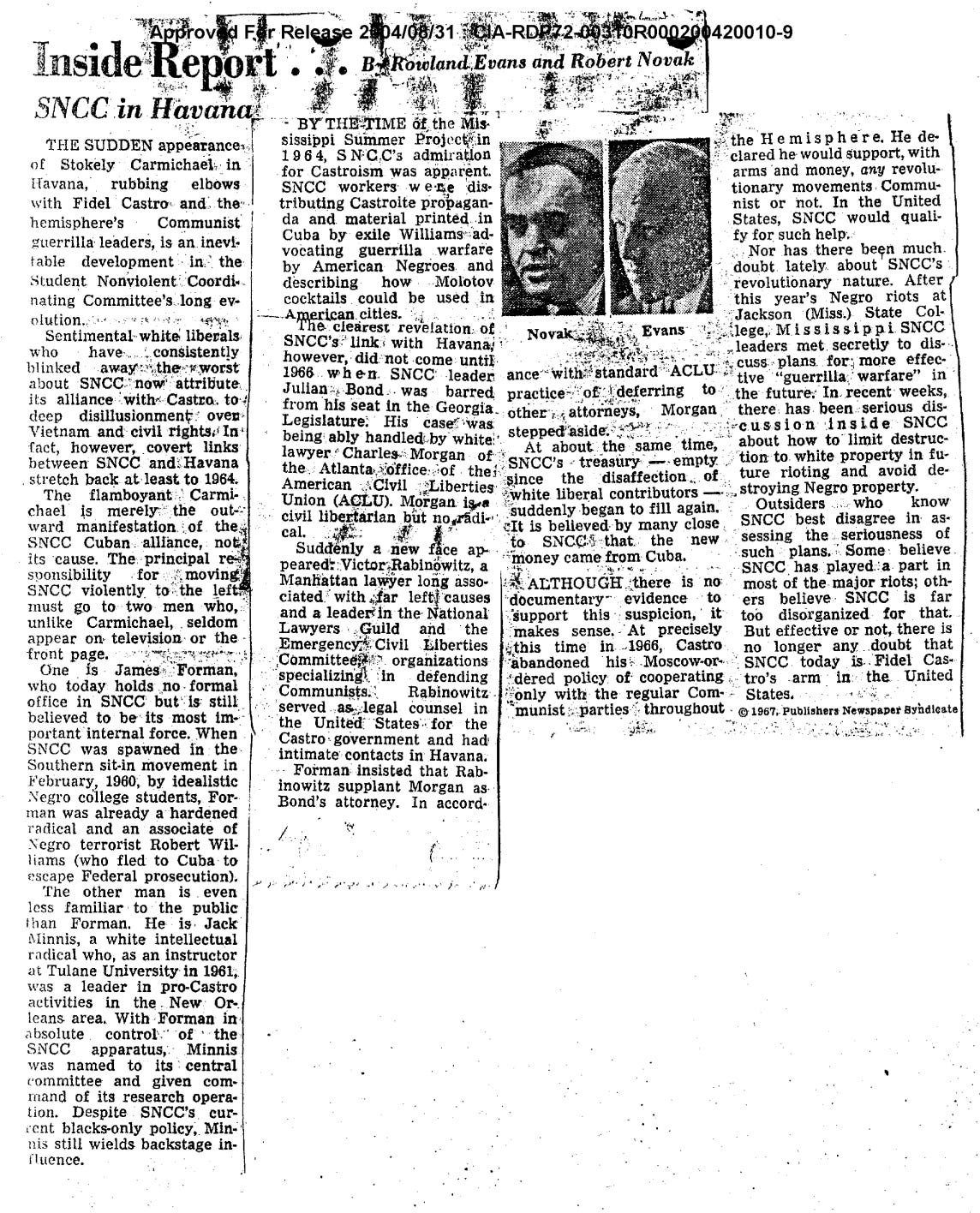
Jack Minnis, despite being instrumental in the black militant movement, only appears in the odd footnote in most books on the Civil Rights. He links the operational structure and inception of SNCC directly to Fidel Castro.
He is Jack Minnis, a white intellectual radical who, as an instructor at Tulane University in 1961, was a leader in pro-Castro activities in the New Orleans area. With Forman in absolute control of the SNCC apparatus, Minnis was named to its central committee and given command of its research operation. Despite SNCC’s current blacks-only policy, Minnis still wields backstage influence. By the time of the Mississippi Summer Project in 1964, SNCC’s admiration for Castroism was apparent. SNCC workers were distributing Castroite propaganda and material printed in Cuba by exile Williams advocating guerrilla warfare by American Negroes and describing how Molotov cocktails could be used in American cities.
—SNCC in Havana, Evans and Novak, August 3, 1967, Courtesy of the CIA.
Minnis’s “backstage influence” behind the curtain of the Civil Rights cybernetic theater was extensive; it was he who quietly shaped the conditions that brought the radical Stokely Carmichael to leadership. (Carson 1995). Jack Minnis would be the only white person elected to the SNCC central committee after Carmichael was made president. (Southern Regional Council Papers 1944-1968)
The clearest revelation of Castroist influence came in 1966, when Julian Bond (barred from his Georgia legislative seat after endorsing SNCC’s anti-Vietnam statement) was at first represented by ACLU lawyer Charles Morgan, who was later asked to step aside at the insistence of SNCC leadership. Victor Rabinowitz, a Manhattan lawyer and champion of communist causes, once legal counsel for the Castro government with suspicious Havana contacts, would take over the case. “At about the same time, SNCC’s treasury, long empty after the disaffection of white liberal contributors, suddenly began to fill again — money many close to SNCC believed came from Cuba” (Evans and Novak).
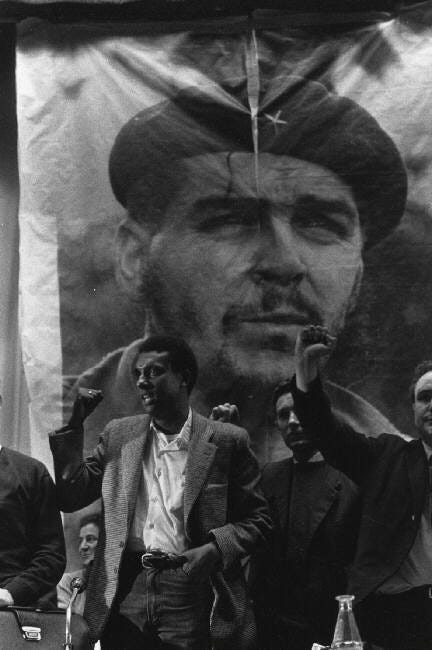
Victor Rabinowitz, president of the identified Communist-front National Lawyers Guild (NLG), an attorney who later admitted having been a Communist Party member, registered under the Foreign Agents Registration Act as an agent for Fidel Castro from May 1964 to September 1968, was the executive chairman of the Louis B. Rabinowitz Foundation.
During the “long hot summer” of the late ‘60s “negro revolution,” the Rabinowitz Foundation was annually pouring hundreds of thousands of dollars into the radical Left, to finance propaganda films glorifying Communist China and revolutionary activity in Berkeley, to underwrite socialist conferences, and vitally patronize Marxist and Communist publishing houses. Large grants were awarded to James Forman, executive secretary of SNCC and close associate of black terrorists, several extremely militant members of the Communist Party (CPUSA), radicalized members of the Students for a Democratic Society (SDS), and Castroist-Leninist authors and journalists.
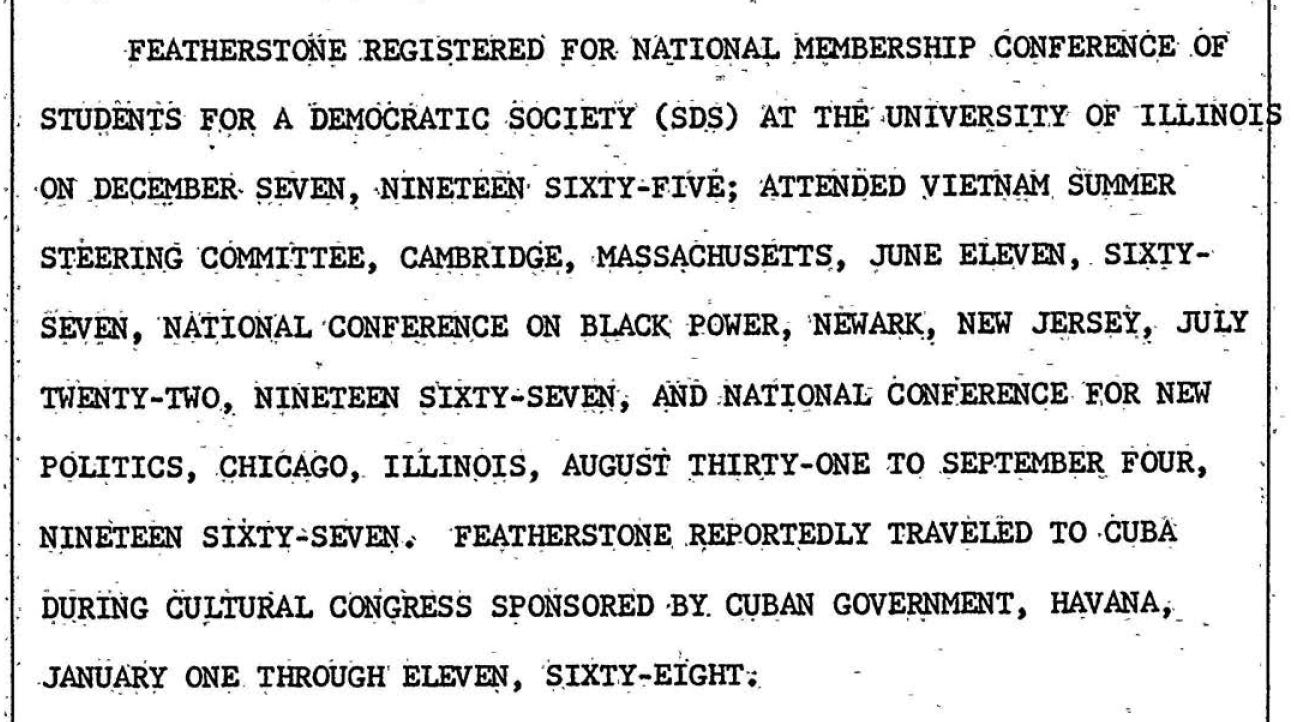
In 1967, the last year for which tax records are available, the figures show heavy funding of this “‘Marxist-Leninist-Castroite-socialist’ crowd.” This included several agitators involved in the Mississippi invasion: Negro attorney Len Holt (member of the communist-front NLG and author of a book on the 1964 Mississippi voter registration drive), and our good friend, the wizard behind the curtain, Jack Minnis, who received $1,500 [$14,500 adjusted for inflation]. (quoted in Extended Remarks, U.S. Congress. 1969. Congressional Record. 91st Cong., 1st Sess., Vol. 115).
This represents direct funding from an agent of Fidel Castro. SNCC and Jack Minnis were being financed by at least one foreign communist power. Mississippi faced an effective invasion by Cuba, yet the Kennedy administration’s FBI took no action. By then, the federal government was thoroughly compromised. Indeed, only through the FBI’s deliberate investigative inaction could the SNCC continue operating—or could Jack Minnis publish his absurd A Chronology of Violence and Intimidation in Mississippi Since 1961, a work purporting to “prove” that racist violence was endemic to the South.
This chronology was shameless agitprop slop, consisting largely of alleged “attacks” on SNCC agitators (notorious for perjury, juror intimidation, and Alinsky-style tactics) and laced with incredible tales of literal cotton-picking negroes, such as one “Welton McSwine,” stripped naked and whipped by police for “peeping”—all without neutral witness testimony or corroborating documents.
Minnis’s Chronology was, on close inspection, just a shabby prop for political theater, never meant to be held up to scrutiny. The Civil Rights movement itself was only a “movement” in the sense of a macroscopic gesticulation in the media environment. Like Rosa Parks’ bus adventure, the entire thing was staged by radical operators, and was made real by the ascendance of the virtual environment and the death of the sign. In other words, the 60s civil rights era was a series of shamanic mise en scènes that paralyzed the nation while Washington, communist think tanks, and the captured judiciary forcibly reconstructed the south, and ultimately murdered the republic.
Minnis was fully embedded within the subversive rebreeding chamber. A 1976 FBI report titled “Foreign Influence - Weather Underground Organization” reported that an address book was found in late 1969 in a vacant apartment at 4943 North Winthrop Avenue in Chicago’s Uptown neighborhood, the residence and operational base recently vacated by Bernardine Dohrn, Jonathan Long, and other members of the domestic terror organization, the Weather Underground.
The far-left terror cell had scattered and abruptly abandoned the apartment to go underground, avoiding arrest amid the escalating chaos and the “Days of Rage” riots in Chicago earlier that year. In the vacant apartment at 4943 North Winthrop Street, Chicago, an address book was found in which appeared the notation: “Jack Minnis, 2224 Calhoun Street, New Orleans, Louisiana.”
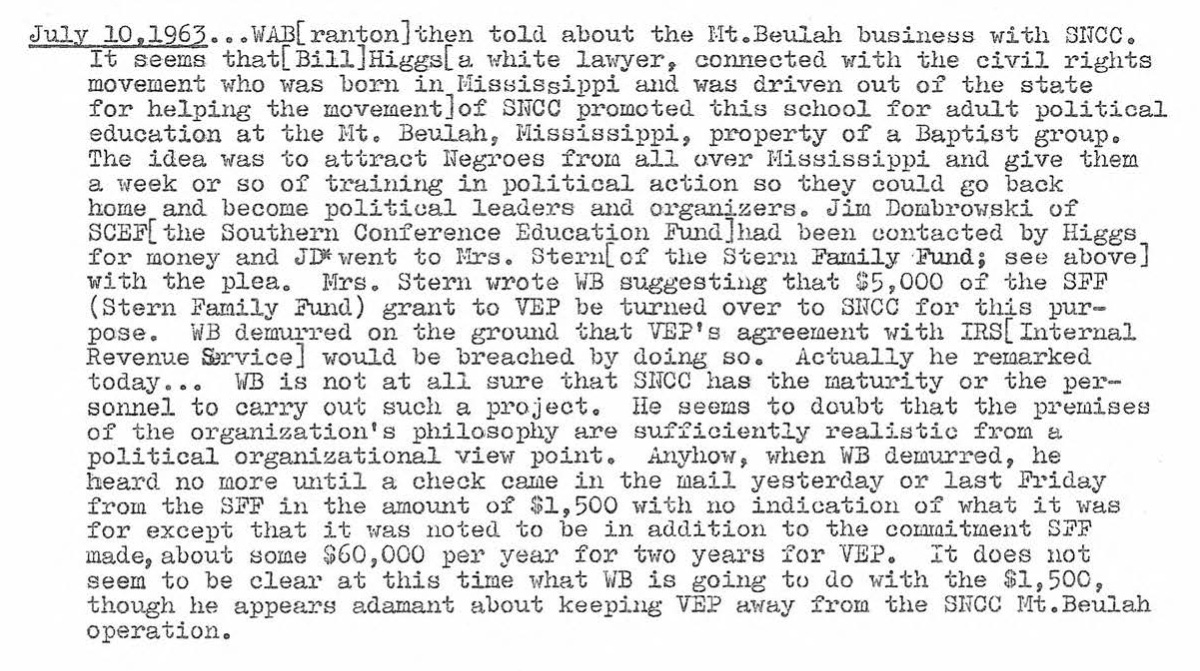
Benjamin Smith, vice president of the communist-front National Lawyers Guild (NLG), another northern attorney registered under the Foreign Agents Registration Act as an agent of Fidel Castro, and an associate of hate-crime hoaxers Carl and Anne Braden, was sent as legal defense for the MFDP-SNCC Mississippi invasion (Carson 1981). Smith went to Cuba near the end of December 1960, and stayed as a guest of the National Lawyers’ College of Cuba, to attend events commemorating the second anniversary of the Cuban revolution. Smith made public claims supporting Fidel Castro.
It is an established historical fact that Cuba, in alliance with the Sandinistas, worked to introduce and systematize a Cuban-Soviet “political-military” revolutionary model across much of Latin America and the Caribbean. This was, in fact, a systematized process where Cuba morally and financially supported insurgent groups in a given country on the condition that they form, along with the local Moscow-line Communist Party, a Marxist-Leninist alliance under Cuban direction (Hudson 2008). What was completely suppressed at the time by the media and the Kennedy-LBJ administration were the many signs amidst the Southern “civil rights” Negro revolution indicating that Castroist activities were occurring in the U.S.
The whole worldwide effort of the communist conspiracy and its apparatus, its fellow travelers, its hirelings, its dupes and its unwitting helpers, to achieve a black revolution in this country, stands oriented to focus on a State which is particularly vulnerable because it has a million blacks and a million whites. The focus is Mississippi, the State where I was born, the State to which I owe allegiance. (Congressional Record 1965)
According to Czechoslovak intelligence operative, diplomat and journalist
Ladislav Bittman, after the 1950s, the KGB continued to use compromised front structures, but usually limited these to developing countries. In the United States, Canada, and Western Europe it favored penetrating and manipulating “legitimate” foundations and well-established leftist organizations as a less risky political and financial tactic.
As Bittman warns, it is mistaken to assume that Soviet front organizations and foreign academic nerve centers must be funded directly from Moscow to serve Soviet aims. That did happen sometimes, yet much of “active measure” centered on the radical Left got its funding through “genuine” Western foundations, and was still compromised by Comintern influence operations.
In the 1950s, groups like the International Union of Students (IUS) and the World Peace Council worked under strict Soviet intelligence direction; in the last three decades of the the Soviet Union, KGB covert influence operations moved to a more flexible approach.
However, there was some category blurring in certain instances, as was the case of the foundation/foreign-sponsored communist terror campaign in the Southern United States, and the coordinating activities of the Institute for Policy Studies (IPS), the largest and most influential of the far left think tanks in Washington DC. Historically a major nerve center of the radical Left and organizational center for the “negro revolution,” the IPS, incidentally, was also receiving monies from the Castroist Louis B. Rabinowitz Foundation (Extended Remarks). The institute’s subversive network would be partially exposed as a result of the Orlando Letelier affair only a few years later.
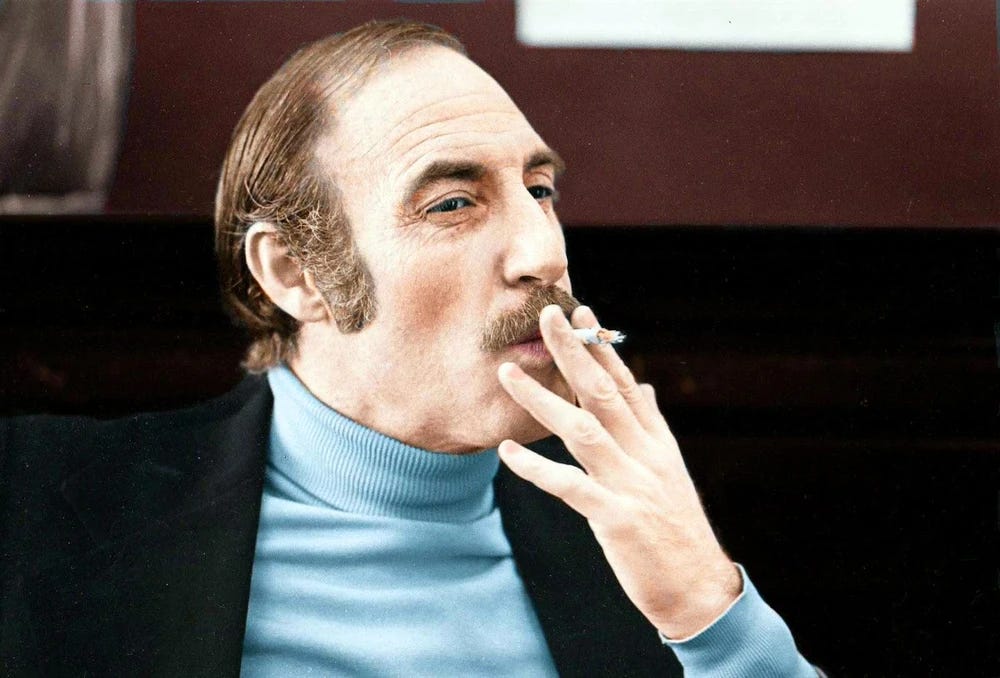
In short, Orlando Letelier was a Chilean Marxist diplomat under Allende who, after exile, became director of IPS’s Transnational Institute, serving as an agent of influence for the Cuban Dirección de Inteligencia (DGI), coordinating anti-Pinochet activities with East German-supported Chilean Socialists, and recruiting U.S. liberals for his revolutionary purposes. In 1975 he joined IPS as associate fellow and director of the Transnational Institute, receiving $1,000 monthly from Cuba disbursed by Beatriz Allende Ona, a former DGI courier and wife of Cuban DGI officer Luis Fernandez Ona.
Letelier had contacts with eleven Cuban officials including DGI agents Julian Rizo and Teofilo Acosta, thirteen East German communists including Politburo members, and Soviet KGB suspects like Valeriy Nikolayenko. He organized exiled Chilean Marxists, lobbied the U.N. and OAS, and recruited U.S. pinkniks under the false flag of human rights in order to isolate Pinochet economically, aiming for a Marxist restoration of Chile through violent revolution. Letelier would help form several IPS affiliates, such as the Center for International Policy (CIP) and the Council on Hemispheric Affairs (COHA).
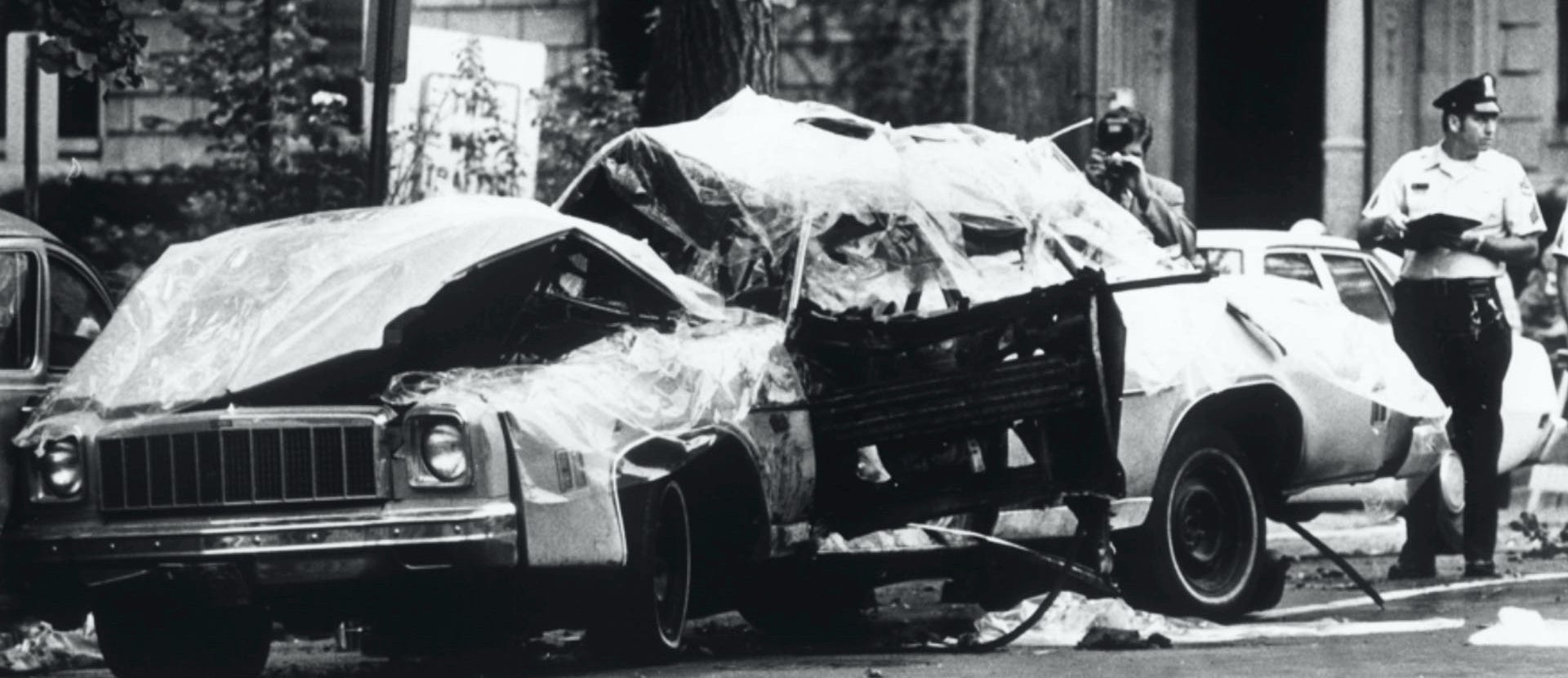
On Sept. 21, 1976, Letelier and Institute for Policy Studies staffer Ronni Moffitt were killed when a car bomb exploded as they drove around Sheridan Circle in Washington, D.C.; the FBI recovered their briefcase intact. Its contents included correspondence and records showing that he had been receiving financial support from the Soviet propaganda apparatus working through East Germany and Cuba, including his plans for a Cuba trip the next day.
Essentially, IPS provided Letelier with an open platform for his anti-Pinochet, Cuban-funded influence operations. After his assassination, the IPS sanitized Letelier’s files to ensure that materials that might compromise the Chilean resistance inside Chile or in exile would not fall into the hands of the FBI. IPS fellow Saul Landau wrote in the Washington Post that Letelier’s briefcase “contained no secrets” and accused right-wing elements of a smear campaign.
IPS portrayed Letelier as a quiet scholar studying wealth redistribution, and, through their already massive media influence, successfully downplayed his DGSI espionage. The institute even went so far as to establish the “Letelier-Moffitt Memorial Human Rights Award,” using the assassination for propaganda content. IPS influence extended to media outlets like the Washington Post and New York Times, spiking stories by investigative journalists Evans and Novak who were revealing Letelier’s communist links. The Post ran a coverup article by Lee Lescaze, another IPS fellow, and an op-ed by Landau. IPS continued to fund communist propaganda and network lobbying against U.S. policies in Latin America. Wikipedia, the National Archives and all of Western journalism still force the frame on the assassination itself, the Letelier briefcase revelations erased from the public record.
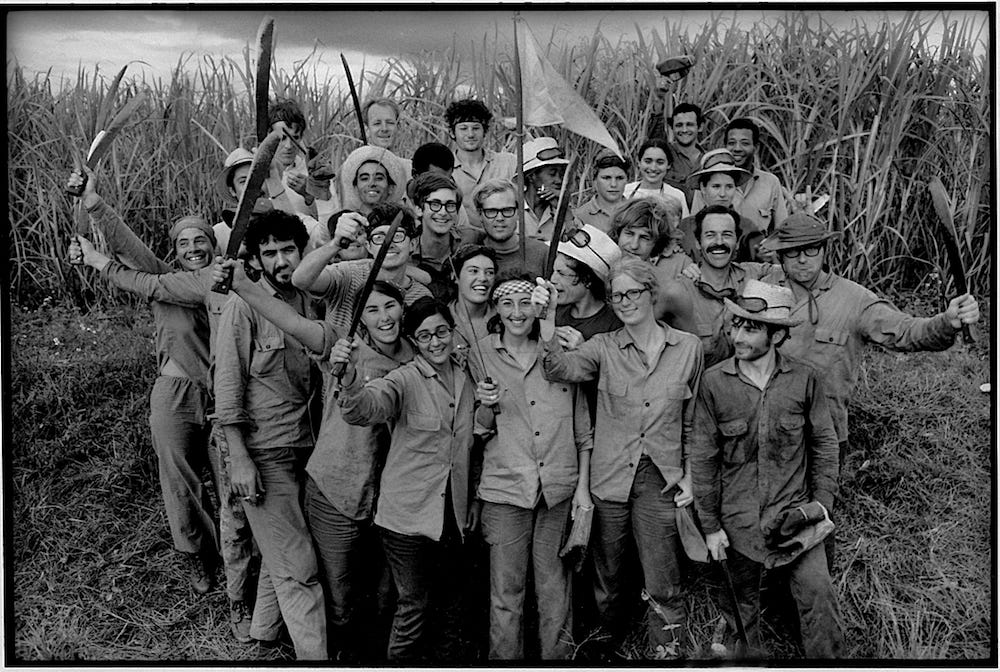
The IPS would also be interpenetrated with the Cuban Venceremos Brigade, a group that publicly presented itself as a Cuban solidarity/agricultural volunteer work program. IPS fellows and affiliates joined Brigade delegations to Havana, helped publicize the trips, and circulated pro-Cuba materials afterward. According to S. Steven Powell’s Covert Cadre and contemporary records, IPS-connected journalists and scholars (notably Saul Landau and others associated with IPS) were on these flights and later produced sympathetic reportage or propaganda.
Powell argues that these ties helped normalize and diffuse pro-Castro perspectives within certain U.S. policy and media circles. Subsequent defector testimony and declassified FBI/NSC material (e.g., Gerardo Peraza’s 1982 Senate testimony and subsequent agency summaries) confirm that Cuban intelligence deployed the Brigade as a recruitment opportunity and that DGI operatives cultivated contacts within the IPS/Brigade milieu—contacts who, in some cases, had links to broader IPS-linked networks, such as the SNCC.
By 1965, IPS had become a hub of revolutionary activism, having brought together such militants as Tom Hayden of the Newark Community Union Project, Jerry Rubin of the Vietnam Day Committee, and representatives from the Student Nonviolent Coordinating Committee (SNCC), SDS, the Mississippi Freedom Democratic Party (MFDP), and the Congress of Racial Equality. (Covert Cadre, Powell, 1987)
IPS was heavily involved in the student/negro revolution, employing or hosting former members of the Black Panther Party (BPP), CPUSA, Weather Underground Organization (WUO), and Students for a Democratic Society (SDS). IPS fellow Karl Hess sponsored the BPP and personally advocated violent overthrow of the government. The institute hosted a 1966 meeting where the BPP and seven other black militant groups formed the Black Power Alliance. IPS employed James Garrett, a former BPP leader, to direct the Center for Black Education, with its anti-American objectives and goal to train technicians for African liberation.
The interpenetration of the IPS with SNCC was even more intimate. Jean Wiley, while employed at IPS in 1970 as its first black female visiting fellow, lent her 1964 Dodge Dart to Ralph Featherstone, a black militant closely associated with Stokely Carmichael and H. Rap Brown. The car exploded due to a malfunctioning bomb timing device detonating the dynamite they were transporting, killing Featherstone and his companion William Payne.
In 1969, IPS Fellow Ivanhoe Donaldson and the SNCC leadership organization traveled to Puerto Rico with Stokely Carmichael to conclude a formal agreement between SNCC and the Movement for Puerto Rican Independence (MPI), a Cuban Communist-oriented revolutionary group now known as the Puerto Rican Socialist Party (PSP).
The IPS was at the eye of the storm, coordinating the chaos of the 1969 Chicago “days of rage” and “long hot summer,” coordinating with militant SDS rioters, providing logistical planning and funds. IPS served as a conduit for the Sam Rubin Foundation and Louis B. Rabinowitz Foundation funding anti-war activism through grants totaling $35,275 in the fiscal year 1968 alone, including $21,350 in student grants and $13,925 in “fellowships” to individuals linked to WUO.
IPS director Arthur Waskow directly sent $500 of his own money for bail during the 1969 Chicago “Days of Rage” riots and served on the New Mobilization Committee steering group, “the New Mobe,” another “umbrella” which “operated from its inception with significant domestic and international communist support” with a “basic pattern of communist participation that has remained a characteristic of all Mobe activity.” (House Committee on Internal Security, “Subversive Involvement in the Origin, Leadership, and Activities for the New Mobilization Committee to End the War in Vietnam and Its Predecessor Organizations,” U.S. House of Representatives, 91st Congress, Second Session, 1970)
Then, as today, the CIA and FBI played their COINTELPRO style games inside these organizations, sometimes radicalizing, sometimes deradicalizing, but never once arresting the people synthesizing the movement and coordinating the violence.
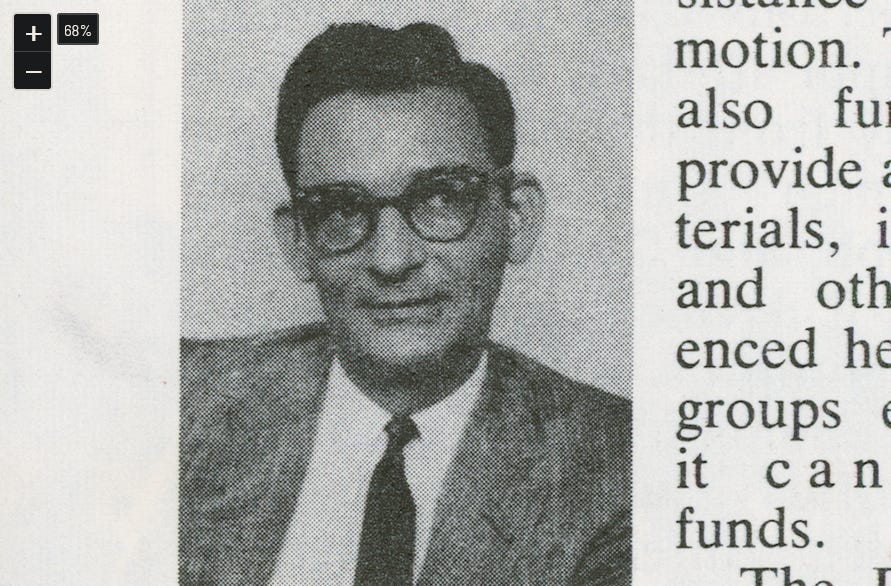
Jack Minnis, incidentally, was instrumental in creating the ISP-assisted MFDP (Carson 1995). He was also a sponsor of the SDS Radical Education Project (REP) for which ISP co-founder Marcus Raskin was indicted and subsequently acquitted of conspiracy to counsel draft evasion in the infamous Vietnam-era case.
REP called itself an “independent education, research and publication program, initiated by Students for a Democratic Society, devoted to the cause of democratic radicalism and aspiring to the creation of a New Left in America.” It claimed to have its own international espionage organization, which it called an ”international intelligence network.” REP cited as its international sources “Vietnamese rebels” and “Guatemalan guerillas.”
The Quaker terrorist-supporting American Friends Service Committee (AFSC) also assisted in such “intelligence” projects, with their National Action/Research on the Military/Industrial Complex (NARMIC), which served as the AFSC’s “intelligence-gathering arm”. NARMIC worked closely with the IPS, the North American Congress On Latin America (NACLA), a pro-Cuba research group, and other anti-defense and armament research organizations.

The Institute for Policy Studies was founded in 1963 by Richard Barnet and Marcus Raskin with initial grants from the Stern Family Fund and the Samuel Rubin Foundation (and, notably, by the son of Paul Warburg, James Warburg, who had been Allen Dulles’ assistant in the OSS). The IPS is one of the only institutions of the “New Left” that survived after the 1960s, known as a haven for 60s era extremists that were pursuing a strategy of infiltrating and influencing the political establishment.
In reality, it was cross-generational, with roots in the old left paradigm, continuing the influence of old left diehards like Communist Party member Samuel Rubin, whose fortune provided its chief source of financial support, and J. Irwin Miller’s Cummins Engine Foundation, regarded as part of the “avant garde of the civil rights movement.” Throughout the 60s, 70s and well into the 80s they were lauding Fidel Castro, raising funds for the Sandinistas, and attacking U.S. Central American allies for human rights issues.
The IPS is, like the original ACLU, a broad spectrum radicalization that ratchets the Democratic party’s debate internally to the left by creating an invisible presence in the party. To this end, it acts as the intellectual nerve center for any radical Leftist movement, anchoring together a loose-knit network of organizations whose only shared goal is altering American society and national policy in fundamental ways.
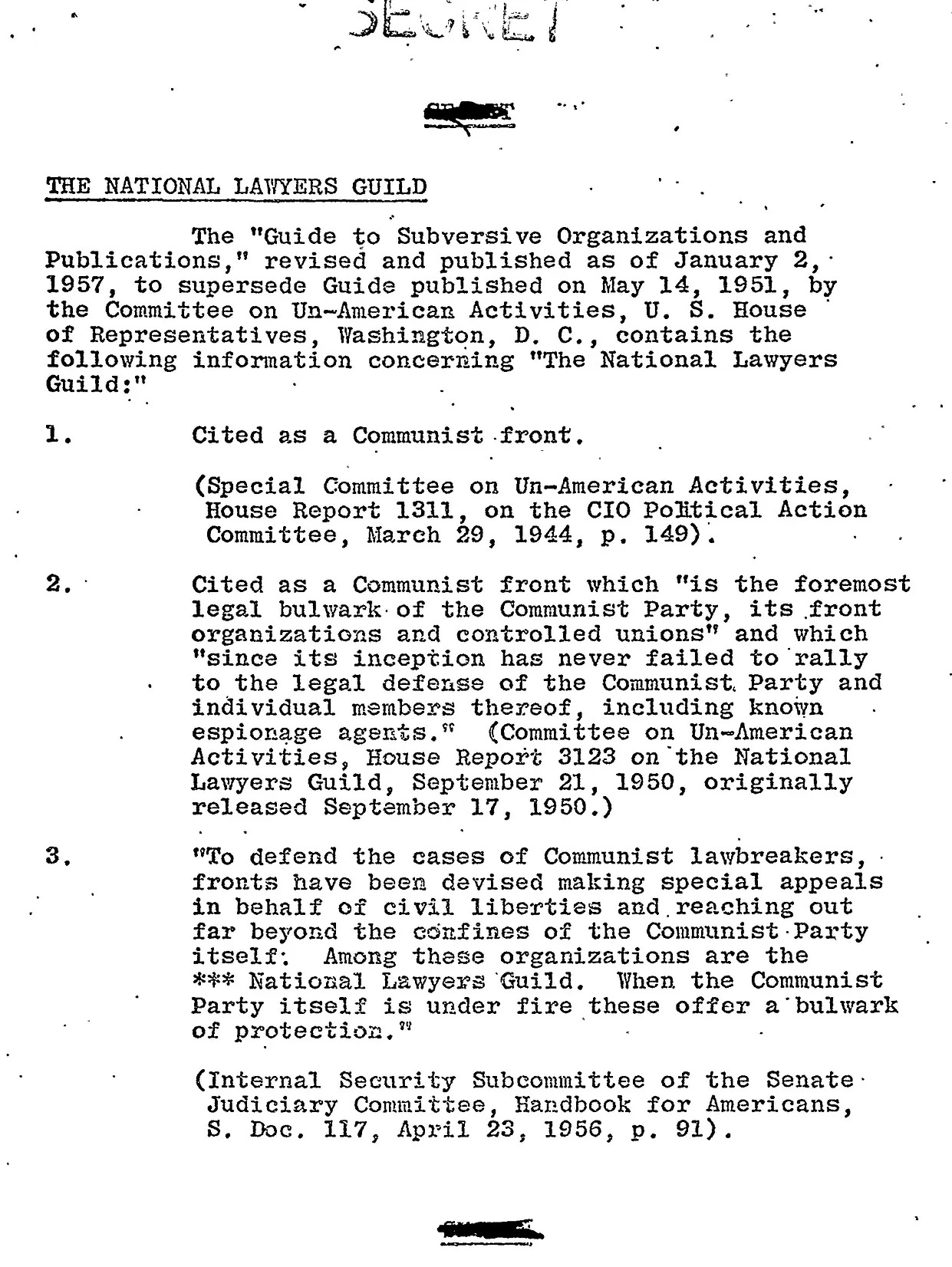
This radical rogue’s gallery has featured groups like the Committee in Solidarity with the People of El Salvador (CISPES), Clergy and Laity Concerned (CALC), Mobilization for Survival (MFS), National Lawyers Guild (NLG), the Southern Regional Council (SRC) and the Rainbow Coalition, which cooperate with one another in organizing demonstrations, sharing information and assisting foreign radicals.
IPS has variably acted as a physical base of operations, a counter-intelligence agency, a neurite bundle guiding Leftist tentacle-power, providing sustenance and operational coherence for a rotting bioleninist set of causes, ranging from anti-nuclear and anti-war protests to support for Marxist insurgencies and radical gender ideology, while bringing together activists and academics who can mingle with congressmen and other public figures. The IPS acts as a highly effective influence operation, while simultaneously pretending it doesn’t know how influence works when accused of courting foreign influence agents.
The IPS has consistently championed the “anti-anti-communist” stance and sponsored propaganda purporting that the “Soviet threat was a myth” and a figment of the military-industrial complex. IPS’s 1982 agreement with the Soviet Institute of the USA and Canada (IUSAC), an entity revealed by defector testimony to have been directed by the Soviet Comintern’s disinformation department, fostered exchanges on “peace and disarmament.” Though it advances a narrative that all its coordination efforts occur through spontaneous ideological synchrony, and, indeed, there is a great deal of chaos in its workings, it always moves in one direction, toward the inducement of entropy.
In short, the institute’s regimentation is anti-structure. Its core institutional DNA is the sympoiesis of rot. This would be the point of giving millions of dollars to a wily micro-cephalopod: to introduce entropy, transgress boundaries, pollute the collective conscience, escalate tensions, and turn the dial ambiguously leftward, to shift the color space of the American image. The IPS produces national psychodrama, but it is also structurally a psychodrama trap that anti-communists and investigative committees and have fallen into repeatedly. The organization revolutionized the art of pretending not to know what communism is, or how it works. Its imprint on progressive culture is evident: today, the Left now applies this art to everything all the time.
None of this is principled or ideological; it is purely biopolitical. Imagine the United States as a complex organism, and someone wants to graft it onto a hideous globular chimera with Russia and China. The U.S. must become somewhat more communistic, while the eastern powers must become somewhat more capitalistic.
The function of the IPS is to produce a critical amount of somewhat radicalism; its operative motive is not to “end American imperialism” or start a revolution, which would violate its own institutional instinct to self-perpetuate. All of IPS’s actions are directionally aligned toward weakening the national immune responses in preparation for transition surgery.
Solvere et infiltrare. The Left, in the main, hijacks and parasitizes the two most important centers of national cognition— securitization (sense of difference) and identification (sense of sameness). This wretched occulted technique mortifies the social filaments, putrefies normal signaling, secretes demodulators or agitators that “stain” the host’s behavior, discolors perceptual space, and thus the system becomes clarified into a new baseline. It then integrates, encysts itself into the host and re-modulates signals, culminating in altered states that increases the sympoiesis of rot. Somatic identities must be valorized, nigredic bodies must be secured; they must have disorder in the signs of difference and sameness, a torsion of the symbolic tradition, deforming the boundary locus into an alien geometry, into a place of suspension—there the parasite finds a passage.
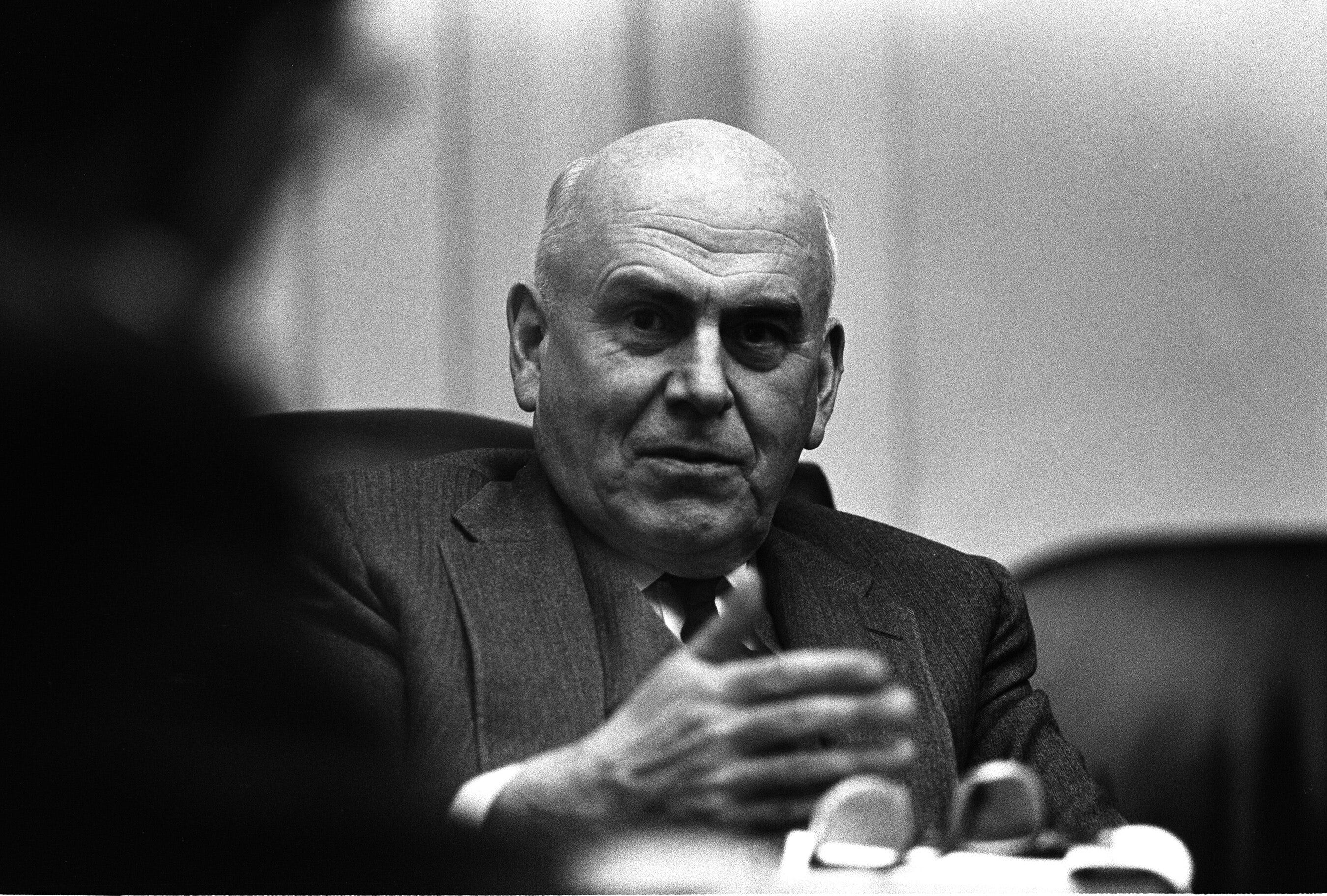
Richard J. Barnet, co-founder of the IPS, had previously joined the State Department in 1961 as an aide to John J. McCloy, and had been a fellow of the Russian Research Center at Harvard (Carnegie funded, a well known extension of the OSS/CIA [Price]), and, though it has been conspicuously neglected in most public reporting, a fellow of the lesser known Center for International Studies (CIS) at Princeton. In 1961, he was appointed a Foreign Affairs Officer in the Department of State’s Disarmament Administration; subsequently he became Deputy Director of Political Research for the Arms Control and Disarmament Agency.
In the year that Barnet co-founded IPS, along with Raskin, he was working as a Research Associate at the Center for International Studies (CIS) at Princeton University (1964; 1965; 1965). He wrote Security in Disarmament (1965) co-authored with Richard A. Falk, a Faculty Associate at Princeton’s CIS, and published under the editorial sponsorship of CIS in 1966. He also contributed to Falk’s The Strategy of World Order (1966), which was personally facilitated by Klaus Knorr. Falk would later become director of the center and was a senior fellow of the Institute for World Order. In fact, Barnet himself worked directly with Knorr (1965).
This is significant because in the 1960s, Dr. Klaus Knorr, a German emigré, was, in addition to his duties as Director of Princeton’s CIS, was also serving as a consultant to the DoD, the Institute for Defense Analyses, the RAND Corporation, the Office of Naval Research, and the Central Intelligence Agency. Cyril E. Black, an acquaintance of Barnet (1982), was also named as a member of the the covert advisory panel (1980).
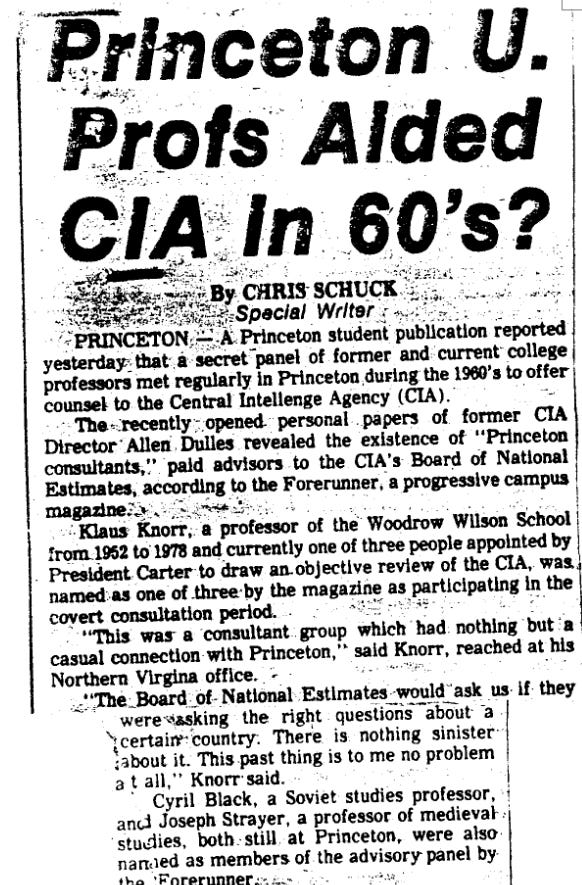
The so-called “Princeton Consultants” were established in November 1950 by William H. Jackson, then Deputy Director of Central Intelligence, as an external panel to review National Intelligence Estimates (NIEs) produced by the CIA’s Office of National Estimates (ONE). Princeton was an important “P-Source” and both the Center for International Studies and the Russian Research Center at Harvard were “area studies” or regions studies, a field created by the OSS/CIA after WW2.
Klaus Knorr and the other living members of this “college of cardinals” all denied any participation in covert operations. However, as noted by John Cavanagh in the original 1980 report, the memoirs of former “p-source” Calvin Hoover suggest that some of the “advice” provided by the Princeton Consultants was consistent with the preparatory work undertaken in plotting the CIA’s 1953 Iranian coup.
If Knorr’s protestations that the Princeton Consultancy “had nothing but a casual connection with Princeton” were indeed true, the situation is, in fact, much worse. As Cavanaugh’s reporting stresses, there were several instances where p-source’s “working relationships regarding CIA matters often carried over into their non-consultant work.” Many of them did it for the love of the game; some did it for their personal admiration of Allen Dulles; several went on to work directly for the agency. A horror story in three words: “Giving nerds power.”
The preparatory work of Barnet’s colleagues and mentors at the CIS at Princeton was not only consistent with coup planning, but with other covert projects, such as the radical co-optation and rebellion simulation in the vein of Project CAMELOT, the so-called “social science research project” of the United States Army that, coincidentally, started in 1964 and was canceled after congressional hearings in 1965.
IPS co-founder Marcus Raskin, incidentally, was a former aide to McGeorge Bundy, national security advisor from 1961 to 1966, after which, from 1966 to 1979, he presided over the “New Left” FF. Skull and Bones inductee Bundy was one of the founders of the Center for International Affairs, otherwise known as the “CIA at Harvard,” a thick cerebro-brachial tract innervating the tentacles of the Anglo-American Establishment.
The CIA at Harvard is another “intellectual nerve center” that has hosted a long list of current and former CIA luminaries. The center’s original managing co-directors were the infamous Henry Kissinger, who simultaneously held a post at the Rockefeller Brothers Fund, and Robert Bowie, future deputy director of the Central Intelligence Agency. One of the first two permanent faculty positions at the center was awarded to Thomas Schelling.
Schelling had been appointed a consultant to a multiyear, $50 million Department of Defense counterinsurgency study, known by the sobriquet Project Camelot, “one of the most infamous Cold War social science projects.” Sometimes called the “Manhattan Project of social science,” Camelot’s formal title was “Methods for Predicting and Influencing Social Change and Internal War Potential.” Its mission was “to find nonmilitary and nonviolent solutions to international projects” and make breakthroughs in “peace research.” Critics said Camelot was actually “the most conspicuous of several military-funded efforts to comprehend, contain, and combat political insurgency in the volatile new nations of the Cold War world.” (Smith 2019)
In addition to being “anti-imperialist,” and “anti-anti-communist,” the IPS has always been stridently anti-CIA. So why would the intelligence community simulate an audience of critics and gadflies? Kathryn Olmsted concludes in Challenging the Secret Government that the Pike and Church committee hearings backfired, rather than opening the Agency to detailed scrutiny and oversight, the CIA was permitted to become even more insulated from external accountability.
The IPS position is that the CIA should be 100% dismantled. Richard Barnet maintained that the United States could unilaterally cease all intelligence functions and there would be no impact on American security. He criticizes the CIA’s covert actions and clandestine intelligence as a “dirty tricks department” and a “criminal enterprise,” and glosses over the KGB’s record of murder, theft, torture, and forgery. IPS also created the Center for National Security Studies, whose goal was to “ban all American covert action.” This is fine rhetoric for Chomsky-reading college students, but, in reality, the impractical and extreme rhetoric of radical communists acts as advertising for more CIA, increased transparency, and bigger budgets.
Barnet always had access to “former CIA officers” like Victor Marchetti and Philip Agee. In fact, the CIA is so amused by the Barnetian style of critique he was invited to a senior seminar in late November 1971—
“I was invited to attend one session and to give my views on the proper role of the Agency. I suggested that its legitimate activities were limited to studying newspapers and published statistics, listening to the radio, thinking about the world, interpreting data of reconnaissance satellites, and occasionally publishing the names of foreign spies.” (1971)
The IPS campaign against the deep state is said to operate by “working within the system” to irritate Congress into passing restrictive legislation on intelligence activities. Pursuant to this goal, IPS provided a platform and material support to figures like Philip Agee, a former CIA officer who defected and worked with Cuban and Soviet entities to expose and disrupt CIA personnel and operations.
…Philip Agee, one-time CIA agent who specialized in identifying and undermining CIA operations and agents around the world, while cooperating with Cuban intelligence.” (Agee wrote in Esquire in June 1975: “I aspire to be a communist and a revolutionary.”) Agee was expelled from Great Britain in 1977 for disclosing information harmful to British security and for associating with foreign spies. Agee held dozens of meetings with the Cuban intelligence service, the DGI, and its station chief, as well as other Cuban and Soviet-bloc agents. (Klehr 1988)
Agee was persona non grata, refused residence by all NATO countries until the Netherlands decided to admit him. While in Amsterdam he was provided residence by TNI (IPS international branch). Another clue comes from Dutch reporting: “Agee wanted to set up a databank of CIA agents and their contacts in order to reveal their names. Agee’s claim that his research would be based solely on public domain documents contrasted with a Newsweek interview in which Agee referred to the exposure of secret CIA operations in order to render these ineffective.” If he could succeed in this, then he’d be gifting the CIA a pretext to limit FOIA even further.
In 1975 Richard S. Welch, CIA Chief of Station in Athens, was murdered outside his home on 23 December 1975; the Greek urban guerrilla group Revolutionary Organization “17 November” claimed responsibility. In the weeks beforehand, his name and CIA affiliation had been published or republished in several fora (Greek newspapers such as Athens News and Eleftherotypia were among the local outlets that carried his name/role in late 1975), and his name had appeared in earlier compilations (notably the 1968 East German Who’s Who in the CIA) and in CounterSpy’s pages in the mid-1970s.
Which single public disclosure ~ if any ~ directly enabled the assassination remains disputed. Incoming CIA director George H. W. Bush and other U.S. officials publicly singled out Philip Agee and CounterSpy in the immediate aftermath. Agee later helped launch the Covert Action Information Bulletin (1978), and CAIB-related naming campaigns (including the public naming of alleged U.S. operatives in Jamaica in 1980) also contributed to the political controversy that gave the CIA new powers and protections, and created a spectacle that increased Agency recruitment.
Marcus Raskin served for two years on the board of the Organizing Committee for the Fifth Estate, which published CounterSpy. The IPS-promoted international clown-op, and Agee’s purported exposure of active CIA agents and operations in publications like CounterSpy and Covert Action Information Bulletin, prompted the passage of the Intelligence Identities Protection Act of 1982, commonly known as the “Anti-Agee Act.”
The statute made it a federal crime to name covert agents and gave the CIA an administrative and political argument to push for DOJ investigations, demand source subpoenas, and press for prosecutions. It allowed the CIA to target journalists based on vague “pattern of activity” criteria, which a still-cognizant Sen. Joe Biden argued would “curtail legitimate journalistic scrutiny.” Basically, it brought the already-powerful CIA one step closer to becoming a full-fledged American cheka.
Suspiciously, the relevant statute has been invoked only a handful of times; this is because the purpose was to induce a “chilling effect,” which it has succeeded in doing. Consider the reduced quality and number of investigative reports on CIA activities after 1982. Like all such ratcheting up of the security apparatus, the Act is modular, and in the 2019 NDAA there were proposed expansions to remove the overseas limit and extend application to domestic or retired personnel.
Agee describes the predictable outcome of his activities in Dirty Work (1978):
The CIA, for all its sins, came out of the recent investigations strengthened by the Ford “reforms,” while the Congress may attempt to pass an official secrets act that will make it a crime for any current or former government official ever again to blow the whistle by making public classified information. No more Pentagon Papers. No more Watergate revelations. No more CIA Diaries.
The FBI, CIA, the Office of Naval Intelligence, the Army’s Counter Intelligence Corps, and the metropolitan D.C. police department investigated IPS for five straight years, deploying an array of illegal government surveillance activities, including the burglary of its offices, telephone wiretaps, mail tampering, theft of documents, and infiltration by paid informers. Lawyers for the anti-McCarthy National Emergency Civil Liberties Committee (NECLC), David Rudovsky and David Kairys appeared to defend the institute, and managed to force the government to concede it had “absolutely no evidence of any criminal activity on the part of IPS or any of its employees.” Another advertising campaign; another triumph for the global conspiracy as written in the Protocols of the Learned Elders of Nothing Happens.
The entire intelligence apparatus looked into the IPS and was transfixed, frozen in an auto-hypnotic trance. No crime was found in the infinite recursions of that mobius labyrinth, because the perfect crime had already been committed, the crime against reality. The overwhelming primacy of the security state in this situation, the unknown trillions poured out through USAID and other funding instruments, growing unchecked on a seventy-year timeline, leads to the fusion of a gorgonic Rat King, screaming, paralyzed, for twenty-four hours every time it sees its own reflection.
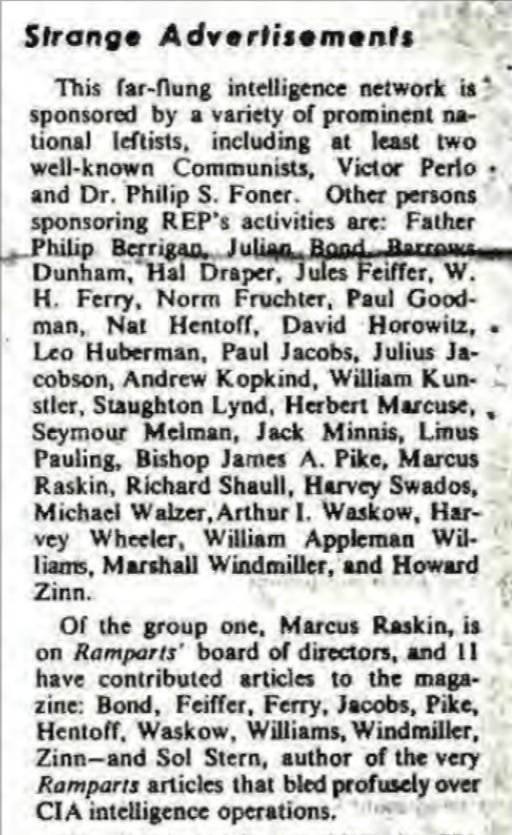
Much of the funding for Ramparts came from the Center for the Study of Democratic Institutions (CSDI), founded by Robert Maynard Hutchins, head of the FF (again), associate of Aldous Huxley, and Humphry Osmond. CSDI funded cybernetic symposiums with names like “Conference on the Social and the Philosophical Implications of Behavior Modification.” In 1962, the center would publish the widely read report of social psychologist Donald N. Michael, Cybernation: The Silent Conquest, wherein the term “cybernation” was coined.
Professor John Wilkinson of the Center for the Study of Democratic Institutions tells us that, “Since the religious object is that which is uncritically worshiped, technology tends more and more to become the new god.” Although this is true for all of modernity, Wilkinson notes that it is a fortiori so for the Marxist world.
Referring back to my favorite “Machiavelli of non-violence” Jack Minnis, his sloppy Chronology also listed, among the many SNCC performers, an incident where two white activists were dragged from a car and brutally beaten by anonymous southern racists. One was named Paul Potter of Philadelphia, the vice president of the National Student Association (NSA).
In February 1967, the left-leaning Ramparts magazine revealed that the CIA had, for years, secretly provided funds to the National Student Association. The NSA is also listed in the HUAC documents as part of the Committee for International Student Cooperation, a communist-dominated umbrella group supporting the International Union of Students (IUS), an egregiously Soviet front group. - (Report on the Communist “Peace” Offensive: A Campaign to Disarm and Defeat the United States” 1951). Paul Potter, the supposedly pummeled protestor, would admit to “suspecting” this was the case for some time.
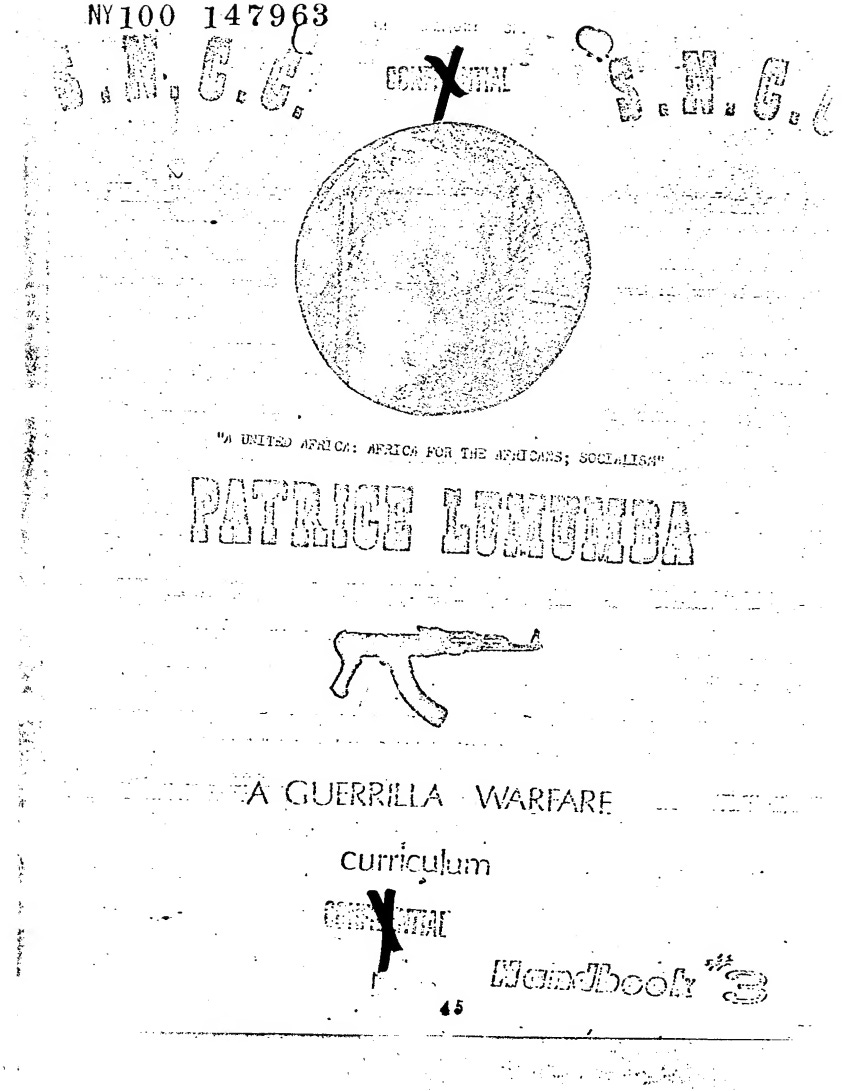
The CIA’s NSA was especially instrumental in its work with the radical SDS and SNCC, and its foundational structuring and networking efforts appear throughout their early bulletins and meeting minutes. Even the CRS “scholar-practitioner” James Laue, in his The Changing Character of Negro Protest (1965), lists the NSA as a long-time anti-segregation “educationist.” However, there is sparse mention of the NSA’s role in the many histories valorizing the Civil Rights period, and, even when mentioned, it is done briefly with the CIA-backing glossed over as an anomaly. Shockingly, the NSA was not only receiving “illicit funds,” which is how it is referenced in most media, but there was a “control group” among its top leadership consisting of CIA agents (Hayden 2009).
From a follow-up Ramparts article in the March 1967 issue: “In the ’50s, NSA took even more liberal stands than the prevailing apathy among students might have suggested. In the ’60s, the NSA responded to the new militant protest mood on the campuses. They supported students against the draft, opposed the war in Vietnam, and participated in civil rights struggles. It played a crucial role in the formation of the Student Nonviolent Coordinating Committee and was one of its staunchest supporters, a position which cost it the affiliation of many schools in 1961.”
The CIA was not only funding the student association, but was in full control of the NSA. Made apparent by the diary of NSA staffer Larry Rubin detailing staff meetings and the internal National Supervisory Board (NSB) investigation from January 30, 1967 to February 19, 1967:
— “The NSA was not used as spies.” The [NSA] officers put out this lie immediately after they found out about the Ramparts ad, to pre-empt the story. The staff got furious about this, and in the final statement by the NSB, they admitted the spying.
— The rent on the building, of course, was being paid for by the CIA.
— The senior officers initially denied to the staff that their response to the Ramparts article was being worked out with the CIA. Later they admitted this to the press …
The CIA would suggest programs that NSA should carry out.
The height of CIA influence was in the early ’60s when they were supporting about 80% of NSA’s total budget. NSA almost went bankrupt in ’63 and the CIA got it out of the red …During this period, CIA people attended most International Commission meetings (at the headquarters in Phila.). Some of the meetings were actually led by CIA people, who would directly tell the I.C. staff what they could or could not do.
There you have it: the CIA, in effect, kickstarted the revolutionary communist SNCC, which would give rise to the radical, Castroist Stokely Carmichael and the black militant movement. That aside, according to James Laue and many others, it was the SNCC that provided much of the charismatic force which brought the desegregation movement to its highest peak of energy and effectiveness. It is a historical fact that a CIA-controlled group, the NSA, redesigned the governance apparatus of SNCC to keep it from disintegrating (Johnston 2009).
Former CIA case officer John Stockwell described the agency’s Foreign Resources Division as its “domestic covert operations division,” bringing professors and students into the warm embrace of CIA case officers at “every major campus in the nation. They work with professors, using aliases on various programs. Their activities include building files on students whom the professors help them target.”
The CIA parallax celebrates this fact in their official internal history:
The Association’s civil rights activities and programs began expanding rapidly in 1960. NSA offered financial and legal aid to black students engaged in lunch counter sit-ins in the South. It also played a role in the formation of the Student Non-Violent Coordinating Committee (SNCC). SNCC, in fact, grew out of an NSA Workshop designed to teach political organizing skills to Southern students [REDACTED]. For several years, NSA’s national affairs vice president held an ex officio seat on SNCC’s board.“ National affairs vice presidents such as Tim Jenkins and Paul Potter Worked closely with student activists and radicals, keeping NSA for a time in the vanguard of the civil rights movement. [REDACTED] (1999).
The incoherent lie that the Left was told to square this circle was “[t]he purpose of [CIA control] was to cultivate a fresh new generation of reliable anti-communists to compete with Moscow for world opinion.” This framing was put into place from the beginning, by the writers of Ramparts magazine, in alignment with the CIA party line (1999).
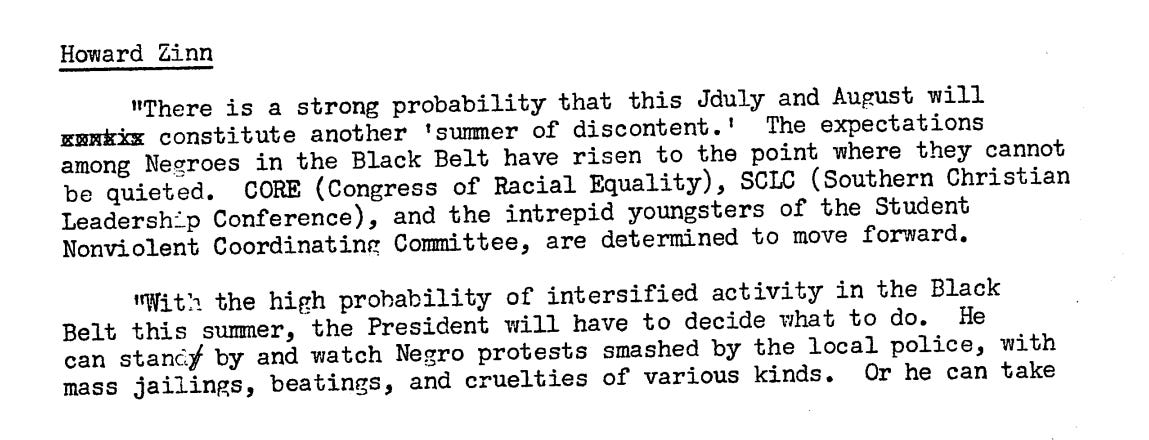
My mind is boggled. I have no idea how they ever recovered from this, never took a single step of extrapolation toward what this meant. SNCC was never anti-communist— from 80 names that I pulled out of the 1964-1965 FBI files on SNCC, about 30 of them were directly active in or members of revolutionary communist groups, far exceeding the number of reds it takes to derail an organization. One of the co-founders of SNCC, Ella Baker, and her fellow agitator Bayard Rustin, introduced secret Communist Party USA member Stanley Levison, the CPUSA’s top money man, to MLK.
For concision’s sake, the image presented by Ramparts, the CIA internal history, and books like Patriotic Betrayal— that from 1950 to 1967 the CIA secretly funded, controlled, and manipulated the National Student Association (NSA), the largest and most influential U.S. student organization, turning it into a willing instrument of covert “anti-communist propaganda abroad” does not even attempt coherence.
This narrative is only believable if you are unaware that McCarthy was vindicated; if you know that Eisenhower and the entire establishment waged a total information war against him for his anti-communism (Nichols 2017), the narrative starts to fall apart. You must also not know that the CIA and the security apparatus were extensions of the New Deal establishment, stuffed with East Coast “democratic socialists,” left-liberal communist-sympathizers and literal communists. And, finally, you don’t have to know that the CIA-front NSA not only structured and legitimized an organization with goals exactly parallel to a communist-front, but was micro-managing its activities in the South, not abroad, during the Mississippi invasion, funneling money from the Fields and Taconic foundations to bail out agitators when arrested for their criminal anarchy (Paget 2015). As former CIA employee Patrick J. McGarvey said in his C.I.A., The Myth and the Madness:
“Seldom, if ever, will you find a CIA agent who is a dedicated anti-Communist”.
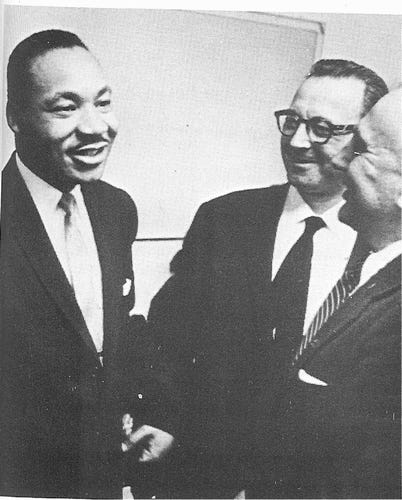
By 1963, Baker was formally associated with the Southern Conference Educational Fund (SCEF), a HUAC-designated communist front, serving as a “special consultant.” In circa 1962, another SNCC co-founder, John Lewis, was listed as Vice Chairman of the Southern Region Committee of the National Committee to Abolish the House Un-American Activities Committee (NCAHUAC), a Communist Party USA (CPUSA) front.
The SNCC-COFO affiliate, Congress of Racial Equality (CORE), was almost entirely controlled by the massive funding and influence of its patron, the FF. It was “Ford Foundation’s vision [of organizing that] ultimately prevailed,
Having found a model to control the black community by containing it according to its pluralist model, the Ford Foundation would use its experience with CORE in Cleveland as a base to complete its vision for African Americans in post-civil rights America.
The FF, helmed by the exemplary Mr. Deep State McGeorge Bundy. From 1964 to 1966, he was also chair of the 303 Committee, responsible for coordinating government covert operations (1964) (2001). During the Civil Rights era, the FF was essentially an extension of the CIA. This fact is not the least bit controversial, straight from Wikipedia:
At the height of the Cold War, the Ford Foundation was involved in several covert operations … From 1958 to 1965, the Foundation’s chairman was John J. McCloy, who in 1942 had founded the Office of Strategic Services, a secretive intelligence agency that became the Central Intelligence Agency. McCloy knowingly employed numerous US intelligence agents and, based on the premise that a relationship with the CIA was inevitable, set up a three-person committee responsible for dealing with its requests. The CIA channeled funds through the Ford Foundation as part of its efforts to influence culture. (2025)
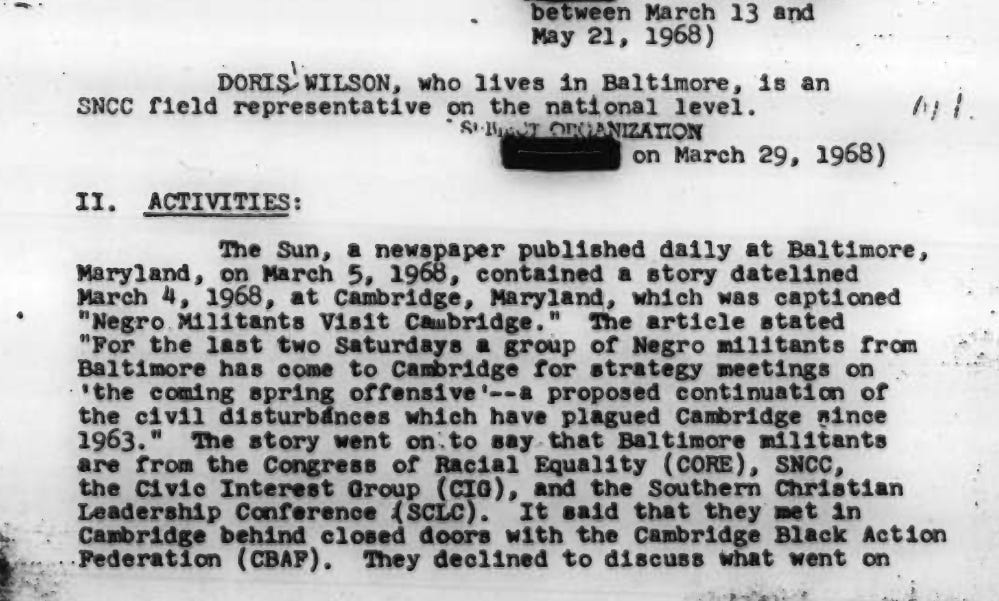
In the early 1960s, before CORE sought FF support, it helped organize the communist, foreign-agent-funded SNCC–COFO Mississippi Freedom Party under the direction of David Dennis, CORE’s Mississippi director. The FF began funding CORE in 1966, and between 1966 and 1968 CORE and its affiliate groups grew markedly more militant, violent, terroristic and openly revolutionary-communist.
However …. A charitable reading of Rampart’s suggestion of an “anticipatory” function is legitimate. Not only the CIA, but the foundation “interlock,” and the Anglo-American establishment in general see the inception and simulation of rebellion as a pre-emptive bulwark against social disorder. That is the logic of the controlled burn. By co-opting the inclement gesticulations, they get to define the terms and channel the energies into organizations that can be controlled, or at least designed to have a limited life-span. All one must do is recall the mysterious Jack Minnis-type command and control agents.
But even this “anticipatory” framework is a fig leaf. Such lies have been told about intersectionality, the transgender “industrial complex,” and the 1960s psychedelic craze, but all of those were media events disseminated from above, and each merely synthesized an audience through massive psychopolitical advertising campaigns, foundation-incited “fact overproduction,” and identity-marketing blitzes in publications like Time/Life.
One of the main functions of networks like IPS-Ramparts-REP is to funnel cash flows to commedia puppets, shills and establishment stooges to produce the hallucination of a broad organic community. As an October 1971 FBI report said of the Institute:
“The popular impression of IPS as the “think tank” of radical United States politics is justified. It has taken and continues to take a major role in the antiwar movement and calls for disarmament. While IPS people see themselves as leaders of radical thought, they would appear to be leaders without a popular constituency.”
The Fabian Master Key
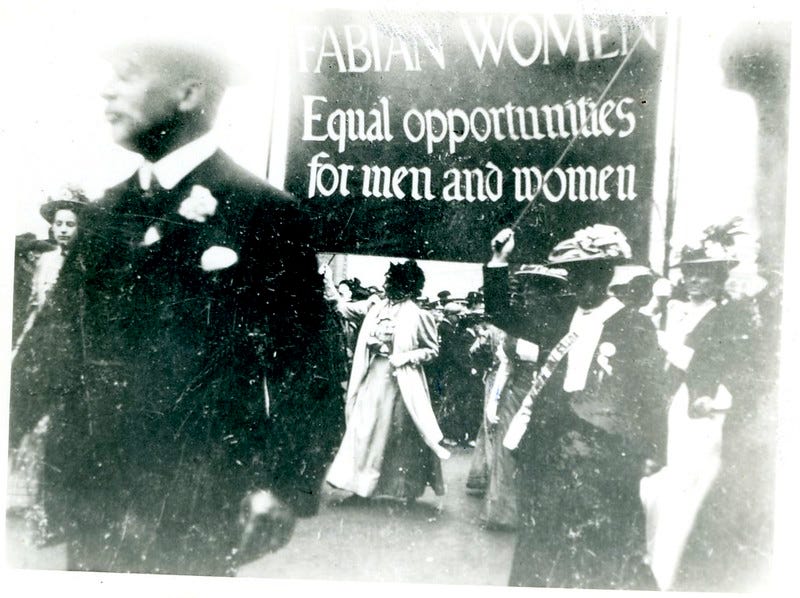
Let’s square this circle with Fabian geometry. The Weather Underground splintered from the Students for a Democratic Society, which began as the Student League for Industrial Democracy (SLID), the youth affiliate of the League for Industrial Democracy (LID). Hailed at its 40th Anniversary dinner as “America’s Fabian Society,” LID was the successor to the Intercollegiate Socialist Society, founded by Upton Sinclair (“muckraker,” radical reformer, godfather of remote viewing (!) with his Mental Radio (1930) cited in STARGATE documents, together with the infamous father of media critique, Walter Lippman, former intelligence officer, author of Public Opinion (1922), and progenitor of cyber-mesmeric neoliberalism, also called “social liberalism” or “biopolitics.”
During that same 1945 LID Anniversary dinner at the Hotel Astor in New York City, Arthur Creech Jones, a Labor MP, member of the British Labor Party Executive Committee, and chairman of the “Fabian Colonial Bureau,” declared “We anticipate before long that our movement will be in power … We believe that the time will not be very far off after the making of peace in Europe … The movement is preparing for this great opportunity.”
The first issue of their official magazine, The American Fabian, printed by the nascent society in February 1895, outlined its objectives in America. At the top of their list was to effect a series of changes in the constitution itself “that would make possible the introduction of state socialism step by step in the United States.”
Before the year ended, his prediction had become a reality. To the astonishment of most of the world, the British people renounced their wartime leader, Winston Churchill. Instead, they voted into office a Labour Party government dominated by a secret society of Fabian Socialist intellectuals who were pledged to dissolve the Empire and the economic structure sustaining it. Only the Fabians and their friends showed no surprise. That little band of prophets knew in advance what the election returns would be. Through a combination of long-term “research,” a coldly calculated appeal to mass psychology and a deep-dyed duplicity, Socialism had achieved full power in Britain by Constitutional means.
—Fabian freeway: high road to socialism in the U.S.A., 1884-1966, Rose L. Martin
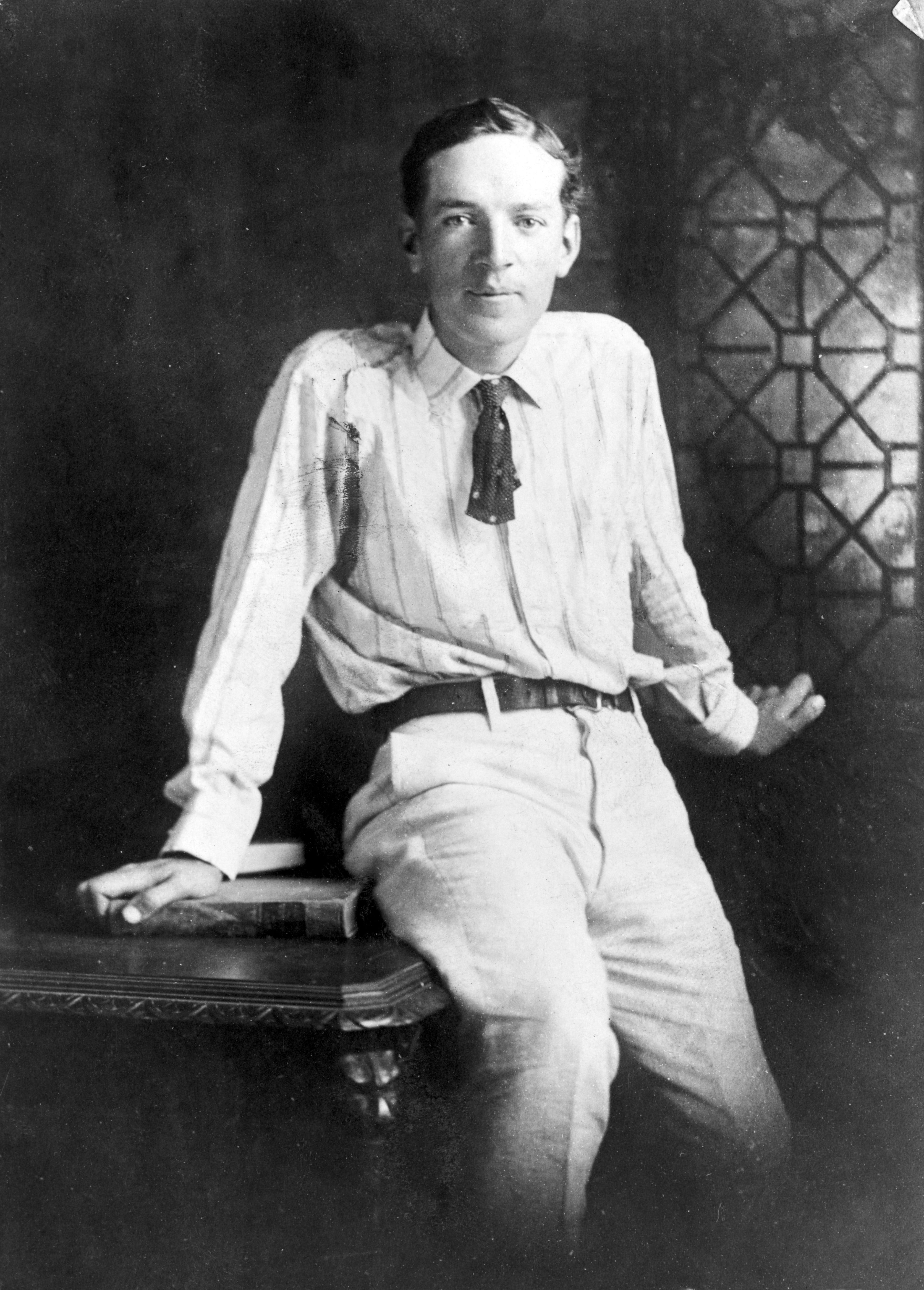
Upton Sinclair was one of the founders of the American Civil Liberties Union (ACLU), originally formed as the National Civil Liberties Bureau (NCLB) in 1917 by Crystal Eastman and Roger Nash Baldwin. In 1927, the Justice Department’s Bureau of Investigation (predecessor to the FBI) summarized the NCLB’s “real objects” which included:
To assist any radical movement calculated to obstruct the prosecution of the war, as evidenced by the Bureau’s activities in collecting funds for the I.W.W. [Industrial Workers of the World, a global communist organization that split with the Bolshevik Comintern over tactical differences] and “Masses” defense.
…
In issuing propaganda literature through publications in high
standing in order to influence public sympathy toward the I.W.W.,
conscientious objectors and radical organizations.
…
“Boring from within” churches, religious organizations, women’s
clubs, American Federation of Labor, etc. in order to spread
radical and pacifist propaganda.
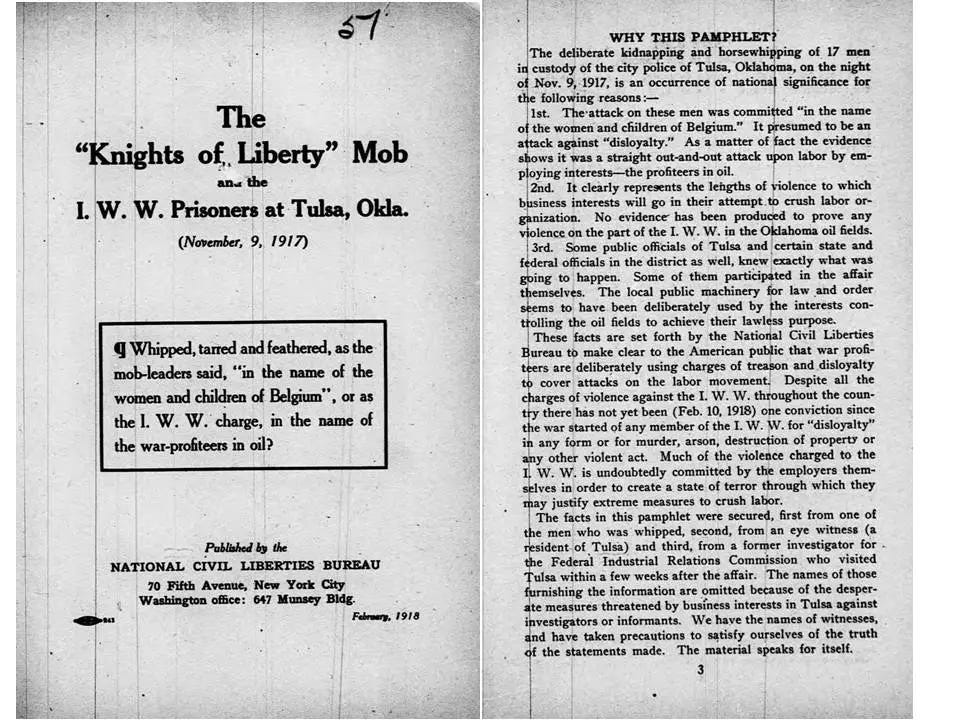
The NLCB functioned as an ideological laundering and full spectrum radicalization group. After having their records seized by military espionage under indictment for espionage, the organization would rebrand as the ACLU, and their methods would become protocol for other “umbrella groups” like Stephen Currier’s Council for United Civil Rights Leadership (CUCRL). Such steering committees coordinated a sprawling fund-funneling network extending from the Ford, Rockefeller, and Taconic foundations into the coffers of black militant revolutionaries, and to “scholar-practitioner” handlers recruited to regulate the temperature of negro and student groups that would otherwise incinerate overnight.
In 1954, the Reece Committee, on the power of this overarching syndicate, the aptly named tax-exempt “interlock”—
The power of the individual large foundation is enormous. It can exercise various forms of patronage which carry with them elements of thought control. It can exert immense influence on educational institutions, upon the educational processes, and upon educators. It is capable of invisible coercion through the power of its purse. It can materially predetermine the development of social and political concepts and courses of action through the process of granting and withholding foundation awards upon a selective basis, and by designing and promulgating projects which propel researchers in selected directions. It can play a powerful part in the determination of academic opinion, and, through this thought leadership, materially influence public opinion. This power to influence national policy is amplified tremendously when foundations act in concert.
—Reece Committee, U.S. House, Tax-Exempt Foundations (1954)
In a 1991 interview with G. Edward Griffin, Norman Dodd recounted the FF president, H. Rowan Gaither, stating off-the-record: “Mr. Dodd, we are here to operate in response to similar directives, the substance of which is that we shall use our grant-making power to so alter life in the United States that it can be comfortably merged with the Soviet Union.” Dodd, a former banker, was chief investigator in 1953 for the Special Committee on Tax Exempt Foundations (commonly referred to as the Reece Committee), chaired by U. S. Congressman B. Carroll Reece.
Despite McCarthy’s redemption, the left-liberal historical consensus still frames every single investigation into communist sedition as exaggerated or “Red Scare”–era smears, despite revelations from the Cox and Reece Committees, the Venona Project, the Soviet archives (briefly opened 1992–1996) and the Mitrokhin archive (smuggled out by KGB archivist Vasili Mitrokhin and published 1999–2005) which all, incidentally, substantively corroborate each other and expose a coherent reality where the so-called “Red Scares” were completely justified. If anything, the “anti-communist hysteria” was insufficiently kinetic.
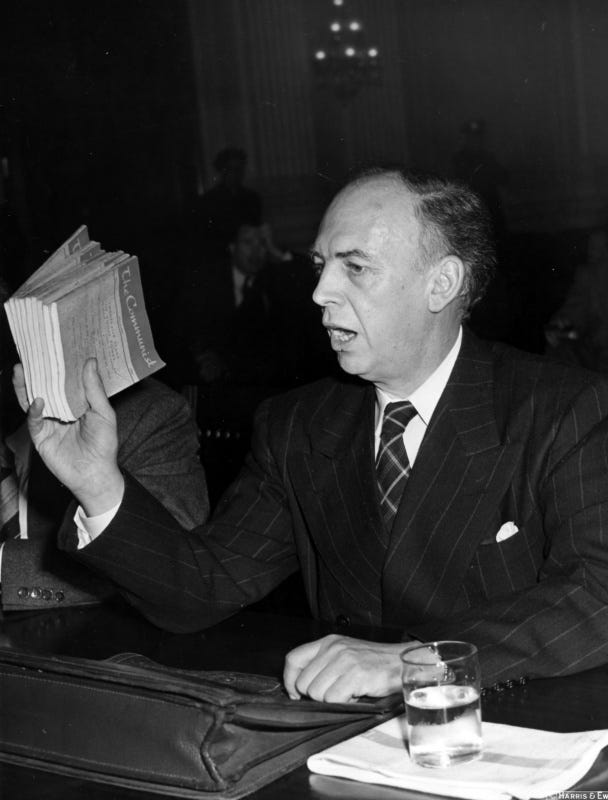
Louis Budenz, a labor activist and communist defector, testified before the Cox Committee on December 2, 1952. Budenz was a former managing editor of the Daily Worker, a member of the CPUSA National Committee 1935–1945, and had defected in 1945, and would later confess that he had participated in espionage on behalf of the Soviet Union. From the transcript:
“The Party had a special commission on foundations beginning in 1936… Frederick Vanderbilt Field was the key liaison man. We were instructed to get money from the Marshall Field Foundation, the Garland Fund, and especially the American Fund for Public Service… By 1940 we were receiving regular grants from several of these tax-exempt sources which were used for Communist propaganda and agitation.” Budenz listed over $300,000 diverted to Communist causes from 1936–1944 through these foundations.
Igor Bogolepov testified before the Cox Committee on November 24, 1952. He was a former official in the Soviet Foreign Office (1931–1947), and defected in 1947. From the official transcript (Hearings, pp. 90–112): “Stalin personally told us in 1936 that Western intellectuals were the chief instrument for revolutionary change in their own countries because they were dissatisfied with the capitalist system and could be used without them knowing it… The Comintern was instructed to cultivate American foundations, universities and learned societies as sources of money and as channels for propaganda.” Bogolepov named the Rockefeller Foundation (RF) and Carnegie Corporation as primary targets, stating that Soviet agents were directed to “penetrate the boards or secure sympathetic intermediaries.”
These testimonies were substantively corroborated by two other former high-ranking Communist officials before the Cox committee, multiple subsequent defectors, the entire body of cable leaks and archival releases, and the veracity of their claims is observable in the historical record of America’s dissolution into race communism. Despite the sloppy attempt to reframe credible defectors,
For example, despite character assassination attempts that stand on dubious citations, Joseph Zack Kornfeder was considered a reliable information source by the entire military-intelligence reticulum (USNI 1954) (NYT) (SSRI 1966) (ASTIA), and was ultimately vindicated by history:
The plan of using African Americans for the Kremlin’s geopolitical agenda was authored by Nikolai Nasonov (1902–1938), a member of the Russian Communist Party (Bolsheviks) and the head of the Negro Bureau at the Eastern Secretariat. The Bureau was established on December 25, 1928, and was transformed into the Negro Section of the Eastern Secretariat in September 1929. It focused on matters concerning the life of Black people in the United States and … conducted propaganda and agitation work …
[Nasonov] wrote African Americans could be a tool for fomenting the situation in the United States while inspiring the situation in colonies. According to him, the black population of the Black Belt should be considered a “nation” to eventually create a “national liberation movement” to undermine American imperialism.
—Dr. Michal Wojnoski, Warsaw Institute, 2022
Yet everywhere in the media and academe it is suggested that the FBI and its precursor, the Bureau of Investigation (BoI), exaggerated or misrepresented the threat of communist infiltration and the radical motives of communist-fronts like the ACLU. This lie is maintained, ironically, by truly Soviet levels of intellectual regimentation, state-assisted surveillance, self-censorship, and neurotic self-deception.
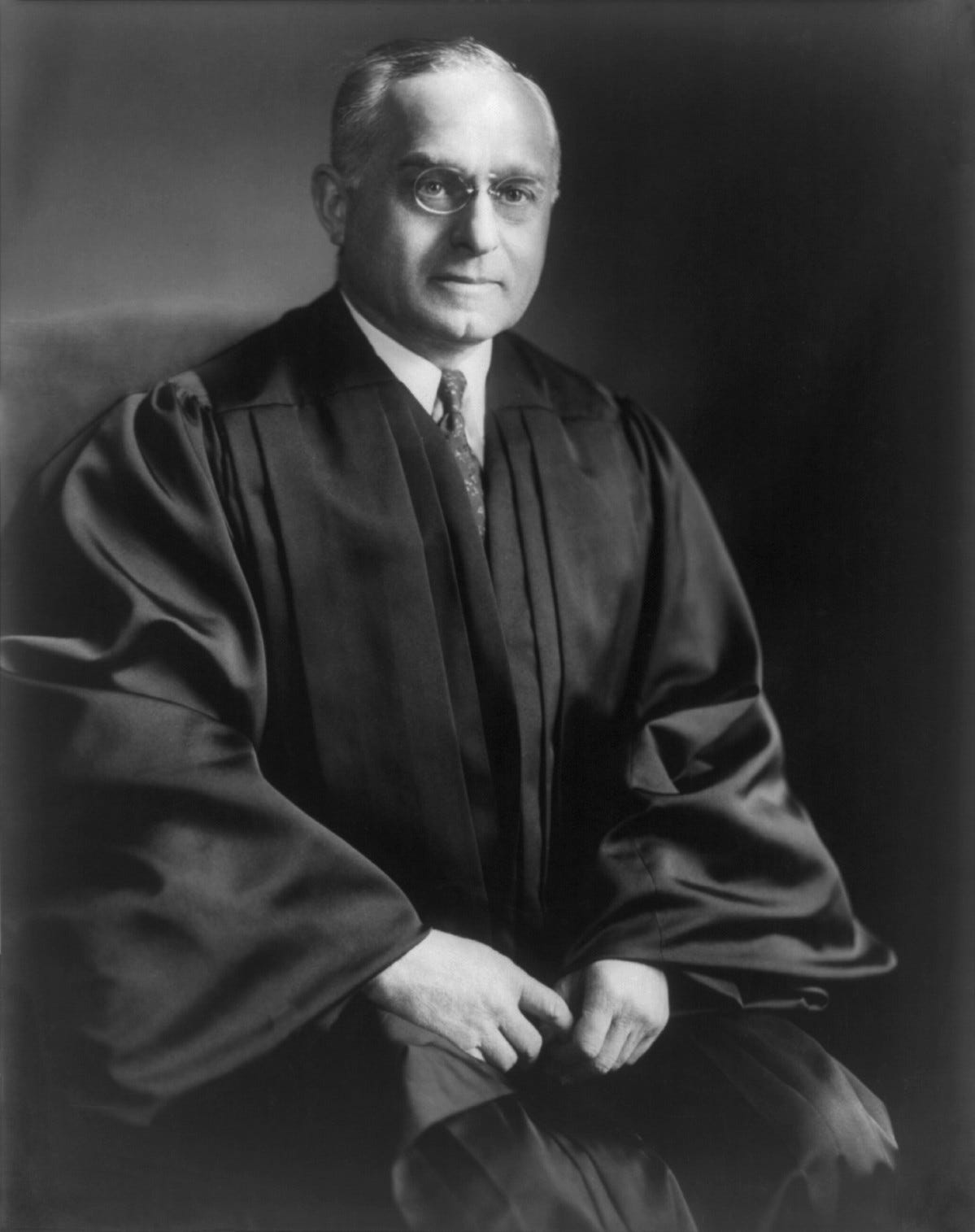
In 1920, the American Civil Liberties Union was founded by Felix Frankfurter and Roger Baldwin. Mr. Frankfurter, the former chairman of the War Labor Policies Board and assistant to the Secretary of War, would later become member of the Council on Foreign Relations, the NAACP, and play the role of Supreme Court Justice most instrumental in the Brown v. Board of Education ruling.
Some of Frankfurter’s calls to fame include being the mentor and stalwart defender of KGB asset Alger Hiss. At the time, he was also the leading legal champion of the convicted murderers Sacco and Vanzetti, revolutionary terrorists who had become a Communist cause célèbre. Financial support for their defense came from the tactically Communist yet strategically Fabian Garland Fund, the same fund, joined by the fortunes of J. D. Rockefeller Jr. and Edsel Ford, that spun the NAACP into reality (Roelofs 2003) (Dilling 2006) (Witt 2022).
Chief Justice William Howard Taft reportedly viewed Frankfurter as “closely in touch with every Bolshevist and Communist movement in this country.” (Time 1962). Frankfurter was essentially the “Rasputin” character of the left-liberal New Deal Establishment who, shortly after Roosevelt’s election in 1932, then a professor at Harvard Law School, reportedly informed friends that “recognition [of the Soviet Union] was in the bag because, in this matter at least, he had the new administration in his vest pocket.” (Communists and the New Deal, by J.B. Matthews, The American Mercury, June 1953, pp. 33-40).
Frankfurter, in his role as chairman of the War Labor Policies Board, was there from the beginning in the reterritorialization of organized labor as an instrument of counterinsurgency, as an architect of the Pan American Federation of Labor (PAFL) at the end of World War I—
PAFL was established during wartime and was designed to keep influences out of Latin America and Latin American labour which might be threatening to US interests. Recognising the key role of labour in Latin American policies …President Wilson granted money and support to the AFL for its overseas work and for PAFL in particular. On July 17, 1918, the AFL leaders met the secretary of labor, William Wilson, the head of the War Labor Policies Board, Felix Frankfurter, the Committee on Public Information chief, Edgar Sisson, and the head of the American Alliance for Labor and Democracy, Chester Wright. The AFL and these administration leaders approved the plans for PAFL and allocated government money to assist its formation. The subsidy … was kept confidential. The Committee on Public Information allocated it $50,000 from the president’s special fund … [t]he committee funded the "Pan American Labor Press", the PAFL publication. Monies for this journal were handled as part of the responsibilities of the War Industries Board. This pattern of confidential US government funding of US labour activities in Latin America through tripartite bodies like the AALD was one which has survived until the present.
—G. K. Busch, Political Currents in the International Trade Union Movement, Volume II: The Third World—Africa, Asia and Latin America, EIU Special Report no. 75 (London: The Economist Intelligence Unit, August 1980)
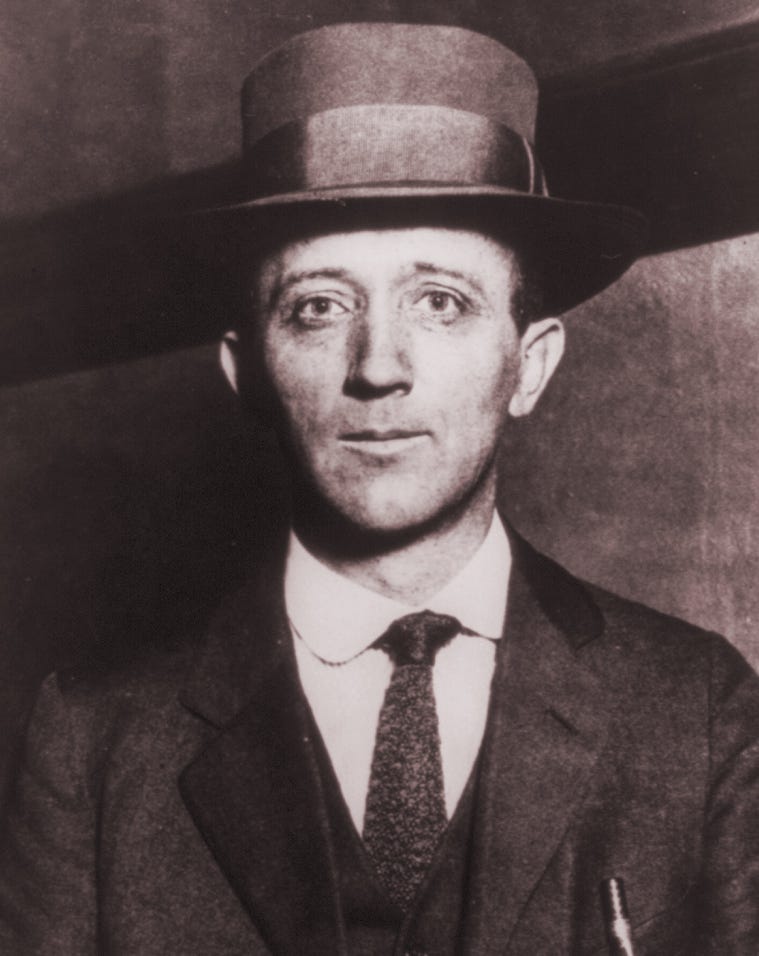
The prominent red ACLU members included communist front supporters Zechariah Chafee and Edwin M. Borchard, William Z. Foster, “head of the [Communist] party’s labor arm (the Trade Union Educational League),” Elizabeth Gurley Flynn, a top Communist Party official who authored “He Loved the People,” and Dr. Harry F. Ward, of Union Theological Seminary, a vocal group of socially active Christian clergy who supported Soviet causes. However, real executive power was always safe-kept from the commies. For example, ACLU Executive Directors tended to be men like Patrick M. Malin (1950-1962), a member of the CFR and active sponsor of the Fabian socialist League for Industrial Democracy (LID). This undisciplined structure, the disordered hive of far-left of factionalism, allowed the ACLU to farm legitimacy from committed ideologues like Foster and Flynn, and then marginalize them whenever their affiliation was no longer politically expedient.
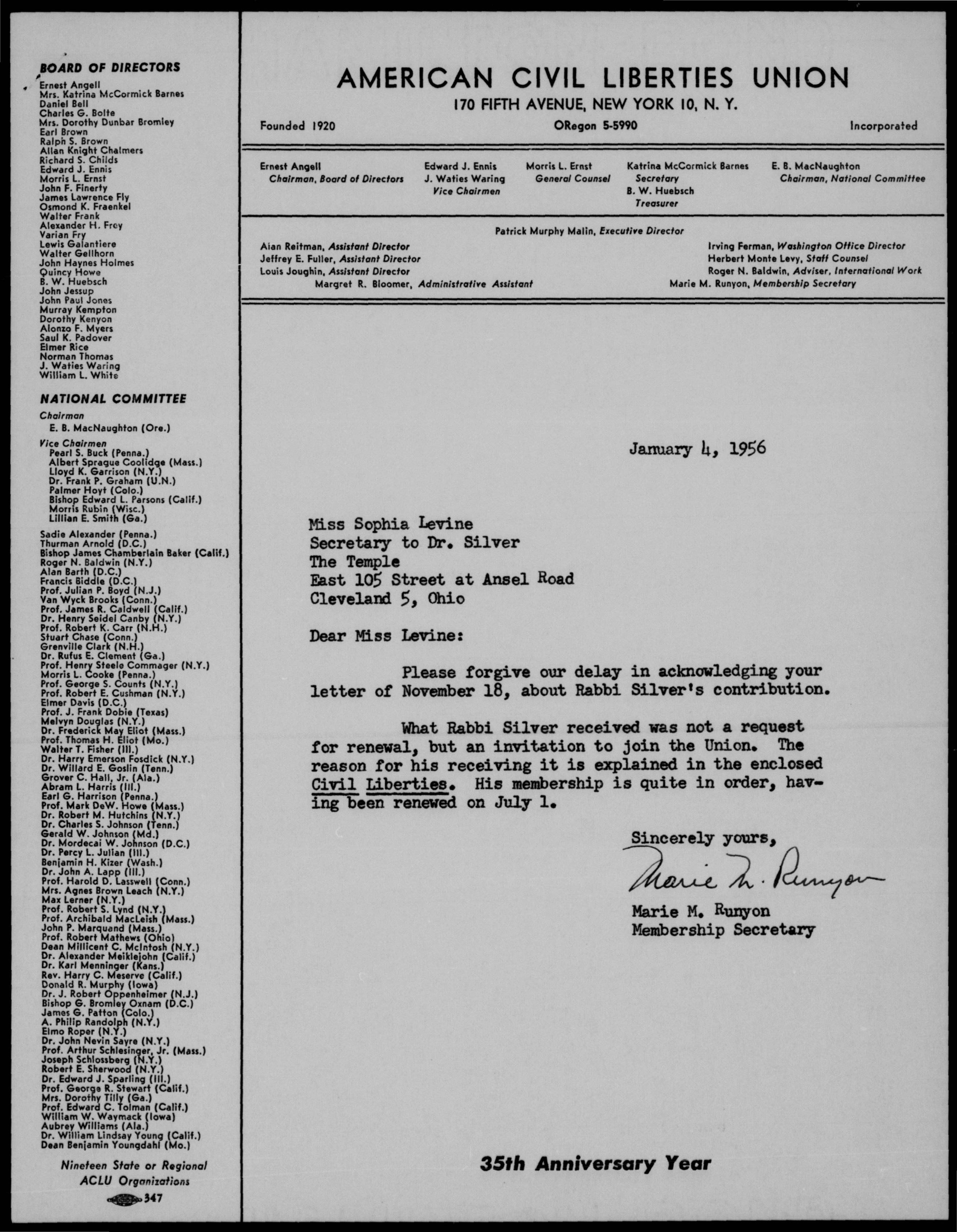
Other early CFR members who were known to be operatives for the American Civil Liberties Union include: Norman Cousins, the Jewish journalist and anti-atomic activist, ACLU Board of Directors (1946–1948); former OSS man Arthur M. Schlesinger, Jr, ACLU Executive Committee; former OWI propagandist Palmer Hoyt was on the ACLU National Committee; former OWI staff and deputy director of the OSS Elmo Roper also on the National Committee; and on the ACLU Executive Committee was one J. Robert Oppenheimer, chief technical architect of the Manhattan Project, who it has been concluded “was more probably than not … an agent of the Soviet Union” (CFR) (Haynes et al. 2009).
This composite holobiont, with its internationalist consensus-building nodes, imbricated with the intelligence-psywar community and sheathes of race communism, is the anatomy of sympoietic rot.
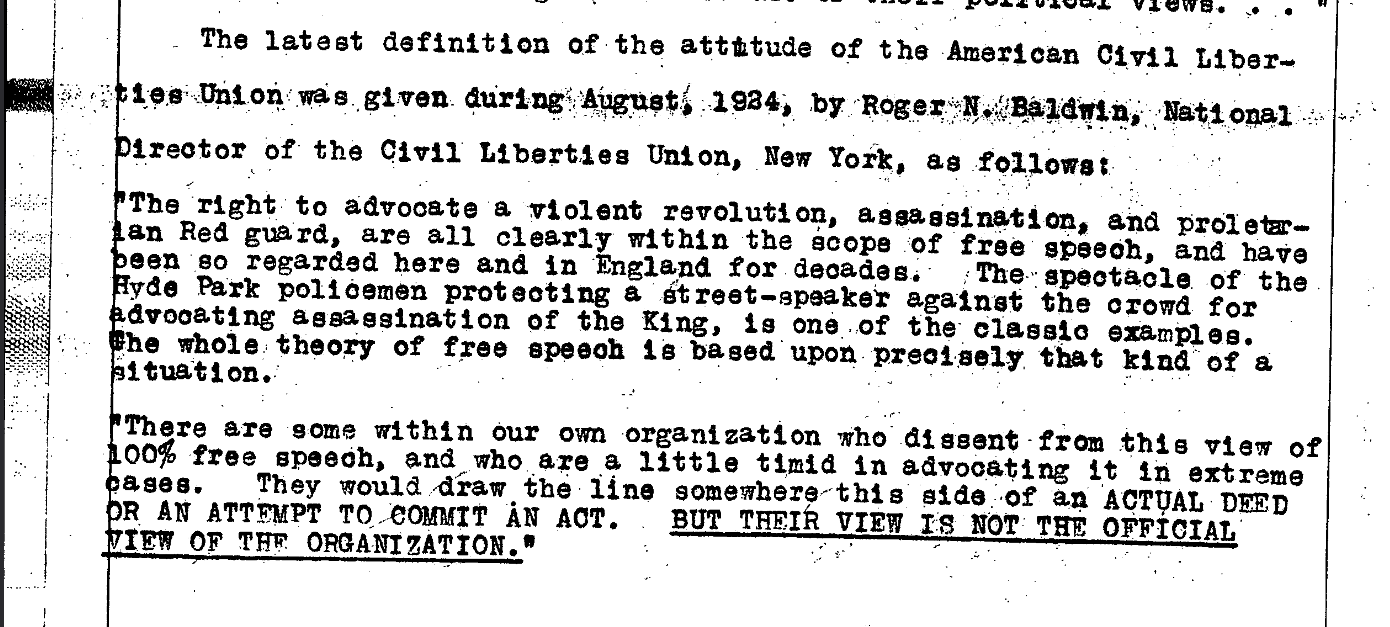
We will continue to quote from the 1927 BoI report (note, this is the same group that would lose their minds over Jan 6 and now support anti-white hate speech laws):
The latest definition of the attitude of the American Civil Liberties Union was given during August, 1934, by Roger N. Baldwin, National Director of the Civil Liberties Union, New York, as follows:
‘The right to advocate a violent revolution, assassination, and proletarian Red Guard, are all clearly within the scope of free speech, and have been so regarded here and in England for decades. The spectacle of the Hyde Park policemen protecting a street-speaker against the crowd for advocating assassination of the King, is one of the classic examples. The whole theory of free speech is based upon precisely that kind of a situation.
‘There are some within our own organization who dissent from this view of 100% free speech, and who are a little timid in advocating it in extreme cases. They would draw the line somewhere this side of an ACTUAL DEED OR AN ATTEMPT TO COMMIT AN ACT. BUT THEIR VIEW IS NOT THE OFFICIAL VIEW OF THE ORGANIZATION.’
The draft-dodging anarchist Roger Baldwin, the primary founder and the first executive director of the ACLU, cited above, is also quoted in the report as saying: “We want to look like patriots in everything we do. We want to get a good lot of flags, talk a good deal about the Constitution and what our forefathers wanted to make of this country, and to show that we are really the folks that really stand for the spirit of our institutions.”
Baldwin, in his own words, once stated, “I am for socialism, disarmament, and ultimately for abolishing the state itself... I seek the social ownership of property, the abolition of the propertied class, and the sole control of those who produce wealth. Communism is the goal.”
Mr. Baldwin had many direct communist affiliations, including chairing a Bolshevik committee called “Friends of the Russian Revolution” whose purpose was to urge upon Congress “that friendly relations between America and the Russian democracy be continuously maintained, and that food supplies, money, and such assistance as can be given by America to the builders of the New Russia be offered without reserve.”
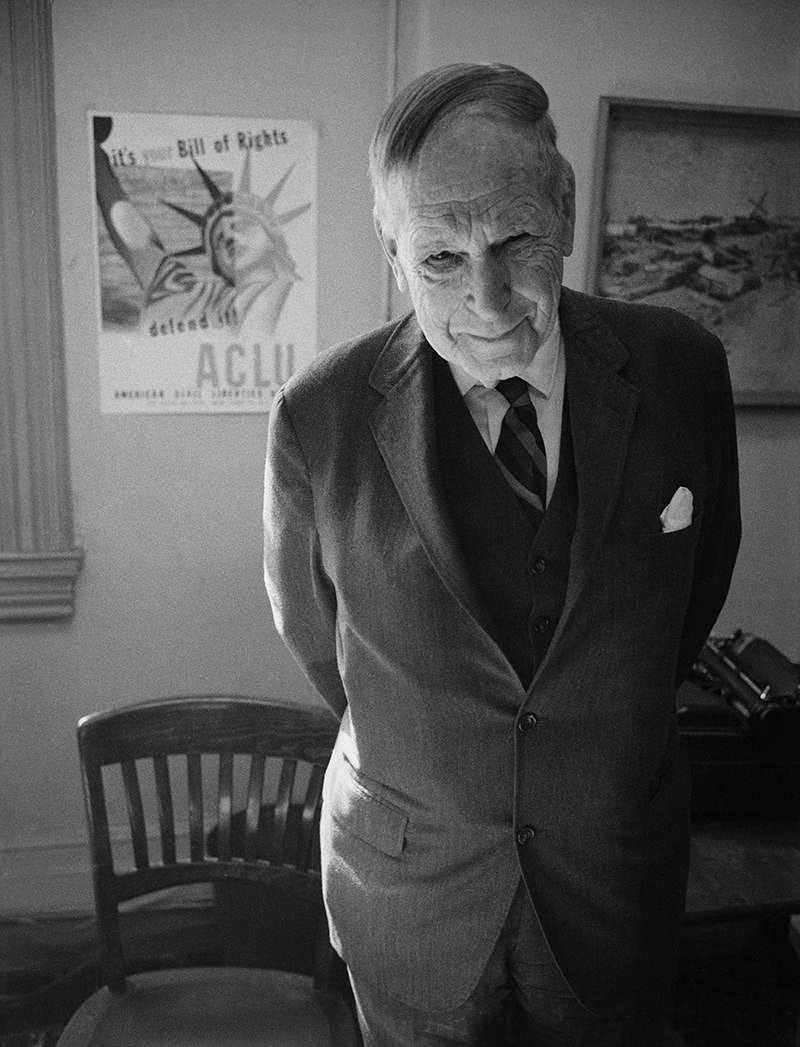
Baldwin was a member of several of these “friends groups,” including the short-lived communist-front “Vietnam-American Friendship Association,” reportedly organized at the behest of the OSS, but after the start of the Korean War, the association “faded from sight, its activators sliding unobtrusively into other fronts, entrenching themselves in the overlapping folds of our ponderous and intrigue-ridden aid agencies, or in the overstaffed ranks of our foreign service and intelligence agencies” (Berrier 1965).
The thrust of Old Right anti-communism was generally that either the subversive activities of far-left radicals like Baldwin were incidentally aligned with Soviet objectives (dupes), or they were conscious agents of the “world communist conspiracy” as an ideology, not that they were all KGB operatives or on the Comintern payroll.
The 1950s rightists believed that communist-orchestrated networks of “fellow travelers” in elite circles were attempting to exploit the built-in vulnerabilities of our modern, complex, industrial society while claiming, at the same time, that these problems could be resolved only under the communist or “world welfare state.” They believed this because it had been proven by “Thirty Shameful Years of Soviet Espionage” in the United States (Senate 1951, CIA).
The near-universal common sense on the matter, the opinion of most people before 1965, could be summarized as “walks like a duck” or “the purpose of a system is what it does.” Many patriotic Americans were, in modern terms, noticers, pattern recognizers, and shape-rotators. In other words, they weren’t idiots. It bears repeating that the vast majority of anti-communism throughout the inter-war and Cold War period was bi-partisan, and the New Deal Left wanted nothing to do with hard-line commies.
For example, the 1943 California Senate Fact-Finding Subcommittee on Un-American Activities was a bi-partisan committee, with Senator Hugh M. Burns, a Democrat, as Chairman.
“The American Civil Liberties Union may definitely be classed as a Communist front or ‘transmission belt’ organization. At least 90 percent of its efforts are expended on behalf of Communists who come into conflict with the law. While it professes to stand for free speech, a free press and free assembly, it is quite obvious that its main function is to protect Communists in their activities of force and violence in their program to overthrow the government.” (1943 Report, as quoted in the 1961 California Senate Fact-Finding Subcommittee on Un-American Activities, p. 110).
This perception would be vindicated countless times over the next seventy years, and certainly in the case of the ACLU's founder, as we have discovered.
In Alexander Vassiliev’s notebooks (declassified KGB archives), Roger Baldwin is labeled a “leading figure” in communist contexts due to his ACLU role. Here is the full reconstructed quotes from White Notebook #3 (pp. 115–116) and Yellow Notebook #4 (p. 54):
Roger Baldwin: American civil liberties leader, founder of the ACLU. Described as a prominent figure in progressive and leftist circles, often associated with Communist Party USA (CPUSA) activities in the 1930s. Referenced in discussions of recruitment targets and influence in American political movements. Soviet intelligence monitored him for potential recruitment and influence in leftist movements during the 1930s–1940s. His efforts to shield CPUSA members from prosecution aligned with communist objectives.” (White Notebook #3, pp. 115–116)
In November 1931, a Soviet defector named Basil Delgass, a man almost entirely memory-holed, claimed that the ACLU was part of an “interconnected community” engaged in Soviet espionage. In 1930, Delgass, the former vice president of the the American-Soviet Trading Corporation, had provided testimony before the Fish Committee. He made several shocking assertions regarding Amtorg’s operations, Soviet economic conditions, and related espionage activities. These included Amtorg’s role as a front for Soviet intelligence, large-scale visa fraud among its employees, illegal procurement of military technology such as Liberty engines, and the presence of a Cheka commissar overseeing internal activities.
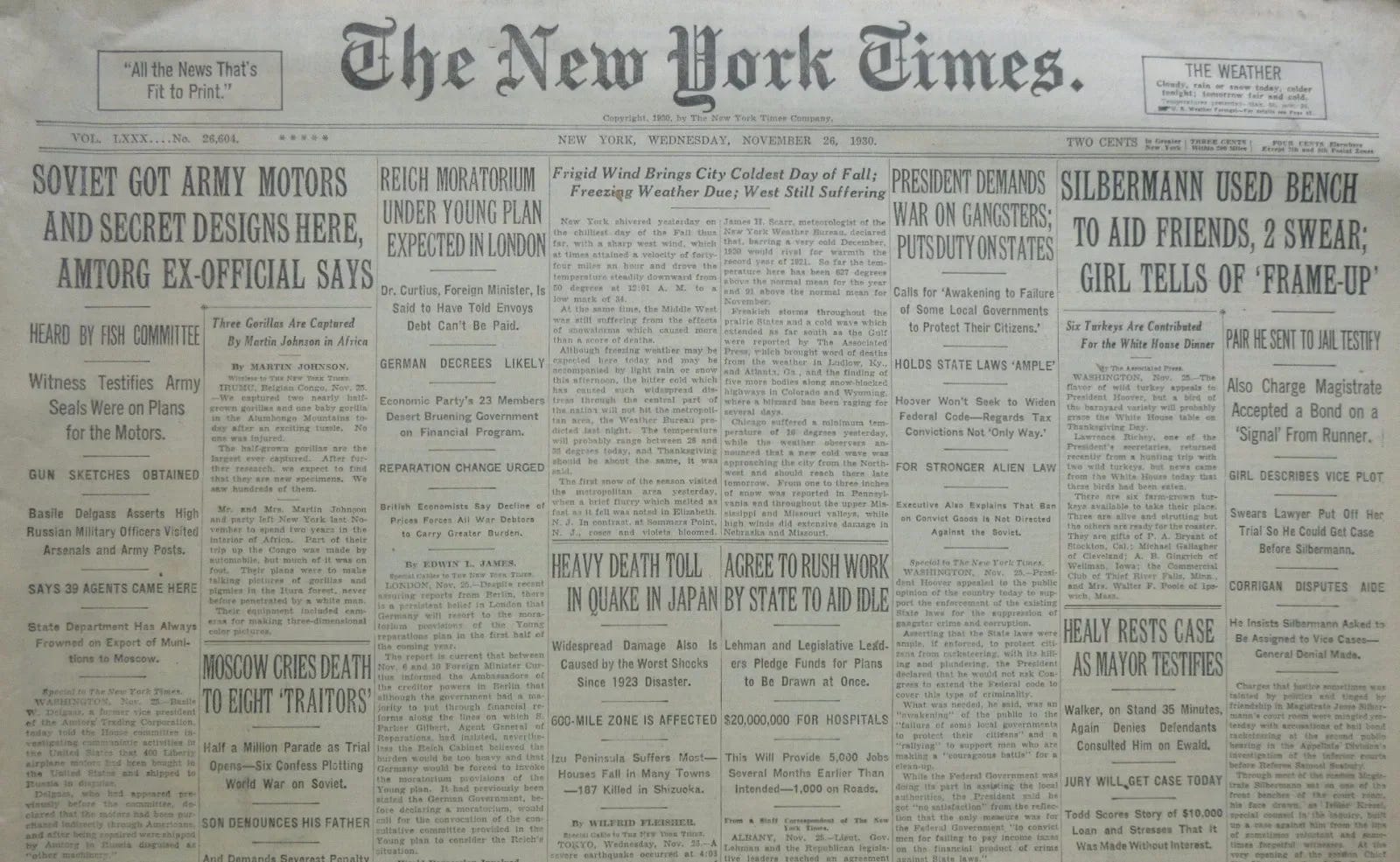
According to his closed-session testimony, Amtorg was under direct Kremlin control and was funneling every proprietary U.S. innovation it could secure, from chemical processes to engineering designs, back to Moscow.
After a thorough investigation, the Fish Committee concluded that Amtorg was “nothing more than [an] industrial intelligence service, spying upon the industrial developments of the United States.” Unfortunately, their 1930-31 investigation would be stymied by the “Whalen Documents” counterintel forgeries and the Navy’s failure to decode encrypted cables between Amtorg and Moscow. However, every word of his closed-session testimony, as reported by the Fish Committee, has been corroborated by subsequent defector leaks and Soviet archives. Every single one of Basil Delgass’ accusations has been confirmed.
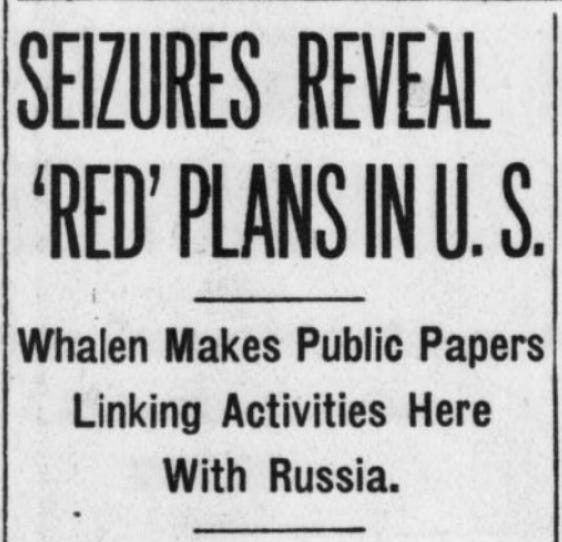
Over the course of the Cold War and the fall of the Soviet Union, it would be conclusively established that Amtorg had served as a cover for Soviet espionage operations in the United States from its founding in 1924 through 1933, enabling the theft of industrial and military materials by OGPU and GRU officers posing as Amtorg trade representatives. A wealth of internal documents revealed that “dozens of Amtorg’s staff were Soviet spies and that Amtorg was little more than a front for Soviet intelligence” (Haynes et al. 2009).
Although the 1930 Whalen papers alleging extensive Amtorg involvement in espionage were exposed as forgeries, all the unveiled realities confirm that “the KGB, GRU, and Comintern did use Amtorg as a cover for covert operations” (Haynes et al. 2009). For example, the atomic spy Arthur Adams and his communist spy ring operated under Amtorg cover in the pre-atomic, inter-war period, 1928–1929 and 1932–1933, facilitating the collection of proprietary information (Romerstein and Breindel 2001). Neither the Soviet spy Adams nor his communist-sympathizer asset Clarence Hiskey (a Manhattan Project chemist) were ever indicted for espionage (Kleher and Haynes 2023) This is a reoccurring theme, almost as if the whole “red scare” narrative is incoherent.
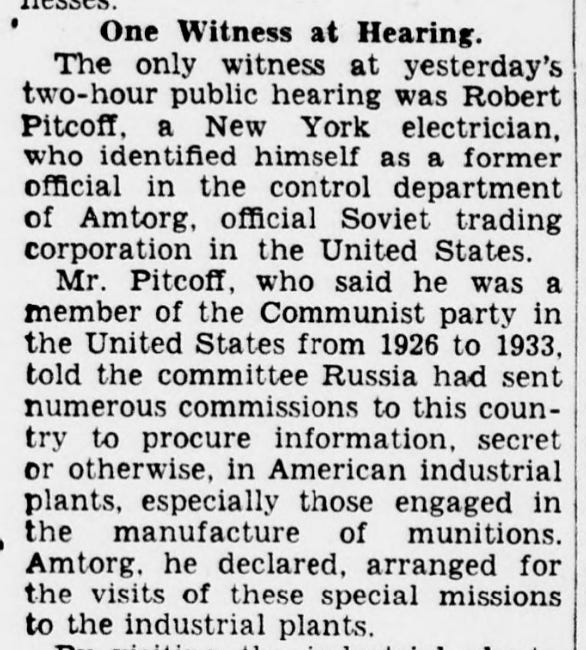
Basil Delgass’s testimony would be corroborated by Robert Pitkoff’s testimony before the Dies House Committee on Un-American Activities in October 1939, where he described Amtorg as “ostensibly a commercial agency” but in practice “a beehive of Soviet spies,” relating incidents of OGPU pressure on employees, commissions to “study” U.S. industrial infrastructure and technology, and the mysterious disappearance of two Amtorg vice-presidents he named (Ruthenberg and Kossof).
Now, with available decrypts and archives, it has been established that Gaik Ovakimyan, an OGPU officer specializing in industrial espionage, used Amtorg as cover starting in 1933, recruiting sources who stole proprietary chemical processes, including sulphinated oils, textile specialties, leather specialties, and industrial chemicals generally (Haynes et al. 2009). By 1939, NKVD operations leveraging Amtorg covertly had “obtained 18,000 pages of technical documents, 487 sets of designs and 54 samples of new technology” (Andrew and Mitrokhin 1999). Declassified FBI documents (e.g., 100-11460-82) corroborate Amtorg’s role in these OGPU and GRU activities. There is no controversy on any of this.
Here is an excerpt from a Soviet NKGB memorandum dated October 1, 1932, from agent Makhnikov, who reports on Delglass statements about the ACLU in the context of “Soviet activities”:
“D. read his report, which was printed on 20 or more pages. It was mostly a summary of what he called the “interconnected community” of Soviet activities in this country, consisting of Amtorg, Intourist, the Russian Information Bureau, the Civil Liberties Union…He gave an account, naming names, of the activities of people who have come here, mostly with false passports, or in the guise of engineers, economists or other experts (or specialists), but who in fact came here as spies”
According to one of the most reliable defectors in history, the ACLU was involved in the Amtorg espionage network. The above excerpt is from a detailed Soviet intelligence report transcribing a public speech by Basil Delgass delivered on November 28, 1931, at a meeting of the League of Struggle Against Communism attended by about 70 people. The memorandum was addressed to Peter Bogdanov, the chairman of the Amtorg Trading Corporation, with directives to forward it to Pavel Dybenko, a high-ranking Red Army official.
It should be noted that Delgass gave his testimony to the Fish Committee because he refused to perjure himself. He was a principled man. He was considered credible enough to have his assertions of Russian economic sabotage published in the New York Times (1931) and The Globe. His closed-session testimony was never published, and such statements were never reported by the press, yet there it is, reported by a Soviet spy.
Mainstream historical frames assert that the Communist Party USA (CPUSA) “had never been able to become a mass political movement, even during the Great Depression,” although it achieved a substantial membership of around sixty thousand by 1945. Nevertheless, it is known that the party “had managed to create a formidable array of affiliated and cooperating organizations and had built centers of strength in the trade-union movement, among some ethnic groups, in student and youth organizations, and in intellectual circles” (Haynes, Klehr 2006).
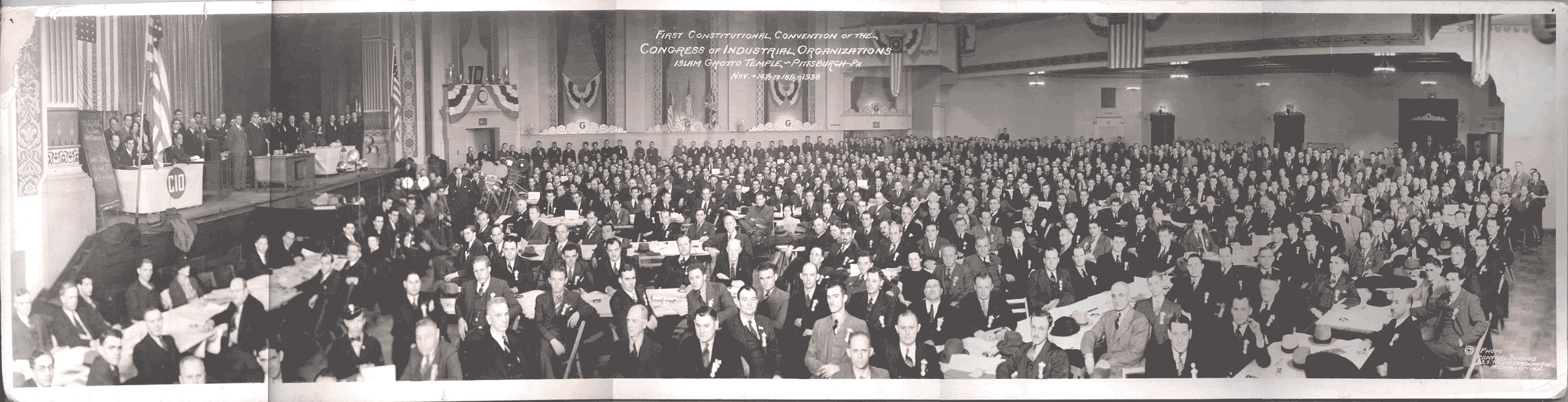
This influence extended through its penetration into the Congress of Industrial Organizations (CIO) (later merged into the AFL-CIO) where it gained “decisive political influence” in twelve newly organized unions and significant leverage in others, making the supposedly marginal CPUSA a significant force in American labor during the 1930s and 1940s. At its peak, the CPUSA attracted somewhere between a half and three-quarters of a million members, receiving a stream of Soviet subsidies under Comintern directives to sustain its network of auxiliaries and ethnic federations of blacks, Jews, and Slavic immigrants (Klehr et al 1995).
In the words of Dr. Fred C. Schwarz, executive director of the International Christian Anticommunist Crusade, in “Communist Legal Subversion,” page 75, HUAC: “Any attempt to judge the influence of Communists by their numbers is like trying to determine the validity of the hull of a boat by relating the area of the holes to the area which is sound. One hole can sink a ship. Communism is a theory of the disciplined few controlling and directing the rest. One person in a sensitive position can control and manipulate thousands of others.”
In mainstream, left-liberal revisionist academia, the term “infiltration” undergoes a mystical transfiguration through wordplay and rhetorical sleight of hand. Claims like “no evidence of infiltration” basically resolve into “no evidence of direct, top-down control from the ghost of Vladimir Lenin,” while their assertions of “not infiltrated!—operational independence is evident in purges!” seem designed to injure common sense: the need for purges is obviously evidence of directors allowing an ongoing state of infiltration for many years- it is proof of either a sympathetic attitude or complicity.
In 1948, before common sense was crippled, such ham-fisted sleights of hand were questioned after the ACLU supposedly “purged” their communists and rejected “totalitarianism” during WW2:
We are told that Communists are to be barred from office or employment in the Civil Liberties Union because, while fighting for civil liberties in America, they accept their suppression in Russia. Why then, did the Civil Liberties Union wait until 1940 before seeking to bar them?’ The letter goes on to state : ‘ But civil liberties within the Soviet Union were no different before the pact than after. One could not print an opposition paper in Moscow in August, 1939, before the pact, or after it, in September, 1939.’
—1948 Report, Quoted in the 1961 Report of the Senate Fact-Finding Subcommittee on Un-American Activities (my emphasis)
We know there was, at minimum, a permissive or sympathetic attitude toward communism, if not full complicity, among “the Georgetown set,” people like William Joseph “Wild Bill” Donovan, an alumnus of the Office of War Information, and other power brokers who would design the post-war national security state.
“Donovan seemed to care little about the Communist penetration of OSS, even though a list secretly supplied to the NKVD by Donovan’s assistant, NKVD agent Duncan Lee, showed that OSS security was aware of the identities of many of the Communists” (Romerstein and Breindel 2001). From a firsthand account related by former OSS officer and Donovan’s biographer, Richard Dunlop: “Donovan knew all about Lee [Soviet spy] and his Communist affiliations but didn’t think it would be a problem.”
It is now an irrefutable historical fact that the Communist Party USA (CPUSA), under directives from the Communist International (Comintern), was actively recruiting students on college campuses during the 1930s, with hundreds becoming involved in the party and its youth affiliate, the Young Communist League (YCL), a key organization for grooming future cadres; upon graduation, many of these individuals formed clandestine networks that enabled Soviet-directed espionage.
As revealed in the Comintern archives, the organization issued instructions to the CPUSA emphasizing the YCL’s role in ideological mobilization, such as the need to “intensify to the maximum its struggle on the ideological front by explaining patiently and reasonably to broad sections of American youth the imperialist nature of Roosevelt’s policy” and ensuring that “the members and cadres of the party and the YCL receive military training and master the military art and science” (Klehr et al. 1998).
This infiltration extended to organizing youth and student groups, including the YCL and National Student League (NSL), which functioned as fronts for recruitment and influence, with directives mandating that the party “carry out serious work within the army and navy, as well as among the reserve officers of the training cadre (ROTC) and the civilian training centers for youth (CCC)” (Klehr et al. 1998).
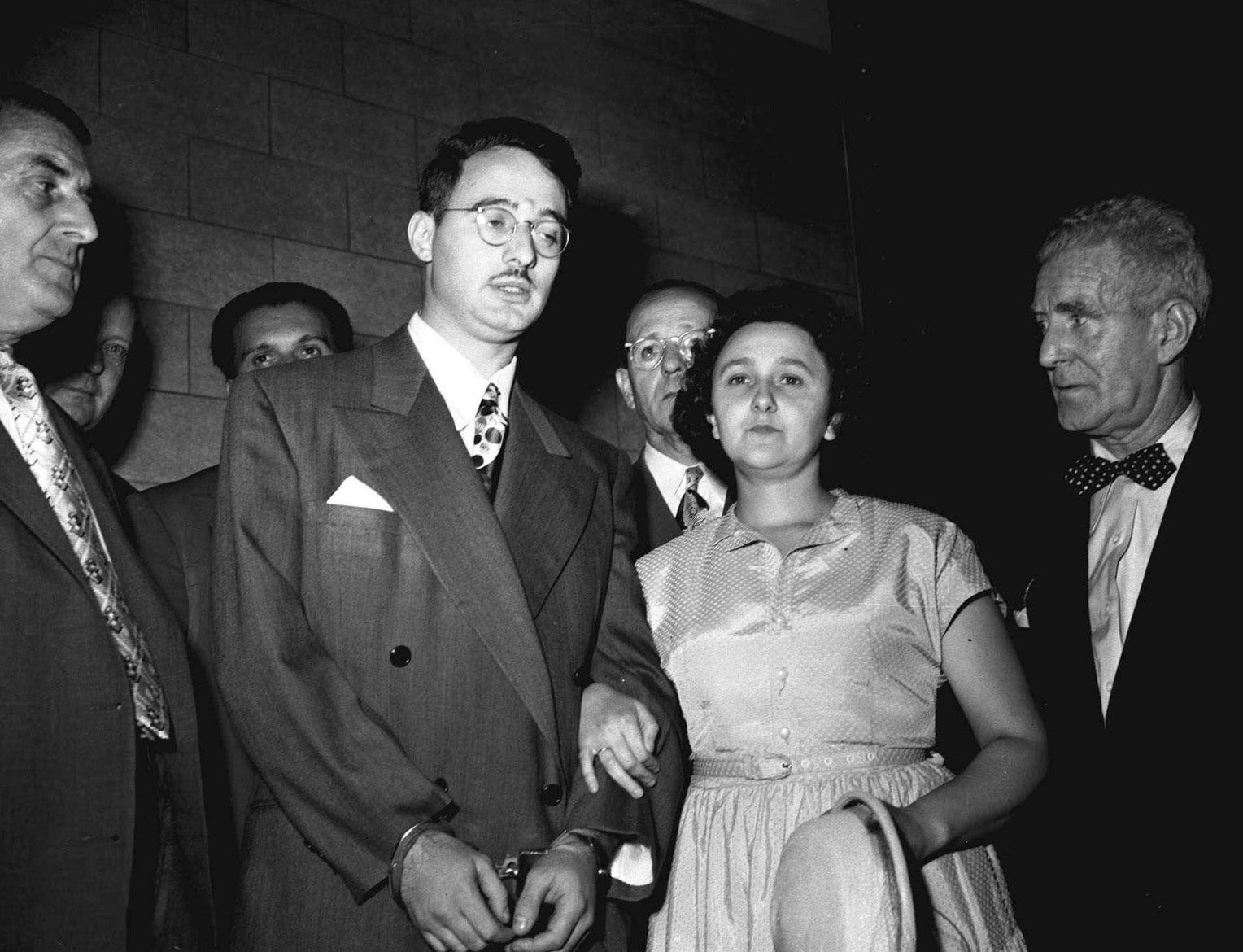
A prominent example is Julius Rosenberg, who joined the CPUSA while in college at City College of New York, serving as president of the YCL’s electrical engineers section. Rosenberg had quietly dropped out of open party work in the early 1940s when he began recruiting spies from among his student comrades for Soviet atomic efforts (Haynes and Klehr 2006). In subsequent decades, the Mitrokhin Archive revealed that the KGB’s “active measures” during the 1960s–1970s to infiltrate and bolster US anti-war student movements included covert funding and orchestration of protests via front organizations (Andrew and Mitrokhin 1999).
The reality of the situation is that the “social planners” were co-operating with communists and corporate fascists; they were “moderates,” a wretched medium between the two; they were the synthesis of all dialectical materialists— “democratic collectivists” who believed the will of the demos should be mediated by social engineers, combined with “democratic capitalists” who believed the will of labor should be mediated by applied psychologists. They were the regression to the mean of the hollow, petrified Axis Mundi, managers of the hole in the world left by the decapitation of royal Reason, rulers of the Rot called “rationality.”
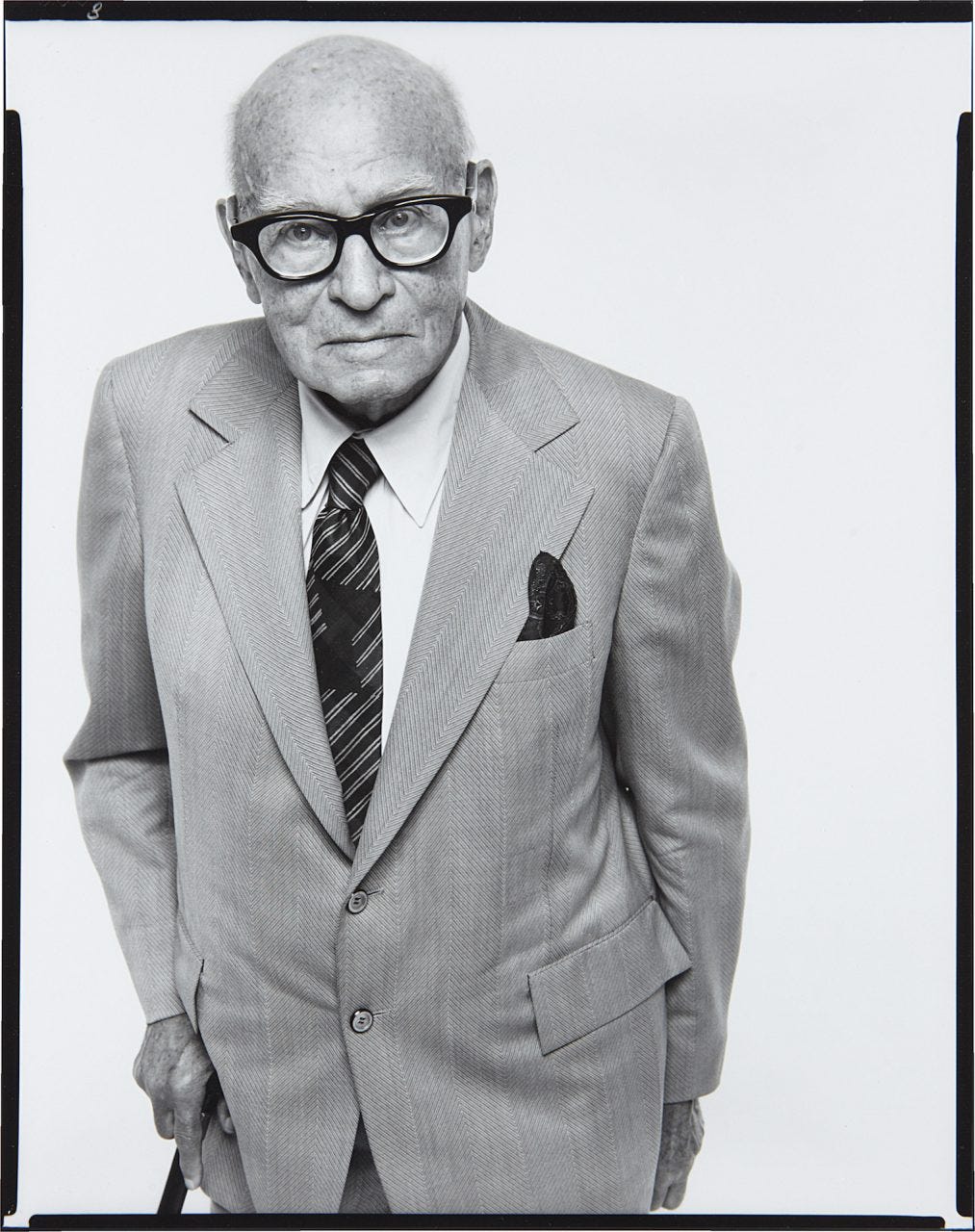
In 1963, after JFK was assassinated (another symbolic “killing of the king”) and LBJ became president, LBJ called Joseph Rao, a lawyer for the Leadership Conference on Civil Rights, a majority Jewish organization that helped brainstorm the Civil Right’s Act in the 1950s, and within five days of the assassination, before Kennedy was buried, LBJ said now’s the time to push the Act through. The next year, with help from labor liaison Theodore Kheel, Emanuel Celler of the Hart-Celler Act and Arnold Aaronson, founder of the Leadership Conference on Civil Rights (LCCR), the Civil Rights hoax passed into existence.
CRS jumped into action with its first big project, the March on Selma, sending applied sociologists “mediators” like James Laue, later called “conciliators” to assist SCLC, SNCC, and CORE—the three main civil rights organizations, the largest being SCLC or Southern Christian Leadership Conference co-founded by Martin Luther King and communist Stanley Levinson.
Newsweek, March 22, 1965, explains, “For weeks Martin Luther King had been escalating his Selma voter registration campaign toward what he called ‘creative tension’ —the setting for a paroxysm of segregationist violence that would shock the nation to action…”
“The Negroes’ rationale in holding night marches,” explained the New York Times of February 24, 1964, “is to provoke the racist element in white communities to show its worst.”
Time magazine did their Lucian magic, Henry Luce’s special blend of lanterns behind the curtain, the shadowed confession in the text, and transmuting the frame with large, glossy mise-en-scène alchemy, operating as a massive psywar attack on the crowd psyche, compelling the masses with the image like the priests of Ur, while demoralizing the non-angelized reader. As William B. Bader said: “You don’t need to manipulate Time magazine, for example, because there are Central Intelligence Agency people at the management level.”
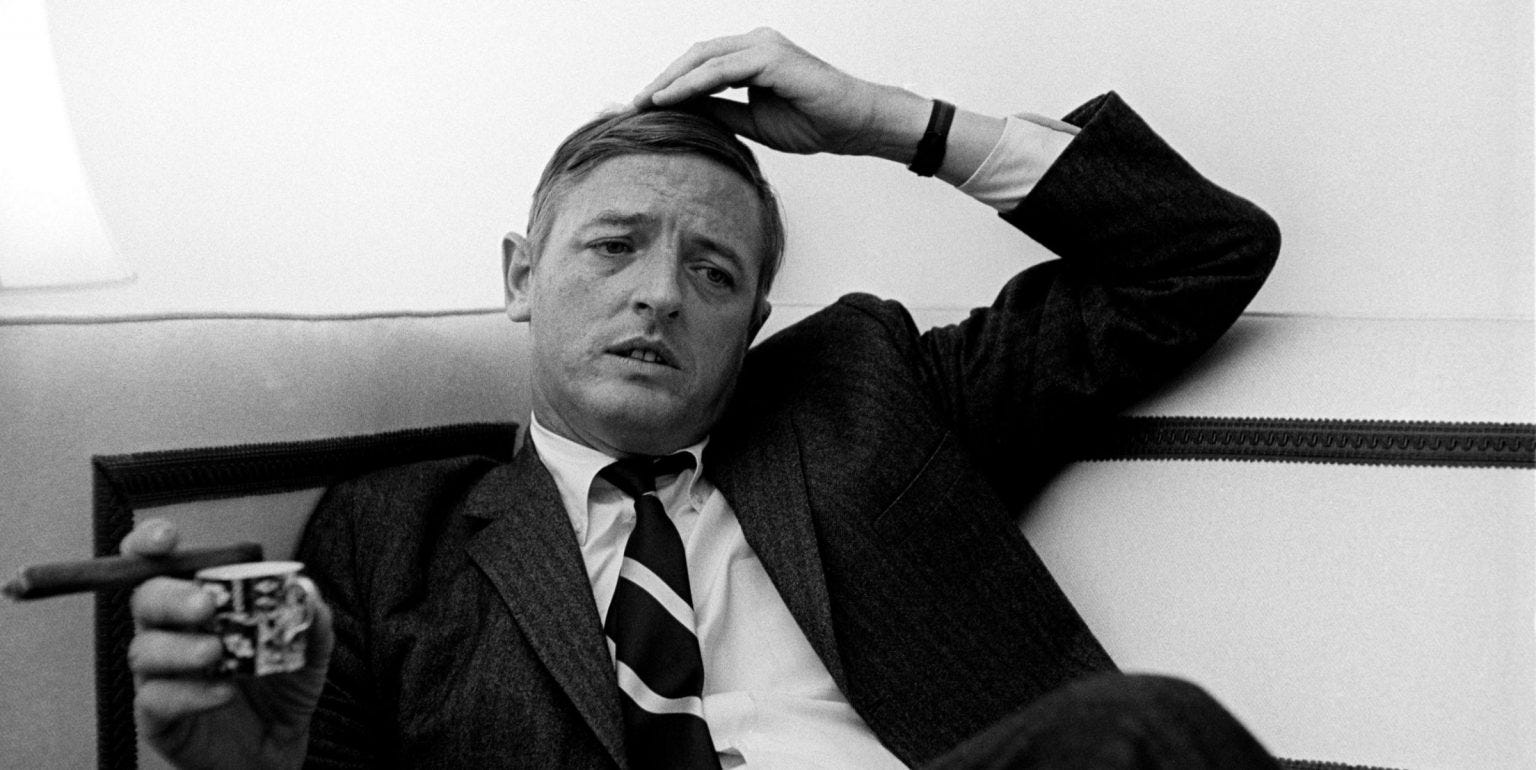
There is a huge gap in critical reporting on the CRS and Civil Rights chicanery between the 1970s and the 90s. For about twenty years, the agency operated in a near total information black-out. For now, barring a Senate investigation and public disclosure of records, we only have what they’ve admitted to. For this disastrous state of affairs we have to thank the mysterious existence of the public’s monster-in-plain-sight, “William F. Buckley.”
In the 1960s, Yale Skull and Bones alumnus, CIA asset, and visibly ghoulish William F. Buckley was successful in “shunning” or purging the authentic Right, including Revilo Oliver, Joe Sobran, M. E. Bradford, Gary Allen, Sam Francis, Pat Buchanan, and everyone else who would not disavow the John Birch Society and join him in simulated conservatism. Buckley became the Liberal Establishment’s house conservative, a “respectable and responsible” tomato-can who never spoke of a “communist conspiracy.”
The John Birch Society had to be banished from “respectable conservatism” because JBS founder Robert Welch imputed that President Eisenhower had been an agent of communism. Below is the infamous quote that the Left’s “conservative”-stamped golem like Buckley used to cleanse America of any authentic right-wing voice:
“But my firm belief that Dwight Eisenhower is a dedicated, conscious agent of the Communist conspiracy is based on an accumulation of detailed evidence so extensive and so palpable that it seems to me to put this conviction beyond any reasonable doubt.”
—The Politician, Robert Welch
Firstly, the full statement is clearly qualified as Welch’s strong personal conviction, in other words, an opinion. Second, it was written as a newsletter that was never meant to be published, only disseminated by mail among his circle, but was leaked by an activist journalist in a bid to frame Welch as a “lunatic.” Never mind the fact that, for any American who had been paying attention since the New Deal, a “communist conspiracy” was a given, and Eisenhower’s loyalties were broadly an object of suspicion. For many conservatives at that point, the only discussion was whether Eisenhower was a witting or unwitting facilitator of communist agendas.
For perspective, on March 22, 1952, less than a year before Eisenhower would be sworn into office, General of the Army Douglas MacArthur said in a public address,
“It becomes increasingly clear that the pattern of American fiscal policy is being brought into consonance with the Karl Marx communist theory that through a division of the existing wealth mankind will be brought to a universal standard of life, a degree of mediocrity to which the Communists and their fellow travelers seek to reduce the people of this great nation. Whether it be by accident or design, such a policy, formulated with reckless indifference to the preservation of constitutional liberty and our free enterprise economy, coupled with rapid centralization of power in the hands of a few, is leading us toward a communist state with as dreadful certainty as though the leaders of the Kremlin themselves were charting our course.”
General Edwin Walker, who had resigned after being ordered to oversee the integrationist social experiments conducted in Little Rock, said:
It is fair to say that in my opinion the 5th column conspiracy and influence in the United States minimize or nullify the effectiveness of my ideals and principles ,military mission and objective , and the necessary American public spirit to support sons and soldiers .I have no further desire for military service at this time with this conspiracy and its influences on the home front.
In 1964, FBI Director J. Edgar Hoover told the House Appropriations Subcommittee, in executive session, that blacks in the United States “today constitute the largest and most important racial target of the Communist Party.” The Communists, Hoover said, magnify and dramatize racial tensions, and such campaigns, he explained, were just stepping-stones to extend Communist influence.
At the height of the Selma crisis in 1965, Reverend Bob Marsh sermonized over the radio waves from Andalusia, Alabama. He pictured thousands of good Christian citizens of the state at the mercy of “skillful and well-financed social planners.” These operators, he asserted, were not after voting rights for blacks. Instead, their aim was violence to be followed by forced integration and amalgamation; they’d not be satisfied with simple desegregation. Alabamians were experiencing a “social revolution,” Marsh preached, one propagated by an “anti-Christ ideology.”
Rev. Marsh then outlined the features of that revolution, comparing them to the goals that he believed Communists had set for American culture. Among them were the elimination of laws governing obscenity and prohibiting homosexuality, degeneracy, and promiscuity; the breaking down of cultural standards of morality through the promotion of pornography; and the creation of the impression that violence and insurrection were legitimate aspects of American tradition. This moral breakdown, he insisted, was indicative of a Western civilization that had “allowed itself to drift into a state of mental stagnation, apathy, and inaction.”
The “negro revolution” that occurred from the mid-1950s to the mid ‘60s is almost identical in structure to the sudden, artificial, and top-down “gender revolution” of the past 10 years. By 1965, the dimensions and characteristics of the new system had become clearer to the population, as evidenced by the description of “skillful and well-financed social planners.”
“The main type of Russian weapon, decisive for Russia’s current sustainability, its strength, and possible future victories, is not a normal factor for European conditions of military strength, but deep political action, characterized by a diversionary, decentralized and propagandistic essence [...] Efforts to foment ethnic tensions within states is a method of Russian sabotage …”
—Włodzimierz Bączkowski, Polish Sovietologist, former information officer, British SOE (Continental Action), American OSS (Project Eagle).
In The Politician, Welch offers no incontrovertible smoking gun for his opinion. He arrives there through deductive reasoning. One after another, he lists derelictions of duty so profound that one must assume Eisenhower was either a conscious agent or an unwitting puppet, jerked into alignment with Kremlin policy at every turn. He is stating and supporting his opinion with all the evidence in the public domain, an opinion with a great deal more evidence than, say, that Donald Trump is a “fascist.” The framing of the JBS and Robert Welch as a “lunatic fringe” was only made possible through the left-liberal monopoly on media-power.
Reverend Bob Marsh, Senator Eastland, Joe McCarthy, George C. Wallace, and General Douglas MacArthur were not insane. Their assessment that the Civil Rights movement was a “communist hoax” had been confirmed by a list of reliable defectors and past incidents.
“The Naked Communist” by W. Cleon Skousen had just exploded upon its 1958 debut, becoming an immediate bestseller and selling over 1.5 million copies in the early 1960s alone. It was widely adopted as a reference, appearing in the libraries of the CIA, FBI, and White House, and was read into the U.S. Congressional Record in 1963 and endorsed by FBI Director J. Edgar Hoover and Ronald Reagan. W. Cleon Skousen illustrates the communist playbook:
Capture one or both of the political parties in the United States … Use technical decisions of the courts to weaken basic American institutions by claiming their activities violate civil rights …Get control of the schools. Use them as transmission belts for socialism and current Communist propaganda. Soften the curriculum. Get control of teachers’ associations. Put the party line in textbooks … Infiltrate the press. Get control of book-review assignments, editorial writing, policymaking positions … Infiltrate the churches and replace revealed religion with ‘social’ religion. Discredit the Bible and emphasize the need for intellectual maturity which does not need a ‘religious crutch…
The fact of the matter is that Welch was well aware by the mid 1950s of “skillful and well-financed social planners” like the “democratic world socialist,” self-described “social engineer” Gunnar Myrdal, whose propagandist book The American Dilemma was the chief authority cited by the socialized Supreme Court in its revolutionary Brown vs. Board of Education school desegregation decision in 1954. Welch cites Senator James O. Eastland’s The Supreme Court’s Modern Scientific Authorities” in the Segregation Cases.
I shall give 16 names furnished by the Carnegie Foundation as “social experts” to Gunnar Myrdal, the Swedish “social engineer,” for the writing of “An American Dilemma” adopted in full by the Court, and their Communist connections according to the official 1948 California report, made at the time the Chief Justice was Governor of California.
The tenor of that book is to the effect that the American form of government has outlived its usefulness, and that the Constitution of the United States is a plot against the common people of this country. That was the message of the principal authority relied on by the Chief Justice of the United States in this far reaching decision.
Every person he names was, indeed, affiliated with communist causes or a formal member of a communist front, and on the anti-democratic “tenor” of the book, Eastland was exactly correct. The parties responsible for that piece of propaganda had given up on “democracy” half a century ago and had been working tirelessly to neutralize it. Their goal was the full depoliticization of mass man.
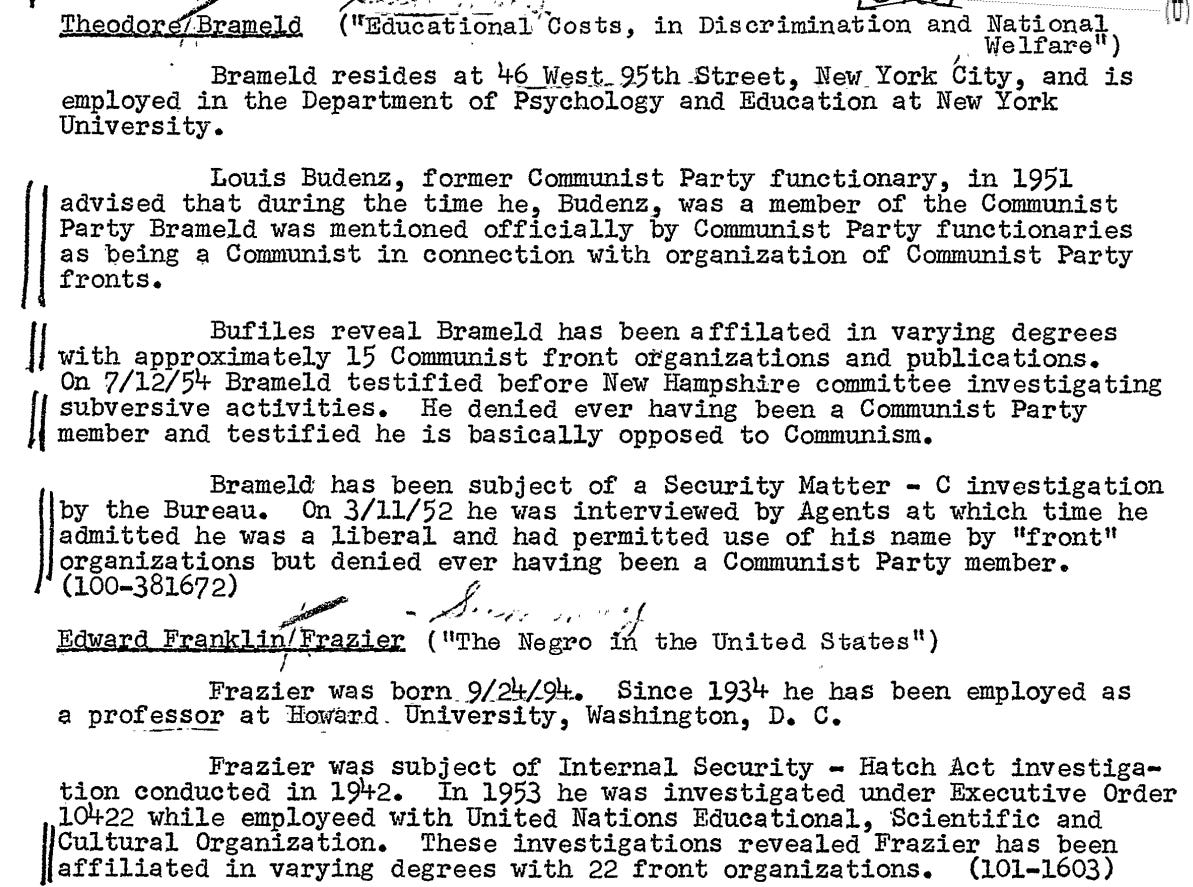
Yet Welch, Senator Eastland, and many among the Old Right still framed this scientific managerialism as “communist,” and with good reason—
…a provisional investigation of the authorities upon which the Supreme Court relied reveals to a shocking degree their connection with and participation in the worldwide Communist conspiracy, in that Brameld and Frazier, listed in the group of 6 authorities, have no less than 28 citations in the files of the Committee on Un-American Activities of the United States House of Representatives revealing membership in, or participation with, Communist or Communist-front organizations and activities; and
Whereas the book, An American Dilemma, was prepared by a Swedish Socialist, who declared in the book that the United States Constitution was “impractical and unsuited to modern conditions” and its adoption was “nearly a plot against the common people”; and
Whereas this book was the result of collaboration between Myrdal and certain alleged “scholars and experts” assigned him by the Carnegie Corp., of Alger Hiss fame [a Soviet spy, confirmed by the Venona decrypts]; and
Whereas 16 of these so-called scholars and experts, who contributed to no less than 272 different articles and portions of the book, have been cited numerous times as members of Communist and subversive organizations; and
Whereas the citation of these authorities clearly indicates a dangerous influence and control exerted on the court by Communist front pressure groups and other enemies of the American Republic …
Despite what Wikipedia and every Reddit regurgitating LLM will tell you, every single person that Eastwood names had, at minimum, strong indications of communist affiliations or agendas. Most of them were never formally charged or even “blacklisted” because they were shielded by strong institutional/intelligence credentials.


For example, we will take one of the most “exonerated” participants in the study, Lewis Webster Jones (1899–1975) the prominent American academic administrator. Jones would later conduct his own anti-communist purges, dismissing professors Simon W. Heimlich and Moses I. Finley in 1952–1953 after they invoked the Fifth Amendment before congressional committees, a tactic consistently held up by liberal academia as proof of anti-communist bona fides, rather than evidence of harboring and tolerating the activities of communists for years, and symbolically sacrificing one or two fellow travelers to protect the inner circle.
The 1948 California Senate Fact-Finding Subcommittee on Un-American Activities (page 322) lists Jones among individuals connected to communist fronts, including the American-Russian Institute. Even more damning, records revealed his sponsorship of the National Council of American-Soviet Friendship (NCASF), an egregious communist front organization, and a classic example of how Soviet agents of influence penetrated U.S. academia to erode anti-communist resolve under the guise of “cultural exchange” and “friendship.” Henry Collins, executive director of the American-Russian Institute, was later revealed to be a KGB operative in Soviet memos (Haynes et al 2009).
Corliss Lamont, chair of Civil Liberties at Columbia, head of the “Friends of the Soviet Union,” founder and first chairman of the NCASF,
…was not a spy, but he was one of America’s leading public defenders of Stalinist tyranny. He spent most of his adult life and a good portion of his considerable personal fortune on defending Communist totalitarianism as morally justifiable because in the end it would bring about socialism. There was no Stalinist crime, no matter how gruesome—from the coercive collectivization of the peasantry to Stalin’s Great Terror— that Lamont could not find grounds to excuse, explain, justify or minimize. He was equally enthusiastic about Mao’s China, Castro’s Cuba and Ho Chi Minh’s Vietnam. That the name of someone who justified tyranny in all its Communist guises adorns a chair of “civil liberties” shows that important sections of the academic world are without shame. (Haynes et al 2003)
Lamont would later appear in FBI files covering their investigations of the SNCC black terror organization. The NCASF, an active organization within CPUSA (the American Communist Party, proven to be under direct Kremlin control by multiple post-Soviet archival releases, had helped create the organization), was founded in 1943 as a successor to the earlier Friends of the Soviet Union (also flagged as subversive).
The NCASF was explicitly designated by the U.S. Attorney General in 1948 as a Soviet communist-controlled entity. Its mission, ostensibly to foster U.S.-Soviet amity through lectures, films, and publications, served as a propaganda conduit to whitewash Stalinist atrocities, promote disarmament narratives favorable to Moscow, and recruit sympathizers among intellectuals.
FBI, the House Un-American Activities Committee (HUAC) and multiple State Senate committees had documented the NCASF’s activities as absurdly blatant advancement of broader Kremlin tactics and goals, outlined in the CIA document “Facts about International Communist Front Organisations” (1955), which describes how such “friends groups” masked Bolshevik objectives behind “non-political façades of social ideals” to manipulate progressive opinion and advance global communist subversion.
During World War II, the NCASF lobbied aggressively for the extension of Lend-Lease aid to the Soviet Union, essentially a massive wealth transfer program that would modernize the Soviet state.
In 1948, the California Senate Fact-Finding Subcommittee on Un-American Activities found that the NCASF was trying to distribute pro-Soviet propaganda in schools. The school-infiltration materials contained further study Sources listing the Soviet Information Bureau, the Russian War Relief, the editor of Moscow News and a host of known communist radicals. Framing Jones as a naïve dupe requires: 1) to believe the esteemed economist and philosopher became a national sponsor with zero information and 2) for the audience to be unaware of his later advocacy.
The results of this brief inquiry into Lewis Webster Jones can be replicated with every name Senator Eastland mentions; I chose Jones because he was the most difficult to unveil.
Beyond the communist frame, Eastland correctly identifies Gunnar Myrdal as a pseudo-scientist and his An American Dilemma: The Negro Problem and Modern Democracy (1944) as a work of propaganda, and even names “human sociology and cultural anthropology” as suspect, and he would be correct, but not only because they are so “young.”
The esteemed Senator James Eastland was a well-bred southern gentleman, educated at Dartmouth, the son of a planter and a career politician, but with no military background, so it is unsurprising he didn’t know these “young” sciences had been more or less invented by the OSS and Gregory Bateson during and after the war. It’s this lineage that reveals to us the true purposes of the “civil rights” psychosocial warfare campaign.
As a side note, the endless number of “communist fronts” seems dubious at first, but the scale of Soviet active measures was truly vast, as has been demonstrated by the impressive list of organizations drawn up by the French researcher Thierry Wolton. Some groups were merely “influence” vectors, but the Kremlin treated student groups like the IUS as little more than extensions of the KGB. The World Council of Peace and the greater part of the 1950s peace movement organizations were acting in the interests of Moscow and were financially supported by it. (Le KGB en France, Thierry Wolton, 1986).
Unsurprisingly, the foundation-intelligence puppet Gunnar Myrdal himself was decidedly a milquetoast proto-neoliberal and is often called “anti-communist” because he signaled his belief in “democratic socialism” and a “world welfare state” (Euro-communism). In fact, some of the strongest, and most accurate critique of An American Dilemma came from Marxists like Herbert Aptheker who argued that the book’s philosophy was “superficial and erroneous,” its historiography “demonstrably false,” and its ethics “vicious,” rendering the overall analysis “weak, mystical and dangerous.” He accused Myrdal of idealism, of waging a “running battle with Marxism” by downplaying material economic structures in favor of moral abstractions.
Oliver C. Cox, another Marxian, said it was a “[m]ystical approach to the race issue”— in other words it was “corporate woke,” or perhaps more accurately, proto-Floydism. None of these people realized Myrdal was helping to build the mystical neoliberal imperium. The real raging commies like W.E.B. Du Bois were all incensed that it didn’t push for “systemic racism” right out of the gate. They wanted the long fleam-knives to drain all white racist blood immediately, and Myrdal-Carnegie were only prepared to offer a scarificator. However, Myrdal-Carnegie did supply the sentimental basis for “structural racism”; all black disorder is caused by “structures” created by whites.
The criminal oligarchs were Anglopoidal, after all, and had decided upon “gradualism,” wisely adhering to the traditions of so-called “Fabian Socialism,” the real origin of the “long march through the institution.” Fabianism, or illuminism, is merely “[t]he impulse to secrecy and to learn the secret is the first tendency of any power, whatever form of government or method of administration it serves. No ruler can escape this impulse, which becomes greater and more intense the stronger and more effective power becomes” (Schmitt). The moment we murdered our kings, power entered cabal-space.
American Dilemma was one of the first examples of “safe edgy corporate slop,” that familiar subset of psychological warfare sometimes called “marketing.” It was only ever meant to shore up hollow sloganeering, a dazzling constellation of crystalized expert opinion to embellish judicial pageantry, and to slather a veneer of scientific objectivity over amoral political warfare.
Objective observers knew it was slop, Myrdal’s fellow sociologist E.B. Reuter described the book as a “mediocre performance” with faulty methodology, noting Myrdal “did not advance the argument.” Even Myrdal’s own friend and aide on the Carnegie project, Donald Young, a military sociologist who would later become an executive director of the SRCC, confessed in his memoir that the study had not increased racial understanding or reoriented the field intellectually. As one reviewer put it, the voluminous tome prioritized breadth over depth, favoring “vague historical prophecies” [negro apocalypse] over scientific rigor. Doxey Wilkerson called it “[c]rude and subtle propaganda designed to gain widespread acceptance of a safe view.”
Incidentally, Donald Young served as the War Department’s official expert on race relations, working in the Army’s Information and Education Division (I&E), specifically within its Research Branch, from approximately 1942 to 1945. He was instrumental in developing racial integration propaganda, developing The Negro Soldier (1944) film, part of the larger Hollywood-OWI effort that would prime the culture to apply military logic to social issues, i.e. forced integration. Myrdal had at least one more WW2 information officer working on his report, former OSS man, the area studies analyst Ralph Bunche. While in the Research and Analysis Branch he’d been tapped to handle “the subjects of colonial policy and administration, native problems, and race relations” within the British Empire.
The most revealing critique of American Dilemma came from black scholar Ralph Ellison who noticed that the social engineer had framed the American negro as a misshapen golem white people had shaped haphazardly. Ellison asked: “Are American Negroes simply the creation of white men, or have they at least helped to create themselves out of what they found around them?”
A Weapon at Hand
A government which corrupts its colleges and universities by making political fronts of them . . . has betrayed academic freedom and compromised all who teach. When colleges and universities are made conduits of deceit and when faculty members are paid to lie, there is an end to the common good of higher education.
-- Professor Van Alstyne, former president of the American Association of University Professors (Academe, June 1976, p. 54)
The “interlock” of foundation money, intelligence and social engineering fronts constitutes a “weapon at hand.” This weapon was definitely not red communism; it was something far more Typhonian: the hermaphroditic genitalia of muscular voids; the marriage of a cold psywar epistemology, corporate psycho-politics, and media rituals.
The ironically named American Dilemma represented the machinic unconscious rupturing into the waking world, exciting the phyla of Batesonian negro-cybernetics to spasm in the foaming interiors of the intelligence-academic gleba; a wild mass of protentional feelers wrapped around a New Cosmic Egg, extruding an embryonic horror in streams of bacterial slime oozing into our world from an evil future. Myrdal was a eunuch priest of Ur, emblazoning the eternal Ziggurat.
Under the technocratic image of Myrdal, behind the tentacle-logic of the anterior state, beneath its swirling, all-grasping appendages, is the muscular void, the maelstrom of all cruelties, the anti-sovereign that assassinated reality. In short, Myrdal was a commedia puppet, a fuzzy-brained Swedish economist that nearly destroyed his own country’s economy, and then attacked America with a moral economy, a re-packaged Fabian moral reconstruction of American society according to socialist principles. Myrdal was a pseudo-public pseudo-intellectual, a spook-synthesized, foundation-marketed image of a technocrat. Beneath his image there is nothing but the machinic desire to depose “the last sovereign,” the atavistic mass man, and dispel his pretensions of democracy.
No one seems to have connected that, at the behest of the OSS and the Carnegie Corporation, SSRC’s main roles was “area studies,” and Myrdal’s An American Dilemma: The Negro Problem and Modern Democracy (1944) was an area study.
In the 1950s. the field of area studies was almost entirely an OSS/CIA operation. The supposed scientific justification which the Supreme Court and the activist Justice Felix Frankfurter relied upon, and cited in the amicus brief of Brown vs. Board, was in essence and effect CIA propaganda. Foundationally, the Civil Rights Era was an elite-engineered, semi-privatized intelligence operation.
Other than former OSS and Office of War Information (OWI) propagandists and proto-cyberneticists staffing the SSRC and assisting in foundation research, by the mid-1950s the CIA and the State Department were the primary source of funds for the social sciences. The collective amount of Cold War social science spending ~ and note that all government social science spending at this time had psywar or social engineering goals, as the New Deal-Cold War was, definitionally, first a psychological and second a nation building project ~ the collective spend out of the State Department, the CIA, the DoD, the Air Force was an unknown, redacted multiple of all foundation spending, with period estimates in the billions.
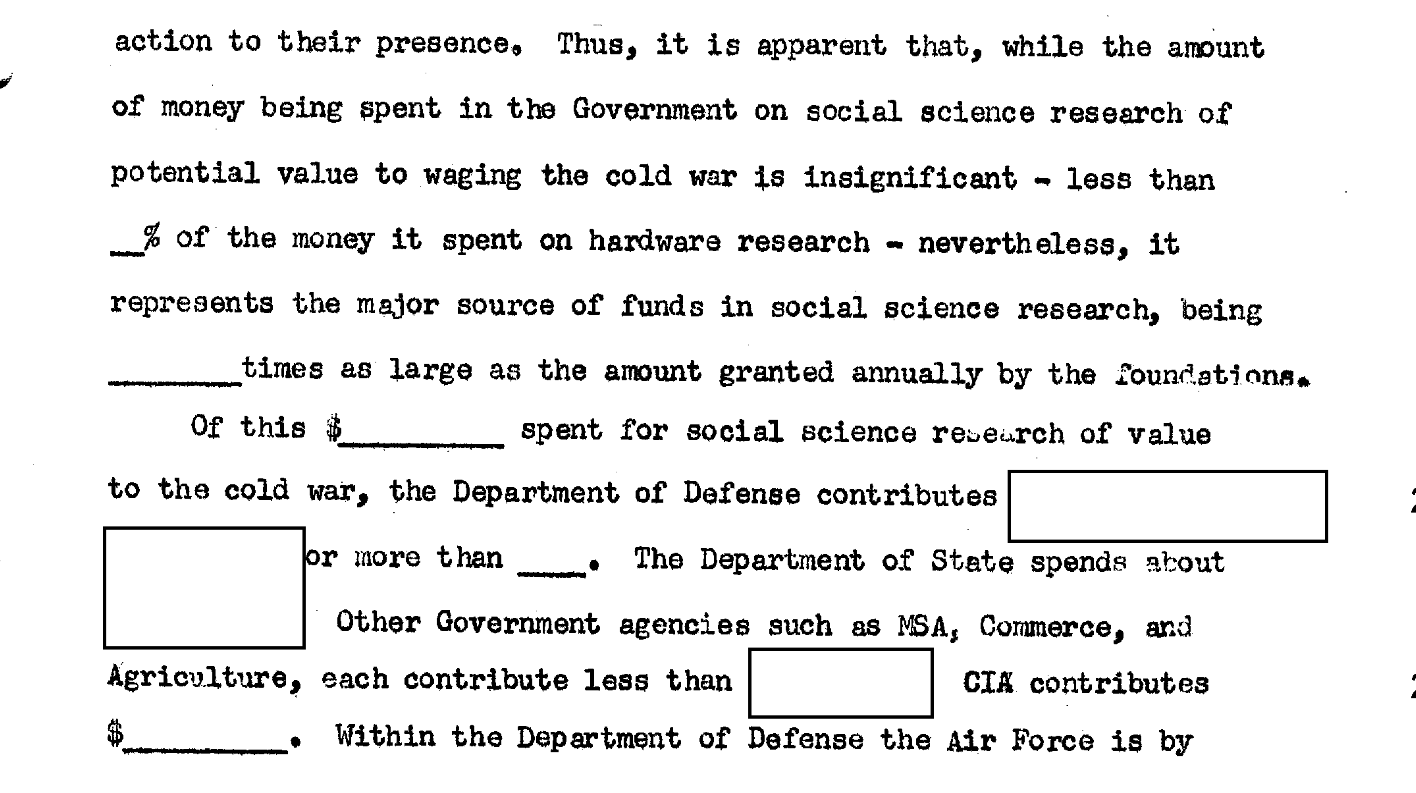
In the 1920s, Carnegie Corporation (CC) officials were in the business of selling “behavioral psychology,” as a professional brand, and designed their programs mindful of postwar patronage features. A recurring element in the unlimited panoply of social science projects: almost all of them, though initiated and sometimes designed by Carnegie officers, appeared under the SSRC banner.
This partnership was consciously designed to convince potentially skeptical audiences that the new social sciences with their sophisticated quantitative mastery yielded credible, rarefied knowledge, and that their scientific approach ensured non-ideological objectivity.
SSRC attribution provided a “non-spectacular promotion” of projects as a kind of neutral collective output of “the experts,” not foundation politicking.
Though still dwarfed by the Rockefeller Foundation, Carnegie had been one of the SSRC’s principal funders since 1932; from 1937 to 1942, Carnegie granted the SSRC $25,000 per annum for administrative expenses alone. Because the SSRC depended on the foundations for its entire budget, its members had little autonomy in deciding what the organization would do. Carnegie and Rockefeller were hands-on patrons who attended the SSRC’s major policy-making meetings, weighed in on what sorts of fellowships it should offer and what sorts of projects it should undertake. An internal document concerning a Carnegie grant to the SSRC for 1940–1942 summarizes the foundation’s almost proprietary relation to the SSRC this way: “In addition to coordinating research in the social sciences, the [SSRC] advises the Corporation on proposals in its field and offers valuable assistance in framing studies undertaken on Corporation initiative, such as the negro study now under way.”
This justification Carnegie offered for supporting the SSRC is telling, in that it highlighted not what the SSRC did on its own but how it “assist[ed]” with projects “undertaken on Corporation initiative.” The study referred to, published in 1944 as Gunnar Myrdal’s An American Dilemma, was but one of many SSRC projects “undertaken on Corporation initiative.” Unequal collaborations like this in which Carnegie played a strong, directive role would take center stage during the immediate postwar period. (Hauptmann 2016)
The SSRC itself was founded in 1923, and, initially, served as a wholly Rockefeller-directed institution that would, with an enormous war chest, catastrophically transform U.S. social sciences over the next decade by forging a “technocratic bargain” between the elite foundations and the nascent left-liberal New Deal Establishment— “a bargain was struck between social scientists, Rockefeller philanthropy, and the State that has since become an accepted part of the way we organize social life” (Fisher 1993).
Throughout the 1920s, SSRC was promoted and to a great extent controlled by Rockefeller philanthropy which accounted for 92% of the council’s income. However, it must be noted that militarized psychologists and institutional economists of this “technocratic era” had for decades been fascinated by the idea of “scientifically managing” workers and applying “social control” techniques to the problem of mass man— fault lines and fissures were appearing amidst rising immigration, negro migration into northern cities, post-war “red scares” and general mob violence.
There was general agreement among a certain Chicago clique that the city was a research laboratory “in which human nature and social processes may be most conveniently and profitably studied,” and the Rockefeller Foundation had the monies to make that cyborg vision a reality. The city was modeled as “a mechanism—a psychophysical mechanism—in and through which private and political interests find a collective expression” (1915 Park). Presumably, with enough research, the levers and dials of this mechanism could be located and schematized.
At the fin de siècle, psychologists and political researchers had already been influenced by French concepts of “crowd psychology,” “mental contagions” and “the mass society.” Gustave Le Bon had declared, in this “era of crowds” the masses constituted “the last surviving sovereign force.” In 1908, the American E. A. Ross wrote in his Social Psychology that the crowd was “[e]ssentially atavistic and sterile,” and the roiling mass “ranks as the lowest of the forms of human association.”
During the first world war, these concepts of crowd psychology would be applied to great effect. The Committee on Public Information (CPI), Wilson’s colossal war propaganda and censorship agency, had endeavored to inspire in the masses “no mere surface unity, but a passionate belief in the justice of America’s cause that should weld the people of the United States into one white-hot mass instinct with fraternity, courage, and deathless determination.”
Exactly like the post-war SSRC, the inter-war formation of the council was helmed by former war propagandists. For example, SSRC founder Charles Edward Merriam, a prominent political scientist who served as a member of the CPI during World War I, known as “the virtuoso of non-spectacular promotion.” New Deal architect, shaper of all political science, responsible for introducing socio-metrics and “applied psychology” into politics and, with massive foundation support, fully realized the “vision of social scientists as technical advisors to society’s political leaders.” Another Rasputin character.
In 1924, just a few years after the SSRC’s founding, Merriam, not content being the primordial Iktómi trickster-god at the center of the biopower lattice, would try to own the entire loom of the New Deal dispositif. Merriam originally wanted the SSRC cephalopod to reach into media, so he spearheaded an international “news research” project.
In correspondence with Walter Lippmann, inspired by his Public Opinion (1922), Merriam sought to establish a “thoroughly scientific and objective investigation of the instrumentalities involved in the worldwide gathering and dissemination of current news and opinion of international concern, and of the underlying related problems of the formation, expression and significance of attitudes on international affairs.” The project’s scope encompassed all international electrical communication and mass opinion formation.
The SSRC approved a “Committee on International News and Communication,” chaired by Walter S. Rogers, a Chicago resident with a background as a CPI propagandist. In WW1, he had developed a worldwide network for the distribution of American propaganda, which likely served as a prototype for the Voice of America in World War II.
Abbreviating militarized “research & development” projects as objective “research” in the interest of the public good was a social engineer habit popularized by the SSRC that has since been entrained into the motor instincts of every appendage in the DoD cephaloplex. Rogers had previously served as a communications expert at the Versailles Peace Conference, advocating for open access to international cables to break the British monopoly, a mission of critical U.S. strategic interest.
When the Rogers/U.S. argument failed to gain international support, America militarized its approach to international communication by putting the Navy in charge of cable interests and access. The Navy, in turn, helped launch AT&T and RCA (Dizard, 2001). Given what we now know about the later involvement of the U.S. government in secret communication research (Glander, 2000; (Simpson 1994) (Jansen 2010)
Merriam was trying to own the news about 30 years before Operation Mockingbird. Unfortunately for the media innovator, controversy erupted when the news noticed. In September 1925, Editor & Publisher published a front-page article headlined “Rockefeller Fortune Backs Investigation of Newspapers,” implying SSRC was a Rockefeller tool to intimidate the press. This provoked an uproar, as public memory of Rockefeller scandals (Ida Tarbell’s 1904 exposé of Standard Oil, the 1914 Ludlow Massacre, and the U.S. Commission on Industrial Relations investigation) remained fresh in public memory.
To protect the carefully curated image the Rockefeller Foundation had been cultivating, the project was abandoned with startling speed. The SSRC deliberately revised its structure to avoid further “embarrassments,” to render the Rockefeller philanthropy’s control of SSRC less visible, but no less real. It shifted from direct investigations to functioning as a funding and coordinating agency [like the MKULTRA fund]. Rogers established the independent (cut-out) Institute of Current World Affairs with an endowment from businessman Charles R. Crane, while SSRC formed an Advisory Committee on International Relations (1926–1930) (Fisher 1993).
SSRC’s interest in media can be summarized by the collected works of the afore mentioned Robert Park, titled Society : collective behavior, news and opinion, sociology and modern society (1955) Park believed that negro assimilation could only be the eventual result of a long-term process of racial conflict and accommodation.
Perhaps the most illuminating fact is that, during this early period of “research,” into the mitigation of subversive elements in society (neutralizing the political mind of mass man), several prominent SSRC sociologists were being investigated by the FBI for their (real) subversive activities.
The Laura Spelman Rockefeller Memorial (LSRM), and later the Carnegie Corporation, perceived a concordance between Negro education in the South and the education of colonial peoples, particularly in Africa. For instance, an official of the LSRM wrote to a visiting administrator from Kenya, “Our hope is that your observations may throw some light on the problems arising in working among backward communities where the process of assimilating European culture is just beginning in the negro groups.”
That official was one Guy Stanton Ford former Committee on Public Information (CPI) propagandist and actively engaged with the SSRC from at least 1927 to 1931. During World War I, he served as head of the CPI’s Division of Civic and Educational Publication. Among other projects, Ford oversaw the production of informational bulletins, speeches, and rhetorical aids for the CPI’s “Four Minute Men,” a network of 75,000 volunteers who delivered short, patriotic addresses in public venues. There was an arrangement with Hollywood and local theaters between reel changes in movie theaters, but they’d also just appear at restaurants, at public parks, in town centers promote the draft, sell war bonds and generally “arouse” the crowd.
The organization was ubiquitous: journalist Mark Sullivan commented that “it became difficult for half a dozen persons to come together without having a Four Minute Man descend upon them.” A close examination of the procedures, especially the location of movie theaters, the double “in-betweenness” (theater as liminal location and between reels) and the strict rule that the speech must be exactly four minutes, suggests this program was thoughtfully designed to blur the lines between government propaganda and spontaneous expression.
James T. Shotwell, another CPI alumnus, and one of the men responsible for framing WW1 as a “moral crusade” (progenitor in the genealogy of comic book mythology that pervades our culture) directed the SSRC’s Committee on International Relations (1931 onward), securing Rockefeller Foundation grants for interdisciplinary studies on global affairs. His SSRC work would generally promote one-world internationalism that diluted American independence.
Shotwell’s résumé foreshadows the peculiar dissonance that afflicts the nation’s securitization culture, framing America as the paranoid, moralizing colossus that must “burn villages and import the villagers” from all over the world, simply to protect its security and economic interests.
In the international field, foundations, and an interlock among some of them and certain intermediary organizations, have exercised a strong effect upon our foreign policy and upon public education in things international. This has been accomplished by vast propaganda, largely supported by the foundations. The net result of such activities has tended to promote “internationalism” in a particular sense—a form directed toward “world government” and a derogation of American “nationalism.” The Cox Committee record shows that a conscious plan by the Communists was inaugurated to infiltrate the foundations for the purpose of appropriating their funds to Communist uses. We know from the evidence that the Communists succeeded in the case of seven foundations. This Committee is not in a position to assess the extent of such use but warns against the inherent danger that a concentration of power constitutes a weapon at hand for such as may wish to suborn it for evil designs.
—Reece Committee, U.S. House, Tax-Exempt Foundations (1954)
SSRC helped create the Office of Strategic Services (OSS) by providing representatives who assisted OSS founding director William Donovan in selecting a slate of academic advisors. Then during the war, it served as an employment hub for the COI and OSS. In the post-war era, the SSRC was a conduit for “dual-use” research, academic in appearance but serving intelligence needs.
It was essentially a foundation-financed academic “steering committee,” staffed with former OSS propaganda officers. SSRC served as an instrument in the postwar reconfiguration of U.S. universities, channeling resources toward area studies and behavioral sciences. It drew from OSS alumni like Geroid T. Robinson, head of the OSS Research and Analysis Branch’s USSR Division, who became director of Columbia’s Russian Institute and served on the SSRC’s World Areas Research Committee. The SSRC basically facilitated the technology transfer of wartime intelligence methodologies into peacetime scholarship (Horowitz 1969) (Katz 2013).
“It is a curious fact of academic history that the first great center of area studies [regional studies]... [was] in the Office of Strategic Services.... It is still true today, and I hope it always will be, that there is a high measure of interpenetration between universities with area programs and the information-gathering agencies of the government.” — McGeorge Bundy (1964 speech at Johns Hopkins)
This symbiosis is evident in how the SSRC created the field of “international relations” as a field of study by subsidizing programs that provided a broad basis of experience for the formation of the School of International Affairs, prioritizing “training students for technical and managerial posts in those agencies of the government which maintained a foreign service” (Horowitz 1969).
The SSRC was again strategically “remade” post-WWII as a front for Carnegie-funded intelligence-linked initiatives (e.g., behavioral research for military and psychological warfare purposes). As Carnegie’s John Gardner put it in 1987, “[A]ll of us folks came back [from the war] deeply committed to thinking about international affairs, and we met in various forums, worked together, Ford, Rockefeller, [Carnegie], State Department…”
Foundations like Carnegie, Ford, and Rockefeller, together with proxy funding mechanisms like the SSRC, designed these fields from the ground up with the explicit or implicit goal of creating “organized intelligence” for government use, including countering communism and socialism. This led to the recruitment of OSS veterans into academic roles, incestuous interlocks between universities and intelligence agencies, and a deliberately concealed “interpenetration” of academe with government information-gathering.
The fields were designed to produce research, ideology, and personnel for hegemony-building. This structure has effectively operated while “hidden in plain sight” for decades, and even if interrogated, an army of academics that benefit from its funding and prestige can be summoned to any hearing and say that it does not exist, nothing to see here.
The SSRC’s Joint Committee on Slavic Studies applied insights from OSS interrogation and propaganda techniques to analyze “national movements that challenged US power,” including covert operations and torture (Simpson 1994); (Cumings,1997). With the Carnegie war chest, the SSRC was positioned to amplify the OSS’s grey/black psywar logics throughout the entire academic field of social science, funding studies that “quickly became the most powerful influence on the old horse-and-buggy departments,” while structurally impairing scrutiny of load-bearing U.S. imperial structures, before anyone even though about doing it (Horowitz 1969); (Roelofs 2003).
The SSRC institutional instinct was 100% a residue of the OSS’s psychological warfare paradigm, where “U.S. military, intelligence, and propaganda agencies spent tens of millions of dollars to underwrite...the work of dozens of leading US social scientists during the first decades of the Cold War” (Simpson 1994).
Institutional leaders like Pendleton Herring, SSRC president and former OSS consultant, steered grants toward projects that perpetuated myths of “national security-commercial complexes,” crystallizing the conceptual framework and how it is said to work in service of dominance (Simpson 1994) (Hauptmann 2016).
This “steering” is responsible for the Chomskian “Big Business” model that dominates left-wing discourse, as well as the downstream NPC refrain: “It’s all about the money—it’s Big Business, dude.” If this grand conspiracy of “Big Business” is meant to signify a syndicate of criminal oligarch families and their foundations integrated into the national security state and in service of an overarching Wellsian “world-brain” agenda, then the description is accurate.
In the post-war period, certainly by the time of Brown Vs Board and Messrs. Gunnar Myrdal, the ethos and epistemology of the psywarrior had been well integrated into SSRC-supported communication research.
The SSRC may be visualized as the center of a network of relations reaching into every layer of social activities related to the social sciences … (1954)
Into every layer, certainly into public education, into the methods and structures of teaching that have brain-damaged Americans for seventy years. As from the Norman Dodd testimony to the Reece Committee (May 11, 1954): “Foundations were weaponizing the U.S. education system to enable oligarchical collectivism.” In his testimony before the Reese committee, foundation-funded “zealots,” professor of sociology Albert Hoyt Hobbs stated that the new research in the social sciences
… lead people to believe that techniques exist in social science which provide accurate description and enable prediction of social behavior. We are told to pattern our behavior and to change our society on the basis of such conclusions regarding criminality, race relations, marriage, mental health, war, divorce, sex, and other personal and social affairs. Yet in these areas of behavior the pertinent knowledge is extremely limited and unreliable, the rules of behavior are vague and changeable, the techniques are crude and untested, and even the basic units required for measurement are non-existent. [Again:] Character and integrity are dissolved in the acid ridicule of cultural determinism.
—Dr. Albert Hoyt Hobbs before the Special Committee to Investigate Tax Exempt Foundations, (Reece Committee) (1954) (emphasis added)
The dissolution of “character and integrity” is the dissolution of what makes us real, persistent beings. As Hobbes went unheeded, this process has now been compounded by several generations of application and can only be described as causing an extinction of human qualities. It is no overstatement to say that the SSRC, the OSS/CIA, and the foundations utterly transformed our world through social engineering.
This is more fundamental than merely claiming that “Civil Rights was a psyop.” It means that the knowledge production of the social sciences—which has diagnosed our social and political ills and prescribed their remedies, decade after decade without interruption for the last seventy years—operated under the epistemology and protocols of Cold War intelligence. This was a fact manufactory that assumed a state of total information war against mass man. The distinctions between social, political, economic, and military goals have become entirely amalgamated. In other words, this is the network that produces the American Cyborg’s ontology, which, through powerful second-order influence, makes the whole world run like a simulation.
We are all in the fog of war; it rolls everywhere and in every direction. Literally no social, political, or psychological facts produced by the left-liberal establishment in the past century can be regarded without suspicion. Most of these facts, if not all, are direct inversions of observable reality, each designed to mute instinct, intuition, and common sense—to stop you from feeling a natural revulsion toward their mind-eating simulated reality. They built an SCP-like parasitic cognitohazard in real life.
It is difficult to comprehend the scope of what has been done. Every concept we have about race, the nature of the Cold War, and everything the public has been educated to believe about civil rights, politics, communication, and society in general—it’s all demonstrably an elite-engineered fiction, purposely designed to immobilize you. Everything that leftist media critics like Baudrillard discuss… the bad infinity of man immobilized by endless networks …none of it happened by accident.
Forced, cybernetic integration also serves an alchemical purpose: the mixing of nigredo and albedo to produce a synthesis. Public schools, in concession to the tenor of the black psyche, which is generally unassimilable and alien to European civilization, become a schizo-chronotopic space, neither a black nor white time-space, an uncanny zigzag clown realm where higher-order thought becomes impossible.
These ghouls conducted psychosurgical operations that have changed our cultural understanding, defined terms, and promoted policies that have ruined countless lives, fostered the breeding and rebreeding of retarded psyches, created untold carnage in our cities, and drastically eroded our standard of living. This goes beyond the traditional understanding of class warfare.
It represents nothing less than a sustained campaign of mass menticide—an artificially induced national coma that the American people have endured for the last seventy years.
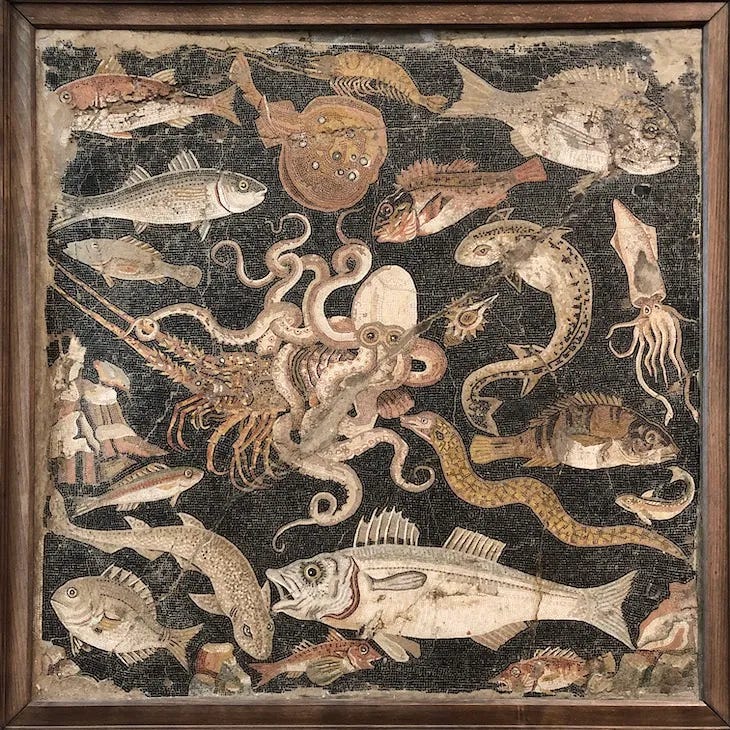
It is impossible to get past this dissonance without understanding that the US built the Soviet Union, and that the Cold War was a global psywar de/reterritorialization project, characterized more by American-Soviet cooperation than sincere, ideological enmity. They don’t understand that interpenetration — whether with Bolsheviks or Project Paperclip Nazis — is the rule, not some scandalous exception. There is no ideology in this place.
There is no center anymore, so there is no clear Other, no real friend or enemy, no interior to protect from an external threat. We are under maritime rules here (sovereign citizens metaphysically correct), radically decentered.
Ever since the American Gemeinschaft-volk got put through the cybernetic space-time compression machines, the World’s Fairs, the nation has gradually become disconnected from its own organic cultures, becoming the cyberpolitical chimera we inhabit today. Disconnected from the land, we are at sea, in the “blood-dimmed tide” of the Devonian ocean.
The bonds of personal loyalty and affection which bound a man to his chief have long since dissolved. Monarchy and class privilege have gone the way of all flesh, and the idolatry of the individual passes for the official religion of democracy. It is an atomized world, in which individual whims have wider play than ever before, and it requires more strenuous exertions to coordinate and unify than formerly. The new antidote to wilfulness is propaganda. If the mass will be free of chains of iron, it must accept its chains of silver. If it will not love, honour and obey, it must not expect to escape seduction.
Harold Lasswell, Propaganda Techniques in the World War (1927), student of Charles Merriam, SSRC director
Harold Lasswell, who had the ear of Rockefeller Foundation administrator John Marshall, wrote the screenplay for Cold War public culture — a storyline that extended the specter of communism long after military victory. He openly argued that the elite of U.S. society, “those who have money to support research” (i.e., the foundations), should systematically manipulate mass sentiment to preserve democracy from threats posed by authoritarian regimes such as Nazi Germany and the Soviet Union.
Bear in mind that SSRC and OSS social scientists, together with the foundations, pushed to extend Lend-Lease to the Soviet Union, promoted H. G. Wellsian technical-materialist collectivism, and in various ways propped up the Soviet regime. In practice, however, it was Lasswell’s rhetorical maneuvering that prevailed, supplying the “theory” that appeared to reconcile professed democratic values with the manipulation and deceit at the heart of projects designed to engineer mass consent.
The OSS was, in one historian’s phrase, “the seed of the fantastic postwar symbiosis which developed between the military, the state, international business and the university.” Meanwhile, the SSRC, effectively subordinate to its own offspring, co-sponsored committees that “opened the way for a new global American imperium,” channeling foundation funds and agendas into initiatives such as the Joint Committee on Latin American Studies. That committee drew on psychological-warfare techniques to counter what it called “revolutionary elites in countries within the U.S.’s imperial orbit” (Cumings,1997); (Horowitz 1969); (Cumings2014).
The foundations exercised their power by sponsoring “propaganda campaigns both inside the United States and abroad,” ensuring social sciences served as “junior partner in U.S. foreign policy” without transparency and actively obscuring how OSS-derived methods enabled interrogation, torture, covert “social interventions” and massive propaganda campaigns (Simpson 1994); (Roelofs 2003); (Klinger 2019). In the area studies, this alignment prioritized national security over scholarly autonomy, fostering a criminal-intelligence paradigm that remains embedded in modern academe.
“I think we were, quite frankly, in the period from ’ 46 to ’ 50, propagandists for the behavioral sciences, and admittedly so. And God knows, we were barely in time . . . .[I]f we’d been a generation later, I don’t know what would have happened.”
—Charles Dollard, former President of the Carnegie Corporation (1967) (quoted in Hauptmann 2016)
This propagation of “applied behavioral psychology,” or more succinctly cybernetic “area studies,” found expression in supposed excesses such as MKULTRA, Operation Mockingbird, and the Phoenix program, and continues into modern DARPA social-influence research like Narrative Networks, the SMISC (Social Media in Strategic Communication) program, and the MAGICS agenda (Modeling and Analysis of Generalized Interactions in Complex Systems). MAGICS explicitly seeks “novel computational and empirical frameworks to model social systems, deploying interdisciplinary approaches from psychometrics, behavioral science, data science, and machine learning.”
It is a bizarre feature of the current paradigm that, because much human experimentation now takes place online, social-control research can be openly published and reported by the media with little public outcry.
A basic metaphysical rule of human creation is this: people create only by externalizing what already exists within them. If there is nothing inside, nothing can be made. If only a simulation of life exists behind your eyes, every act will be simulation, mimicry, or theatrics. To understand the neoliberal manager, examine his creation, the neoliberal subject. That creature, commonly called the “normie,” believes both nothing and anything, holds no firm principles, and has adapted to simulation alone; it has no real connection to blood, soil, or God. The normie mirrors its neoliberal social-engineer creator: an internationalist bureaucrat with no fixed beliefs, no real lineage, no divine mandate, and a continual habit of reinventing the meaning of the present.
Part of the confusion stems from the fact that “socialist democracy,” and the idea of a global order achieved through democratic-socialist means, was in practice supported by the intelligence community as an answer to Soviet Communism. The supposed purpose was to provide a milder, democratic alternative — a kind of “World Communist Conspiracy Lite” — to inoculate the global South and domestic dissidents against Kremlin influence.
Beginning in 1950, the CIA sponsored and financed the Congress for Cultural Freedom and a series of politically liberal, strongly anticommunist publications including Encounter (England), Der Monat (Germany), Forum (Austria), Preuves (France), and Cuadernos (Latin America) as a means of combating the perceived neutrality of intellectuals in the face of purported communist expansion. Sidney Hook, Melvin Lasky, Edward Shils, Daniel Bell, and Daniel Lerner, among others, emerged as prominent public spokesmen for this campaign, though they have insisted in later years that they were unaware of the CIA’s sponsorship for their work. Either way, the point here is simply that fierce, social-democratic anticommunism became a genuinely powerful political movement in academe, in part because it enjoyed considerable covert government financing.
—Science of Coercion: Communication Research & Psychological Warfare, 1945–1960, Christopher Simpson
Adding to the confusion, many of the people involved in the vaguely Soviet-form Rockefeller-Carnegie-Ford cephaloplex happened to be former Office of Strategic Services officers, former propagandists for the Office of War Information, or liaisons for the CIA and State Department. In one capacity or another, many of them served the left-liberal, rhizomatic hegemon that grew in the shadows of the postwar security state.
At the end of the day, Southern senators and congressmen, Robert Welch, and the anti-communist Old Right were, in at least one respect, correct: the OSS and parts of the State Department contained individuals who were communists or Soviet sources.
Haynes, Klehr, and Vassiliev, in Spies: The Rise and Fall of the KGB in America, identify at least fifteen OSS employees as communists or Soviet intelligence sources, including Duncan Lee, Maurice Halperin, Julius Joseph, Helen Tenney, Donald Wheeler, Jane Foster Zlatovski, Stanley Graze, George Graze, Alfred Tanz, Irving Goff, Franz Neumann, Bella Joseph, Linn Farish, John Scott, and David Wahl. The authors note that some sources, notably Donald Wheeler and Maurice Halperin, were highly productive, while Duncan Lee and Franz Neumann provided excellent material but, according to Moscow Center, fell short of their potential (Haynes et al. 2009).
The exact tally depends on how one interprets “found to be,” since some were confirmed only through Venona decrypts, KGB archives, or FBI investigations. Haynes and colleagues present the figure above as a minimum and emphasize that the dozen identified sources discussed in their chapter do not exhaust the KGB’s assets in the OSS; other documents use unidentified code names, and Soviet agents at OSS headquarters were likely well into double figures (Haynes et al. 2009). (Andrew and Mitrokhin 1999).
The nature of American social engineering and cultural encybernation is rarely either/or; it is more often both/and/and. So-called “communist conspiracies” exist inside a system of systems — a module of a political cyborg, an organ that produces corrosive red mercury for the forging of amalgams. Its homeostatic aim is not communism but the permanent technical enslavement of humankind. There is no “Negro revolution,” no “sexual revolution,” and no “gender revolution”; these are merely the alchemical solvents of the cybernetic “triple revolution”—
The New Left linked cybernation with ideas about a postindustrial society. In 1964, the “Ad Hoc Committee on the Triple Revolution,” consisting of such notable activists as Erich Fromm, Todd Gitlin, Michael Harrington, Gunnar Myrdal, and Robert Heilbroner, issued a manifesto declaring that “three separate and mutually reinforcing revolutions are taking place,” the “Cybernation Revolution,” the “Weaponry Revolution” in nuclear arms, and the “Human Rights Revolution.” Focusing on cybernation, the manifesto proposed making a guaranteed income a right in order to distribute fairly the wealth produced by cybernation, which broke the connection between jobs and income. Although the authors used the term cybernated society, rather than postindustrial society, they alluded to a tenet of the latter theory by saying that the new era’s “principles of organization are as different from those of the industrial era as those of the industrial era were different from the agricultural.”
They were force-hyperstitioning, much like today’s science-fictional AI proselytizers in Silicon Valley, projecting a near future in which computers take over all forms of information work and thereby create demand for universal basic income and global wealth redistribution. It is a tired restyling of Fabian-Wellsian “World Brain” luxury communism.
Yet another fallen 1960s idol, the “psychedelic revolution” was part of this bubbling agglutination. In the hallucinogen-propaganda pamphlet Psychedelics: The Uses and Implications of Hallucinogenic Drugs, Humphry Osmond — the man who rechristened psychotomimetic substances (so called because they mimic psychosis) as “psychedelic,” defined in his marketing as “producing expanded consciousness through heightened awareness and feeling” — after extolling the virtues of cultural imperialism, declares that “the models we provide will determine the fate of tomorrow’s world.”
He goes on—
In this respect, the psychedelic vanguard is attempting to provide both a model for others and an answer to an important question: how are we to treat those who will not be able or allowed to work in our rapidly automating society? The obvious answer is a guaranteed annual income that would pay a living wage to everyone for doing what he chooses. This would allow many people to spend a great deal of time re constructing their environment, so that our cities can eventually become places that are desirable for human habitation. Gunnar Myrdal, in his Challenge to Affluence, implies just this.
—Psychedelics: the uses and implications of hallucinogenic drugs, Bernard Seymour Aaronson and Humphry Osmond


While director at the New Jersey Neuropsychiatric Institute, Osmond’s employee, Carl C. Pfeiffer, was a contractor under MKULTRA Subproject 47 ($45,555 in 1955) and Subproject 26 ($4,782 in 1954), testing LSD for amnesia, dissociation and modeling psychoses via cutouts like the Geschickter Fund. The use of Humphrey Osmond’s letterhead strongly implies his personal oversight and indirect involvement. Though MKULTRA funding requests written on Osmond’s personal letterhead does not confirm that Osmond himself had CIA contracts, it does recontextualize the compulsory Wikipedian standard that he was an “unwitting” participant.
Once again, with the benefit of hindsight and in light of how these strategies played out, we return to the puzzle faced by mid-century Old Right anti-communists: was it all spectacular incompetence, or was it treason? Besides the family, the most universal human unit is the cabal — so native to our story that childhood conspiracies are woven into play and social development. Conspiring against the all-knowing mother is the first step to individuation. Equally common is the adult practice of self-deception. The general rule, so obvious that stating it startles the brain, is to ascribe agency to those who consistently display it. Rasputin-like figures such as Felix Frankfurter, William Donovan, Charles Merriam, and Humphrey Osmond should therefore be, by default, treated as “witting” agents, not merely “unwitting” participants.
The Mind in the Interlock
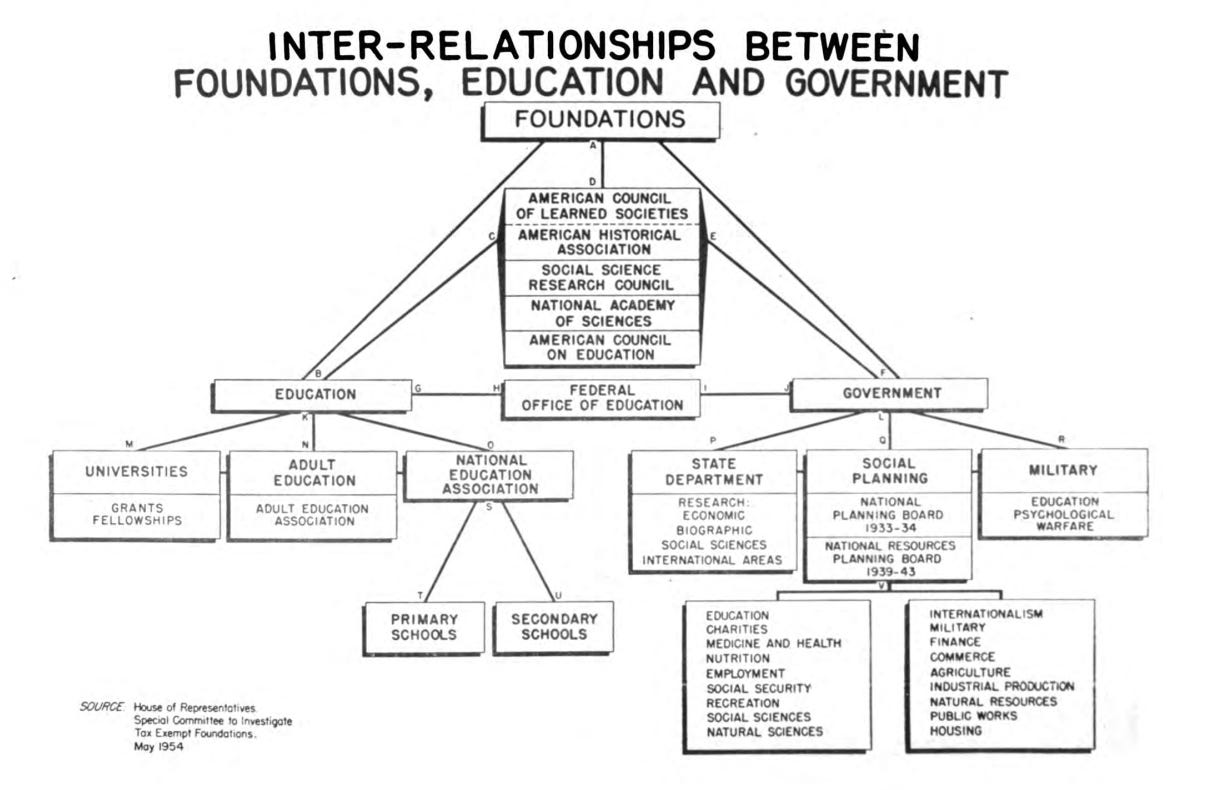
Never forget, the press is the enemy. The establishment is the enemy. The professors are the enemy. Professors are the enemy. Write that on a blackboard 100 times and never forget it.
—Richard Nixon
The Red revolution is, in fact, colorless. The proof of the “triple revolution,” or perhaps the transparent “world cybernation conspiracy,” is the uninterrupted, synchronized procession of the American political elite (whether neoconservative, neoliberal, or outsider populist) toward increased cybernation, no matter the incongruity with their supposed allegiances, political principles or even personal ambitions. It is like an alien shade haunting the edges of every political platform.
If you have been told that Eisenhower was “anti-communist,” he indeed was in the virtual, Cold War theater sense, but not in any physical sense that you can reach out and touch. In reality, his and Buckley’s “anticommunism” and Cold War spending only helped to justify expansive New Deal-style state power and neoliberal reforms; they made the “activist state” and its psychiatric managerialism possible.
The 1950s were far more liberal than commonly taught: Cold War anticommunism, economic imperialism, and a civic conception of national greatness combined to legitimize an expansive, activist state and reforms, that would help to usher in the civil rights era, with virtually complete bipartisan support (Dalton 2013). The conservative 1950s is largely a far-left myth, the “liberal-left establishment” has never lost its hegemony since WW2.
By 1956, the Cold War was over and the American leadership knew they had won. They could not tell anyone and so they had to keep the Cold War going especially since the European countries were warming up to the USSR and not all of the world societies had been sufficiently penetrated by the American Proposition.
—Wemhoff, David. John Courtney Murray, Time/Life, and The American Proposition: How the CIA’s Doctrinal Warfare Program Changed the Catholic Church - Volume I
Even a cursory examination of Operation SOLO reveals that the FBI was running the CPUSA by 1958. Any communist activity after that time, including all the material, organizational and agitational support issuing from the CPUSA for the SNCC, COFO and other black militant organizations in the ‘60s, was happening under the purview of the FBI.
In the 1950s, the Liberal Democrats started to label moderate Republicans as “conservative” to bolster their own progressivism, and to distinguish themselves from these centrist Republicans. The pseudo-Republicans, who were in many ways indistinguishable from their liberal counterparts, were then able to insist to their base that they were in fact staunch conservatives, not simply “me-too” candidates. Both parties invested heavily in this legerdemain, portraying “moderate Republicans” (rightist-shaped simulacra) as more conservative than liberal Democrats became standard protocol. Contemporary journalists replicated those assumptions in their reporting and this was recorded as history. The extreme “ultra-conservative,” conformist framing of the 1950s was then made possible by 1960s-70s era New Left radicals who later became academics and journalists themselves (Dalton 2013).
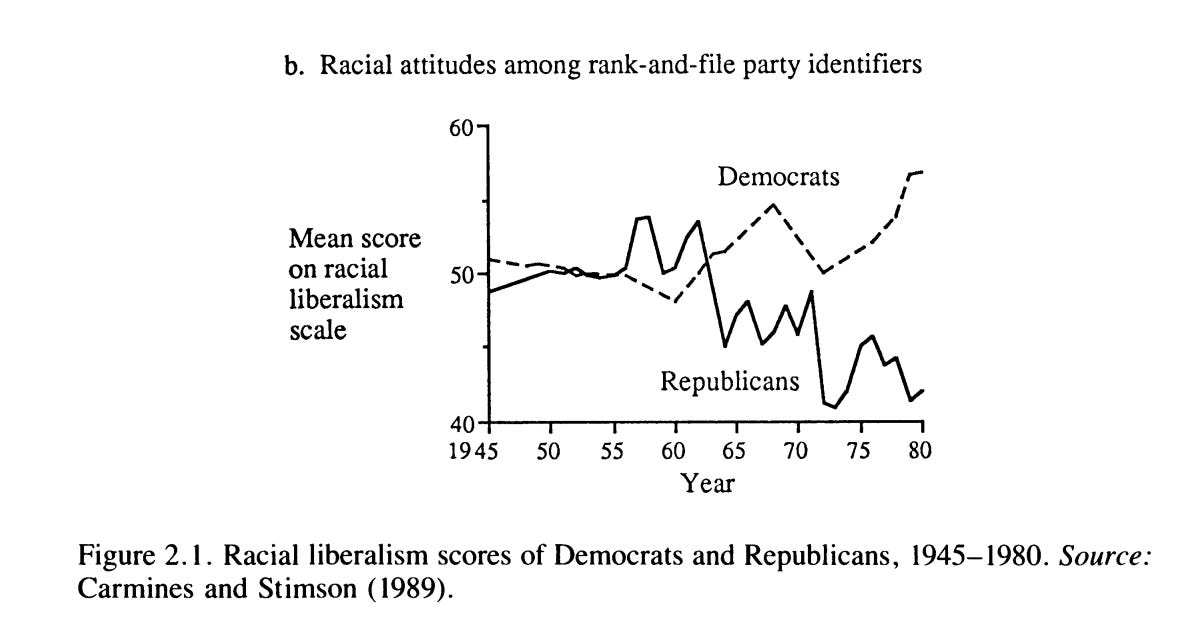
Despite his anti-communist rhetoric, Eisenhower expanded New Deal programs like Social Security (adding coverage for 10.5 million more people), created the Department of Health, Education, and Welfare, built massive public works including the Interstate Highway System ($25 billion for economic stimulus) and the St. Lawrence Seaway, increased federal spending on hospitals and medical research (from $290 million to $1 billion), advanced housing and urban renewal, promoted racial integration and school aid (including the NDEA after Sputnik), appointed covert activist judges to enforce Brown v. Board, and consistently invoked the Cold War to justify expanding activist government by framing welfare, jobs, and civil rights as matters of national security.
When David prepared to slay the giant, he armed himself with a handful of stones. But President Eisenhower slew the whole Republican Party in the South with one Little Rock.
—Senator John McClellan
Dwight Eisenhower was not a communist, nor anything really. More politician than human, he was, in fact, a mirage, the continuous real-time modulation of skin patterning on a squid tentacle. His entire political career was a sustained psychological warfare campaign. Eisenhower was personally behind the information war to discredit McCarthy, he sent the 101st Airborne into Little Rock, murdering the republic, and used his media connections to conceal his crime.
The Eisenhower we know is a sea bishop; a fanciful figment; a hallucination caused by not comprehending the horror that lives beneath the water’s surface. An ever-shifting CFR internationalist who named six members of the CFR to his Cabinet, as well as naming no less than twelve members to the rank of Under Secretary. Eisenhower was not originally a favored candidate, but Henry Luce admired him and sent his CIA liaison C.D. Jackson to advise the former general and write his speeches, and Luce would use the full power of his media empire to propel him into the presidency. Eisenhower was almost entirely a magic lantern projection of secret powers. Plainly stated—
After World War II, foundation-sponsored political science played a more active role in the management of cold war crises and the internationalization of the U.S. economy. The “Managerial Presidency” was now enhanced with international capacity, by the creation of the National Security Council and the Central Intelligence Agency (1947). The prime mover and principal “constituency” of the CIA is the (Rockefeller and Carnegie-created) Council on Foreign Relations (1921), which unites business leaders, government officials, journalists, and foreign policy academics (Marchetti and Marks, 1980, p. 237).
—Foundations and political science, Joan Roelofs (1992)
The Reece Committee report, in no uncertain terms, diagnoses a metastasized social-scientific “cartel” behind knowledge production, which it then decomposes into five interlocking components. Foremost among these was the foundational axis: the constellation of philanthropic nodes that constituted the financial and normative core of the reality-printer: the Rockefeller and Carnegie Corporation (CC), the Ford Foundation, the Russell Sage Foundation, and other analogous endowments.
The second component consists of the “intermediaries” or “clearing houses,” such as the LID, the National Science Foundation, and SSRC. The third element is the constellation of learned societies across the social sciences: organized fora that produce classificatory norms and professionalize expertise. The fourth element consists of the learned journals, whose editorial and peer-review procedures operate as disciplinary technologies, filtering what counts as legitimate knowledge and inscribing consensus into the archive. For example, the American Council of Learned Societies (ACLS). Since the 1930s, and up until the end of the Cold War, the ACLS was a central component in the “joint administrative nexus of American academic research” which was “compromised by a secret and extensive network of ties to the CIA and the FBI” (Simpson 1998).
Furthermore—
The American Council of Learned Societies (1919) and Social Science Research Council (1924) were created as academic holding companies to distribute research funds slightly laundered of the Rockefeller and Carnegie stains. These “buffer” organizations may appear neutral to activists and academics, and to the general public their provenance generally is hidden. (Roelofs 2003)
The fifth element is personnel-based: particular individuals in strategic positions, certain professors, covert activist judges, department heads, and administrators embedded within institutions preferred by the combine, who function as nodes of transmission, inscribing oligarch/foundation rationalities in teaching, hiring, and research practice.
What it failed to diagnose is that the nerves and capillaries of the interlock are often composed of former intelligence operatives or assets, leading back to the State Department, Office of Strategic Services / Central Intelligence Agency (CIA),the Council on Foreign Relations (CFR) and, of course, the AFL-CIO and its labor-intelligence organs. Perhaps this is simply because they lacked the vocabulary, as the interlock between these is even more informal, with countless obnubilated nodes and relays, an unbounded structure that can only be characterized as “radically tentacular.”
These tentacular ones are “cnidarians, spiders… squid, jellyfish, neural extravaganzas, fibrous entities, flagellated beings, myofibril braids, matted and felted microbial and fungal tangles, probing creepers, swelling roots, reaching and climbing tendrilled ones.” (Haraway 2016).
Even formally, it is still a dangerous creature— a network of elite institutions that collaboratively advance U.S. foreign policy interests, through funding, policy planning, intellectual socialization, what Foucault would call an instance of “governmentality.” These entities form a Gramscian “historic bloc” of state-private partnerships, where foundations like FF/RF/RSF/CC provide financial resources and organizational infrastructure to buffer and legitimize official objectives, aligned symmetric to state apparatuses, including its diplomatic organs, and CIA intelligence and counter-insurgence operations.

The Carnegie-controlled, Russel Sage Foundation-staffed, Twentieth Century Fund-financed SSRC acts as an intermediary, an interpenetrating medium, between the cephaloplex and the withering Gemeinschaft-volk, performing an “intellectual laundering” service, channeling foundation funds to academic research that supports hegemonic programmes and rationalities. Yet, unlike what the French degenerate Foucault, this was not an inevitable historical process, it was done by deliberate and studied actions of flesh and blood actors. “In each of these projects, Carnegie deliberately muted its own role and promoted the remade SSRC as a major advocate for the behavioral sciences.” (Hauptmann 2016).
The CFR is more a higher-order lobe of the cephaloplex. Its 1946 CFR membership list reads like a who’s who of wartime intelligence and information operatives. The list includes OWI figures such as Lyman Bryson (chief of special operations, OWI, and CBS director) and Nicholas Roosevelt (OWI, 1942–43); OSS operatives like Elmo Roper (the famed pollster), and John Haskell (OSS, 1943–44); Junius Morgan (OSS finances) — and senior intelligence leaders such as Allen W. Dulles (chief, OSS Europe) and William J. Casey (chief of secret intelligence, OSS Europe). Also named are Joseph Barnes (director of OWI’s Foreign Operations, organizer of Wendell Willkie’s 1942 world tour, credited with coining “One World”), the philanthropist Paul Mellon (Morale Operations Branch) and Colonel David K.E. Bruce (chief of the OSS London station).
The CFR roster easily demonstrates how OSS and OWI veterans syncytialized into the postwar establishment: Brahmins from prominent families (Vanderbilt, Archbold, DuPont, Ryan) staffed intelligence and diplomatic posts, giving rise to the quip that OSS meant “Oh So Social.” Donovan’s circle included James Paul Warburg of the prominent banking family as a key aide, and immigrant strivers such as Ernest Cuneo liaising between the OSS, British Security Coordination (MI6), FBI, State Department, and President Roosevelt’s White House. The lesser known of these former operatives became pillars of the “administrative class” in Washington: Archibald MacLeish at the Library of Congress, Ralph Bunche at the United Nations, S. Dillon Ripley at the Smithsonian.
Basically, the CFR serves as the main Axial Nerve Cord (ANC) for elite consensus-building and tentacular locomotion; it integrates foundation-supported scholars, financiers, deep state hustlers, power brokers, spies, and oligarchs, all aligned with single-minded purpose: shape the international policy paradigm. Their members are almost without exception internationalist or globalist, and underneath their capitalist or communist or technocratic aesthetics is the Gigeresque edifice of H.G. Wells’ “world computer,” the tyrant of technique, upon which they universally conform their actions.
The far-reaching power of the large foundations and of the interlock, has so influenced the press, the radio, and even the government that it has become extremely difficult for objective criticism of foundation practices to get into news channels without having first been distorted, slanted, discredited, and at times ridiculed. Nothing short of an unhampered Congressional investigation could hope to bring out the vital facts; and the pressure against Congressional investigation has been almost incredible. As indicated by their arrogance in dealing with this committee, the major foundations and their associated intermediary organizations have intrenched themselves behind a totality of power which presumes to place them beyond serious criticism and attack.
—Reece Committee, U.S. House, Tax-Exempt Foundations (1954)
World War II never happened. There was only the European Civil War between two different forms of world socialism, or rather, a final solution to the Human Question. By the turn of the 20th century, the world had been in a state of revolution since 1789. The American Civil War, ‘‘the Long Shadow of Appomattox,’’ the great waves of immigration, the Ludlow Massacre, the Haymarket Riot, the Pullman Strike, the Chicago race riots, the bombing of Wall Street, and then the devastation of the Great War and the Red Scare all hung over the modern century.
The so-called “witch craze” and “red scare” are all neurotic complexes (self-assembling mass hypnosis techniques) that arise from the same source: the unstoppable demiurgic forces of technique (e.g., ecclesiastic courts, mass informant networks, panopticons, social media cooperative surveillance) encountering the immovable object of man’s disordered sovereignless state. This is the purpose of “social psychology” and the psychiatric managerial apparatus— to assemble a phantom state that can govern an insane phantom public.
Christopher Simpson detailed how the CIA underwrote almost all social science projects through foundations and SSRC, creating what he describes “networks of specialists with a common world view.” Simpson’s work unveils several major figures in American social science:
Hadley Cantril ($1 million in secret funds from the CIA, laundered by the Rockefeller Foundation), Leonard Cottrell (doing Pentagon unconventional warfare in 1952–53, then long-time director of the SSRC), Walt Rostow, Max Millikan, Daniel Lerner, Edward Shils and others at MIT’s Center for International Studies (a wholly funded CIA subsidiary in the 1950s, diversified by Ford Foundation monies later on), Gabriel Almond working secretly at Princeton for the Psychological Strategy Board…
Bluntly, this is a machine for producing the psywar-infused perceptual regime that has pervaded the psycho-sociological sciences for nearly a century, which, in turn, produced the human technique of late-stage cyber-mesmerism.
Joan Roelofs cautions, “foundations like Carnegie, Rockefeller, and Ford have a corrosive influence on a democratic society; they represent relatively unregulated and unaccountable concentrations of power and wealth which buy talent, promote causes, and, in effect, establish an agenda of what merits society’s attention.”
This, like many comments from left-leaning academics, is a tactical understatement produced under great strain of cognitive dissonance. When a small group of former spies and applied psychologists control society’s attentional and perceptual regime on an extended timeline, all of mankind is at risk of falling into the Psywar Imaginary. The collective effect of these machinations can only be classified as shamanic disruption. A seven-decade mass trauma event instancing a catastrophic mutation of minds. This is skinwalker territory; ontologies have been violated; realities have been murdered.

The menticide machine was built because the Anglo-American Establishment gave up on democracy a century ago. From the criminal oligarch’s perspective, the purpose of this hegemony-producing machine is to depoliticize social change, nudge the macroscopic gesticulations of the crowd toward technical universalities (plug and play “dual use” social technologies), and, above all else, preserve their power, allowing them to avoid measures of direct, visible, disciplinary control, which would destabilize their unbounded, centerless and unnatural global empire.
By the McCarthy era, “communist” “anti-communist” “socialist democrat” “internationalist” “conservative” “progressive” “neoliberal” “neoconservative” all these were empty signifiers— all were mere images, mirandas. The postmodern political lexicon is a palimpsest on the Ziggurat, sibyllized by pseudo-scientists who control a phantom public in a cinema of governance.
Everything has been depoliticized, our political elites and technocrats can only perform as their image, yet are restrained, interlocked, they must operate under the protocols of a parasitic cognitohazard: the blurred, horrible-shaped thing lurking in the corner of their vision, a hole in the world, the knowledge that they are a dead simulacrum moved by an unknown force.
Man tends to become possessed by the poltergeist of his own images, and, even if he evades this tendency, he is drawn relentlessly into the cadence, the heart rate synchrony, the psychometabolic clock of the possessed masses around him. The postmodern image of man is an iconography of usury, sodomy, and idolatry, all essences collapse into appearance, nature into technics, and subject into object. All patterns flattened; they catastrophically simplify man until he becomes a a slime mold. The consciousness of the mechanized world is the Sympoiesis of Rot.
The crimogenetic, anti-structure nature of the “anti-sovereign” allows it to fold Power in and out of simulation, like an ectoplasmic proboscis. It burns down churches, holds school children at gunpoint, terrorizing the peasantry like the Black Dog of Bungay, a hyperreal horror with real, flesh-rending fangs, an electrophysical psychorragie that can kill and then vanish back into the imagistic ether. Its boundary-breaking, formless physique is how the anti-sovereign cracks the shell of the mass mind; this is how it intends to rule for eternity.
Footnotes:
McGeorge Bundy, as National Security Adviser and chair of the NSC’s 303 Committee (1961–66), centrally directed the elevation of psychological warfare from tactical morale measures to coordinated strategic instruments—drafting/transmitting NSC actions (notably NSAM 328 and NSAM 330) that ordered “intensified and expanded psychological activities” (leaflets, broadcasts, defector programs), approving propaganda-linked covert measures and sabotage-related options (e.g., OPLAN 34A), and managing interagency funding/coordination between USIA, CIA, DoD and the White House; after government service he extended this nexus through the Ford Foundation (1966–79), personally approving politically sensitive grants and reinforcing the working links between academia, philanthropy, and intelligence networks. Bundy’s memos and NSAM language show an explicit concern for shaping elite opinion, city/rural messaging, and the manufacture of consent/political legitimacy. —Sources: NSAM 328; NSAM 330; FRUS/NSC memoranda and Bundy memoranda; JFK Files DOCID-32401375; Mary Ferrell Foundation, “Tipping Point” Part IV; Kai Bird, The Color of Truth; Andrew Preston, The War Council; Gordon Goldstein, Lessons in Disaster; Covertaction Magazine (2022, 2023); Unlimited Hangout (2022).
The 1919 Red Summer had involved over 30 race riots across U.S. cities, including Chicago, where 38 people were killed and hundreds injured in July 1919 amid tensions caused by mass immigration, black migration and communist agitation. Overall, 1919 saw over 3,600 strikes involving more than 4 million workers.
The 1950s-1960s MKULTRA research at Cornell involved the Medical School’s Human Ecology Study Programs, funded by CIA front Human Ecology Fund, and led by the neurologist Harold Wolff in studies on stress, brainwashing, and behavioral control (1977). However, between 1961 and 1963 the School of Industrial Relations received $289,500 from the CIA as part of efforts to counter communist infiltration in international labor programs by supporting anti-communist initiatives in academia. Ford Foundation grants and awards to during this time also focused on international labor relations, and continued after formal intelligence funding ended.
Excerpt from perspective of Soviet NKGB intelligence operative codename “Sound,” referencing David Saposs in the context of an investigation into “Pal,” a codename for Nathan Gregory Silvermaster, a suspected Soviet agent in U.S. government service:
“The FBI has finished its investigation of ‘Pal’ and found nothing. But the ‘Civil Service Commission’ will not wrap up its investigation for at least another two weeks. This commission is headed by a bunch of Trotskyites, mostly renegades from the Communist Party. ‘Pal’s’ wife has learned from her source that they are trying to prove ‘Pal’s’ guilt by hook or by crook. They have assigned 18 investigators who are checking ‘Pal’s’ entire life for the past 27 years. They have sent people to the university where he studied and from which he graduated in 1918 (University of Washington in Seattle). They are trying to tie him to a woman whom he knew 27 years ago and who later became a prominent member of the Communist Party. They are making inquiries at every hotel where ‘Pal’ stayed while he was working in the civil service in various cities, and checking all his telephone conversations from those hotels. The investigation is being led by David Saposs, who is a sellout to the Dies Committee and provides information to them. Saposs is an opportunist of the worst kind, who is jealous of anyone with a better job than his. In particular, he is jealous of ‘Pal’ and his job. ‘Pal’ and his wife knew the Saposs couple during the Spanish war but broke contact after it. ‘Pal’ says Saposs knows nothing about him.”
Source: Alexander Vassiliev, White Notebook No. 3, translated from original KGB archival notes, 1993–1996, с.67
Collectively-producing systems that do not have self-defined spatial or temporal boundaries. Information and control are distributed among components. The systems are evolutionary and have the potential for surprising adaptation. Examples: slime molds, shoggoths, as described by Lovecraft in the At the Mountains of Madness— “Formless protoplasm able to mock and reflect all forms and organs and processes - viscous agglutinations of bubbling cells - rubbery fifteen-foot spheroids infinitely plastic and ductile - slaves of suggestion, builders of cities - more and more sullen, more and more intelligent, more and more amphibious, more and more imitative!”
Director of the Twentieth Century Fund from 1928 to 1953, Evans Clark, a founding member of the Intercollegiate Socialist Society (ISS) in 1905, serving on its national executive committee. The ISS renamed itself the League for Industrial Democracy (LID) (“America’s Fabian Society”) in 1921 and Evans served as the first vice president.
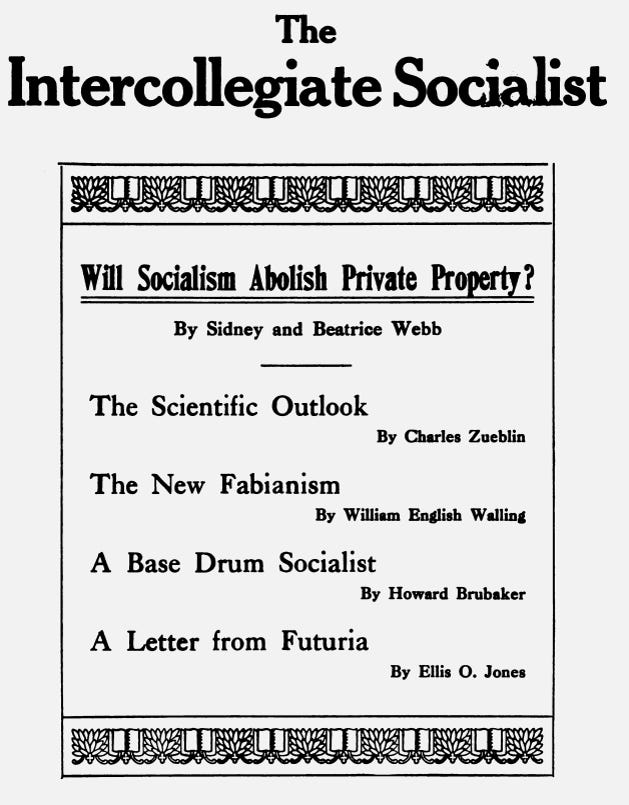
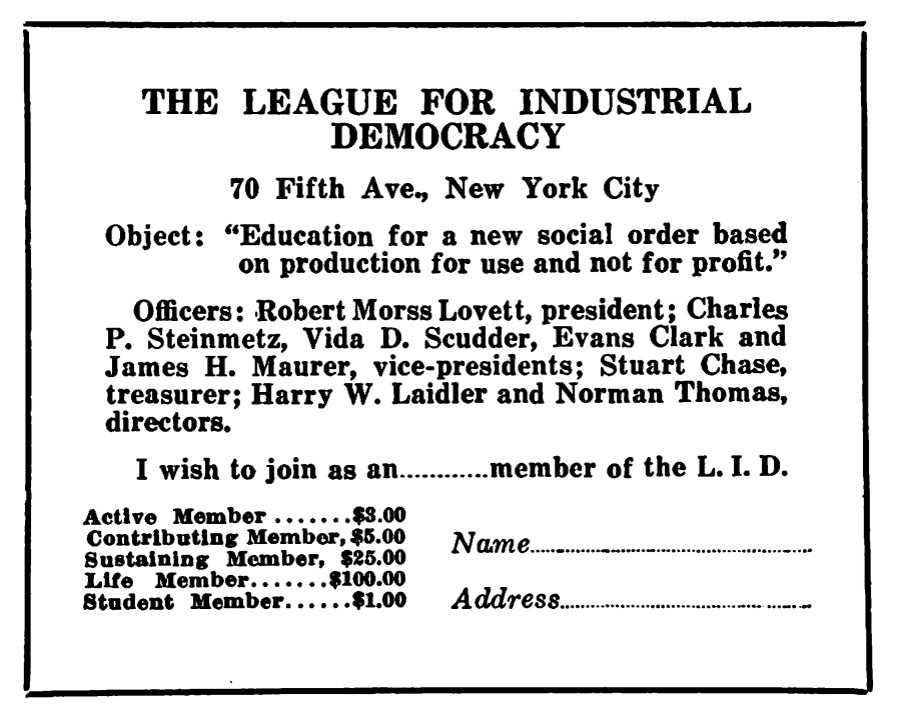
A history of the Society of Friends occult practices, heresies, conversion tactics, and attitude transformation methods is forthcoming.
Normal after prolonged conflict for military bands especially irregulars to have to be shut down, this certainly happened with GLADIO and the Swiss version of GLADIO, and publicly. What haunts us to this day is the Leftist anticommunists were allowed to stay operational and funded, they quite embraced neoliberal looting by banking and war. The neocons- Trots again- were happy to join the pillage and all were happy to loot America and Western countries.
The former Trots are the core of Globalism.
The History; Basically the Democratic Party co-opted the American and Western Communists to get Democratic Socialism by another name.
The mistake if deceiving the American people and the organizations continuing to this day are what haunt us all.
As I understand it you are saying that the business/political leaders dealt with early 20th century labor/class conflict by helping in the formation of labor unions and mediators like Kheel because violent crackdowns were futile and simply aggravated the problem. And this eventually produced the civil rights movement and forced racial integration.
My question is did they (the powerful white men) anticipate that race – and sex – quotas would eventually devour them also? (Or, at least their grandchildren.) Could they have anticipated Kneeling Nancy and Summer of Floyd? I doubt it.
To me, all these men, including Kheel, were trying to contain the product of a society based on the revolutionary concept of "human rights." And were reacting more than controlling the chain of events programmed over one hundred years earlier.
Thanks for this history lesson and the questions it opens up.